
Fragile Forktail Identification Guide
A tiny black-and-green damselfly best identified by a pair of pale exclamation-point marks on top of its thorax.
Read the full Fragile Forktail encyclopedia entry →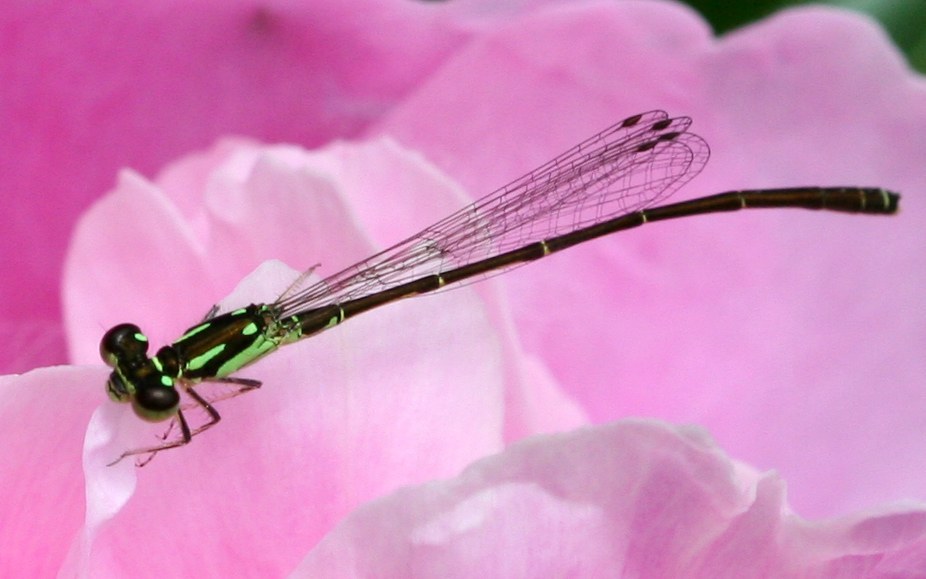
Key Visual Features
The Fragile Forktail is a very small damselfly, about 0.8 to 1.1 inches (20-28 mm) long, among the smallest damselflies commonly encountered, with a slim, delicate build that gives it its name.
- Body color: Mostly black abdomen with only a small patch of pale blue or green near the tip, paired with a green thorax.
- Diagnostic mark: A pair of short, pale green exclamation-point-shaped marks on the top of the thorax, just behind the head — this is the single best feature for confirming this species.
- Body shape: Extremely thin, delicate-looking abdomen, even slimmer in appearance than other small forktails.
- Eyes: Greenish, relatively small for the body.
- Legs: Pale and thin, typical of small pond damselflies.
Where and When You'll See It
Fragile Forktails favor small, often shaded or partially vegetated water bodies — woodland ponds, seepage areas, ditches, and slow-moving backwaters with abundant plant cover. They are active from spring through fall, and because of their tiny size and tendency to stay low in dense vegetation, they are frequently overlooked despite being fairly common. Look for them resting on floating leaves, low sedges, or damp soil right at the water's edge rather than out over open water.
Similar-Looking Species
- Eastern Forktail: Very similar black-and-green pattern but lacks the pale exclamation-point marks on the thorax, showing plain stripes instead.
- Citrine Forktail: Even smaller and generally more yellow-green overall, without the same thoracic exclamation marks.
- Rambur's Forktail: Larger-bodied with different thorax stripe patterns; the absence of exclamation marks helps rule this out as well.
Because the exclamation marks can be faint on some individuals, it helps to view the thorax from directly above in good light, ideally with a close photo, rather than relying on a quick side-on glance.
Quick ID Checklist
- Very small, slender damselfly, under 1.1 inches long
- Pair of pale exclamation-point-shaped marks on top of the thorax
- Mostly black abdomen with a small blue-green tip
- Found in shaded, vegetated ponds, ditches, and seepage areas
- Often overlooked due to small size and low, dense perching habits
Frequently asked questions
What is the single best way to confirm a Fragile Forktail?
Look for a pair of short, pale exclamation-point-shaped marks on top of the thorax just behind the head — no similar forktail shows exactly this mark.
How does this species compare in size to other damselflies?
It is one of the smallest damselflies commonly seen, generally under 1.1 inches long, with an unusually thin, delicate-looking abdomen.
What habitat should I search to find one?
Small, shaded, or heavily vegetated water bodies such as woodland ponds, ditches, and seepage areas are the most productive places to look.
How is it different from the Eastern Forktail?
The Eastern Forktail has plain thoracic stripes without the pale exclamation-point marks that define the Fragile Forktail.