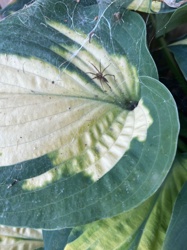
Funnel Weaver Spider Identification Guide
Spot this fast-moving spider by its flat sheet web that narrows into a funnel-shaped retreat.
Read the full Funnel Weaver Spider encyclopedia entry →Key Visual Features
Funnel weaver spiders are best identified through a combination of body traits and their very distinctive web:
- A moderate body size, generally 0.4 to 0.8 inches for the body alone, with a leg span that can appear notably larger
- Long, prominent spinnerets visible at the rear tip of the abdomen — often the longest spinnerets among common spiders, sometimes looking like a small tail
- A body pattern with two darker longitudinal stripes running down a brownish or tan cephalothorax
- Long, fast-moving legs adapted for quick sprints across the web surface
- An elongated abdomen, often with mottled or striped patterning
- A flat, horizontal sheet web that narrows at one edge into a tubular, funnel-shaped retreat where the spider hides
Where and When You'd See It
Funnel weavers are common in grassy areas, gardens, woodpiles, foundation walls, and low shrubs, where their flat sheet webs are often easiest to spot after rain or in early morning dew, which highlights the silk. They tend to be most visible from summer through fall. The spider itself usually stays hidden in the funnel-shaped retreat at the web's edge, dashing out rapidly to grab anything landing on the sheet.
Similar-Looking Bugs
- Wolf spiders can share a similar body coloring and speed but do not build a web at all, instead hunting on foot without any silk retreat.
- Hobo-type spiders in the same broad family look similar in shape and web style, and distinguishing between closely related funnel weaver species usually requires close comparison of leg and body markings.
- Grass spiders, a common type of funnel weaver, are often what people picture, with their sheet-and-tunnel web strung low across grass or shrubs.
Quick ID Checklist
- Flat sheet web narrowing into a funnel-shaped tunnel retreat
- Long, visible spinnerets at the rear of the abdomen
- Two dark stripes along the cephalothorax
- Very fast movement across the web surface
- Found in grass, shrubs, and along foundations, especially visible with morning dew
Frequently asked questions
What is the clearest way to identify a funnel weaver's web?
Look for a flat, horizontal sheet of silk that narrows at one edge into a tube-shaped funnel, which is distinct from the wheel-shaped web of orb-weavers or the messy tangle of house spiders.
How can I tell a funnel weaver from a wolf spider?
Funnel weavers build and rely on a sheet-and-funnel web, while wolf spiders do not build webs at all and hunt entirely on foot.
Why are these webs easier to see in the morning?
Morning dew collects on the fine silk strands of the flat sheet, making the otherwise hard-to-see web highly visible against grass or shrubs.
What body feature stands out most on a funnel weaver?
Its unusually long, prominent spinnerets at the tip of the abdomen are one of the most noticeable features compared to other common spiders.
Funnel Weaver Spider identified by the community
Recent Funnel Weaver Spider finds identified with Bug Identifier.