Gall Midge Identification Guide
Learn to recognize gall midges by their delicate, mosquito-like frame and the distinctive plant galls their larvae produce.
Read the full Gall Midge encyclopedia entry →Key Visual Features
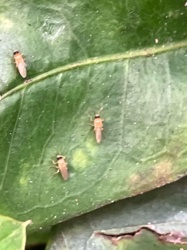
Gall midges (family Cecidomyiidae) are extremely small, delicate flies, typically only 0.04 to 0.15 inches long, easy to overlook without close inspection.
- Body: Slender and fragile, often pale yellow, orange, tan, or gray, with a soft, easily damaged exoskeleton.
- Legs: Long and thin relative to the body, giving a leggy, mosquito-like appearance.
- Antennae: Long, beaded, and often longer than the body itself, especially in males, which may have feathery or whorled hairs along each segment.
- Wings: Broad, rounded, and covered in fine hairs, with few visible veins, held roof-like over the body at rest.
- Overall impression: Small enough to be mistaken for a mosquito at a glance, but with a stouter, softer body and no piercing mouthparts.
Where and When You'd See Them
Adult gall midges are short-lived and rarely noticed, most often seen briefly in spring and summer around host plants such as willows, oaks, goldenrod, and many other trees, shrubs, and wildflowers. The far more recognizable sign of their presence is the gall itself—an abnormal swelling or growth on leaves, stems, or buds that forms in response to larval feeding. These galls come in many distinctive shapes, from smooth round balls to spiny or cone-like structures, and can be found year-round on the affected plant even after the midge inside has developed and left.
Similar-Looking Bugs
- Mosquitoes: Have piercing mouthparts and a narrower, harder body; gall midges have soft bodies and no biting mouthparts.
- Fungus gnats: Similar in size but with shorter antennae and darker, less delicate coloring.
- Non-biting midges (chironomids): Larger overall with more robust wings and no long feathery antennae in most cases.
- Other tiny gnats: Best distinguished by checking for the presence of galls nearby, which strongly points to a gall midge.
Quick ID Checklist
- Tiny, delicate, mosquito-like fly under an eighth of an inch long
- Long, beaded antennae, often feathery in males
- Broad, hairy wings held roof-like over the body
- Soft, pale yellow, orange, or tan coloring
- Presence of characteristic galls on nearby leaves, stems, or buds is a strong identification clue
Frequently asked questions
How do I know if a plant growth is a gall midge gall?
Gall midge galls are abnormal, often smooth or bumpy swellings on leaves, stems, or buds; cutting one open typically reveals a small chamber that once housed a developing larva.
What makes gall midges look different from mosquitoes?
Gall midges have a softer, more delicate body, long beaded antennae, and hairy wings, and lack the piercing mouthparts that give mosquitoes their narrow, needle-like profile.
When are adult gall midges visible?
Adults are short-lived and most often seen briefly in spring and summer near their host plants, making the galls themselves a more reliable and lasting identification clue.
Do all gall midges produce galls?
Most species in this family induce galls on specific host plants, though the exact shape and location of the gall varies widely by species and host plant.
Gall Midge identified by the community
Recent Gall Midge finds identified with Bug Identifier.