
Giant Prickly Stick Insect Identification Guide
A large, spine-covered stick insect that can flare colorful hind wings and curl its abdomen in a scorpion-like defensive display.
Read the full Giant Prickly Stick Insect encyclopedia entry →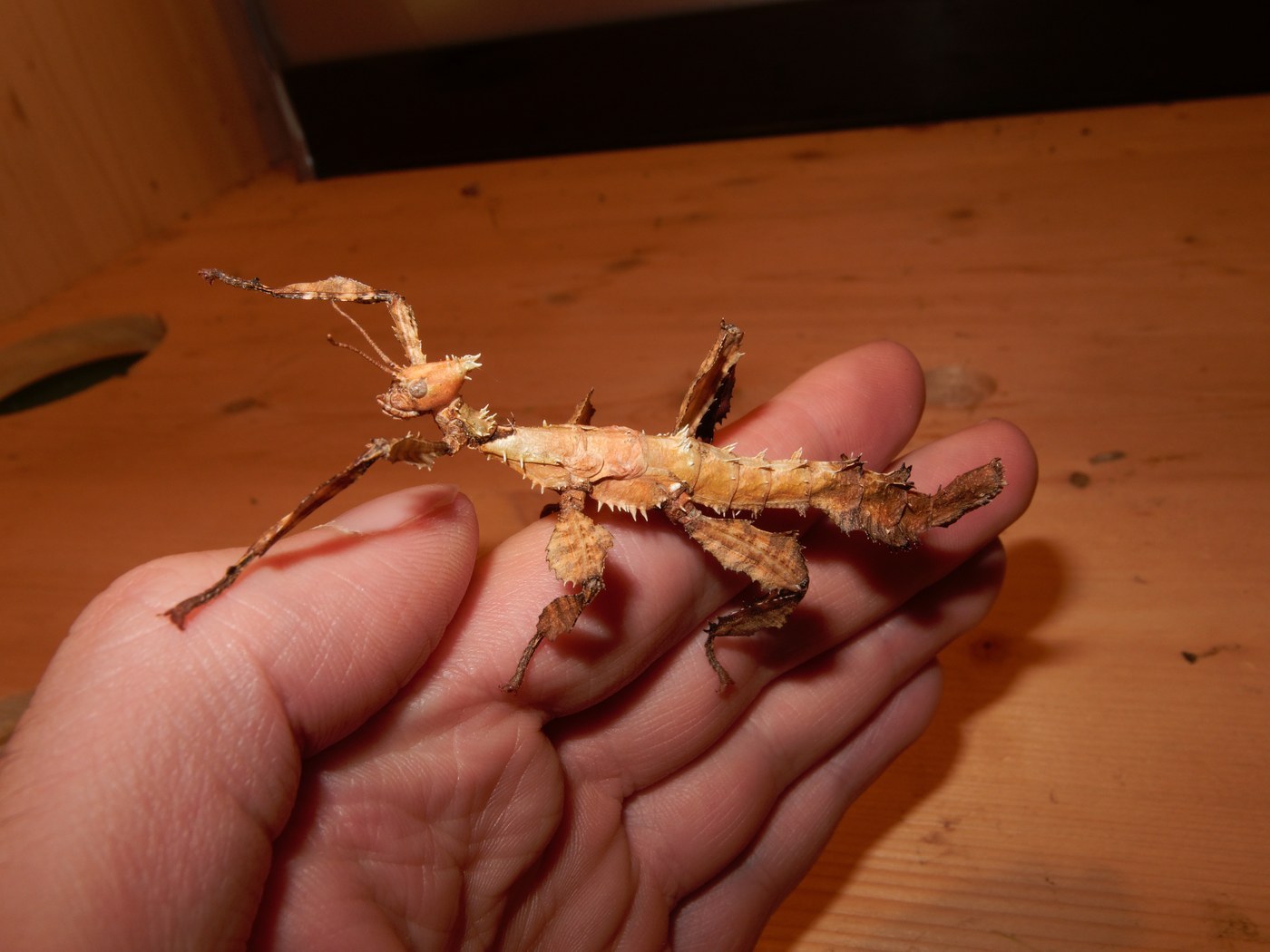
Key Visual Features
The giant prickly stick insect (Extatosoma tiaratum), also known as the Macleay's spectre, is a large, heavily ornamented phasmid native to Australia.
- Size: Females are large and bulky, reaching 5-8 inches (13-20 cm); males are notably smaller, slimmer, and more slender, around 4-5 inches (10-13 cm)
- Color: Brown, tan, or grayish, sometimes with mottled patterning that resembles bark or dried foliage
- Body shape: Broad and robust in females with a leaf-like, flattened abdomen; males are more slender and elongated
- Spines: Covered in numerous small to moderate spines and thorn-like projections across the legs, thorax, and body, giving the "prickly" name and helping mimic broken twigs or bark
- Wings: Males have functional wings and can fly short distances; females have much smaller, reduced wings and are essentially flightless, though the exposed hind wings can be pink or reddish and flared as part of a startle display
- Legs: Long, spined legs, with the hind legs of females often held curled with the leaf-shaped abdomen giving an overall bulky, camouflaged silhouette
- Antennae: Relatively short compared to some other stick insect species
- Behavior clue: When disturbed, this species may curl its abdomen up over its back in a scorpion-like posture as a startle display
Where and When You'd See It
Giant prickly stick insects are native to eastern Australia, inhabiting eucalyptus forests, woodlands, and shrubland where they feed on foliage at night. They are most active after dark, resting motionless on branches and leaves by day where their bark-and-thorn mimicry keeps them hidden. Being found in warm subtropical to tropical parts of Australia, they can be encountered across much of the year in native habitat, with populations building through the warmer months.
Similar-Looking Bugs
- Indian stick insect: Much smoother-bodied and lacks the numerous spines and thorn-like projections of the giant prickly stick insect
- Goliath stick insect: Also large, but typically has a smoother, less heavily spined body and a different overall silhouette
- Giant walking stick: Generally slimmer and less broad than the bulky, leaf-abdomened female giant prickly stick insect
- Leaf insects: Have a flattened, broad, distinctly leaf-shaped body with vein-like patterning, rather than the cylindrical, spine-covered body of this stick insect
Quick ID Checklist
- Large body covered in small spines and thorn-like projections
- Bulky females with a broad, leaf-shaped abdomen versus slimmer, winged males
- Brown/tan bark-like coloring
- Scorpion-like curled-abdomen defensive posture when disturbed
- Found motionless on eucalyptus foliage by day, active at night, native to eastern Australia
Frequently asked questions
How do males and females differ in this species?
Females are large, bulky, and have a broad leaf-shaped abdomen with reduced wings, while males are smaller, slimmer, and have functional wings allowing short flights.
What is the scorpion-like posture some people mention?
When disturbed, this stick insect may curl its abdomen up and over its back, resembling a scorpion's tail, as part of a startle display.
What distinguishes it from other large stick insects?
The dense covering of small spines and thorn-like projections across the body and legs is the clearest distinguishing feature compared to smoother-bodied relatives.
Where is the giant prickly stick insect native to?
It is native to eastern Australia, found in eucalyptus forests, woodlands, and shrubland habitat.