
Gray Hairstreak Identification Guide
A small slate-gray butterfly with a thread-like tail and a bright orange spot that helps confuse predators.
Read the full Gray Hairstreak encyclopedia entry →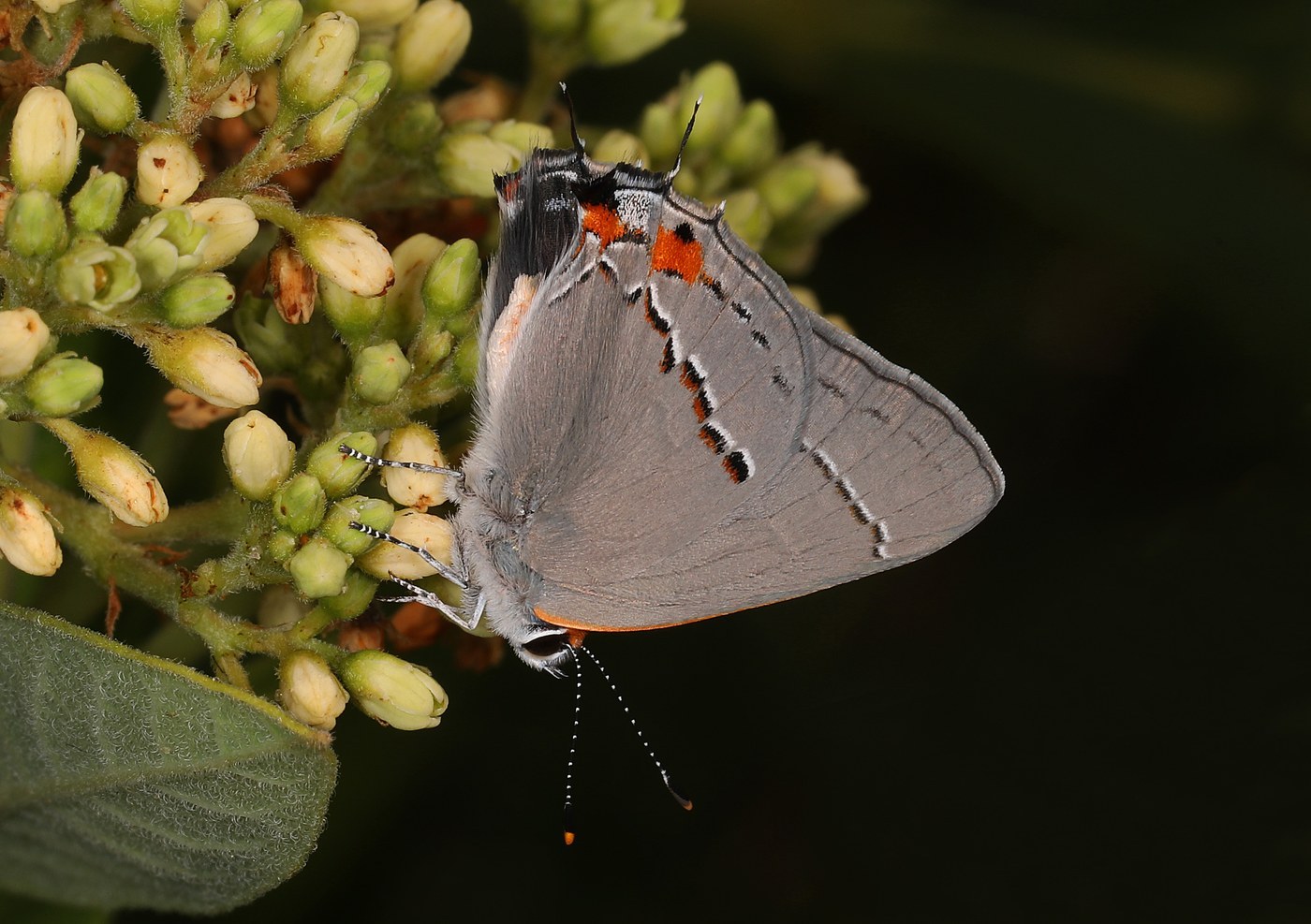
Key Features
The gray hairstreak (Strymon melinus) is a small butterfly with a wingspan of roughly 0.875 to 1.25 inches. Look for:
- Upperside is a fairly uniform slate gray, sometimes with a faint bluish tint near the body.
- Underside is pale gray, crossed by a thin black-and-white postmedian line running across both wings.
- A prominent orange spot sits near the base of a thin, thread-like tail on the hindwing, often paired with black and blue markings.
- The hindwing has one or two hair-like tails that the butterfly rubs together while perched, along with the orange spot creating a false "head" that can misdirect a predator's attention away from the real head.
- Body is small and compact with thin antennae.
Where and When to Spot It
The gray hairstreak is one of the most widespread hairstreaks in North America, found in gardens, fields, roadsides, and disturbed areas across nearly the entire continental United States. It produces multiple generations through the warmer months and can be seen from spring through fall. Look for it perched on low flowers with its wings closed, slowly rubbing its hindwings together, a behavior distinctive to hairstreaks.
Similar Species
- Banded hairstreak: Has a bolder, more jagged white-edged band on the underside and a different habitat preference tied to oak and hickory woodlands.
- Coral hairstreak: Lacks tails entirely and shows a row of bright coral-orange spots along the hindwing margin.
- Eastern tailed-blue: Much smaller and blue rather than gray, with a simpler underside pattern.
Quick ID Checklist
- Small, slate-gray butterfly with thin hindwing tails
- Thin black-and-white line across the underside of both wings
- Bright orange spot near the base of the tail
- Rubs hindwings together while perched
- Common in gardens and open habitats nearly continent-wide
FAQs
Frequently asked questions
Why does the gray hairstreak rub its hindwings together?
This motion, combined with the tail and orange spot, creates a false head pattern that can draw a predator's attention to the wing edge rather than the true head.
How can I tell a gray hairstreak from a banded hairstreak?
The gray hairstreak has a thin, simple black-and-white line on the underside, while the banded hairstreak shows a bolder, more jagged white-edged band.
Where is the best place to find gray hairstreaks?
They are highly adaptable and can be found in gardens, fields, and roadsides nearly anywhere across the continental United States.
Does the gray hairstreak have tails on its wings?
Yes, it has one or two thin, thread-like tails on each hindwing, a feature shared with many but not all hairstreak species.