
Great Tiger Moth Identification Guide
A chunky, chocolate-and-cream patterned moth with fiery orange hindwings that flash into view when it takes flight.
Read the full Great Tiger Moth encyclopedia entry →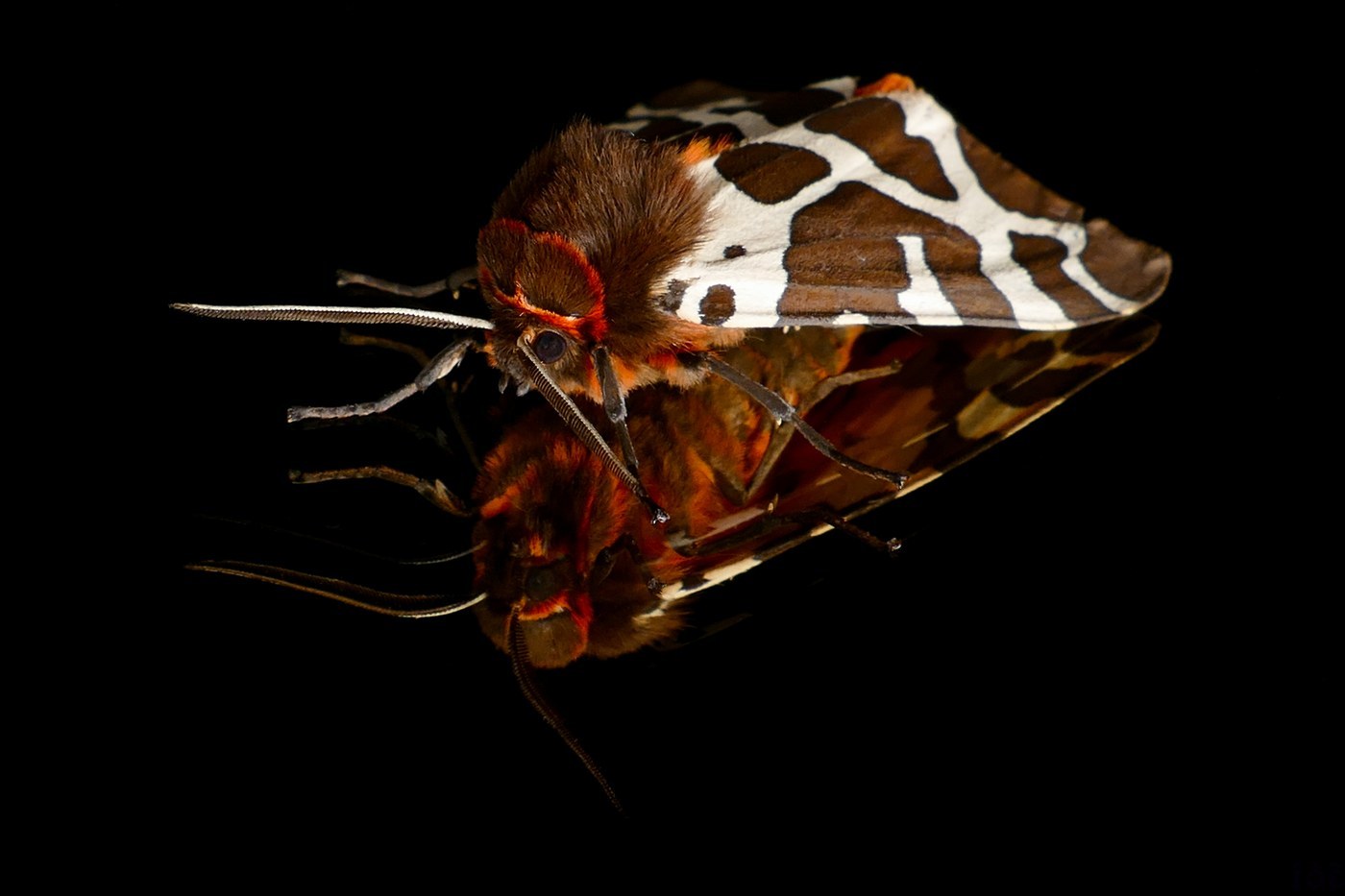
Key Visual Features
The Great Tiger Moth is a large, robust moth with a wingspan of roughly 45-70mm, making it one of the bigger and more eye-catching moths in its range.
- Forewings: Dark chocolate-brown to black, overlaid with an irregular network of cream or white blotches that resembles a giraffe's coat or a cracked-mud pattern.
- Hindwings: Bright orange to red, marked with bold, metallic blue-black spots - usually hidden at rest but flashed suddenly when disturbed.
- Body: Plump, densely furry thorax, often orange with dark spots on the abdomen.
- Antennae: Short and comb-like (feathery) in males, simpler and thread-like in females.
- Legs: Short and hairy, tucked close to the body.
Where and When You'll See It
Look for this moth in gardens, meadows, woodland edges, and hedgerows in temperate regions. It is strictly nocturnal, resting motionless on foliage, fence posts, or walls during the day with its forewings folded roof-like over the hindwings, concealing the bright colors underneath. Adults are most active on warm nights from midsummer into early autumn and are readily drawn to porch lights and outdoor lighting.
Similar-Looking Species
- Ruby Tiger Moth - much smaller and uniformly pinkish-brown, lacking the bold cream network pattern.
- Cream-spot Tiger Moth - forewing pattern is made of separate cream spots rather than a connected web-like network.
- Jersey Tiger - has crisp cream or yellow stripes (not blotches) on a darker background, and hindwings are more pink than orange.
Life Cycle & Behavior
Like other tiger moths, this species overwinters as a caterpillar - a densely hairy, dark-bristled larva sometimes nicknamed a "woolly bear" - which becomes active again in spring to feed before spinning a loose silken cocoon and pupating. Adults emerge in summer, live only a few weeks, and rely on their bold coloring and startle display as their main defense, rather than on evasive flight.
Quick ID Checklist
- Large, heavy-bodied moth with a wingspan over 4.5cm
- Forewings show a brown-and-cream netted or blotchy pattern
- Hindwings are bright orange-red with blue-black spots (visible in flight or when startled)
- Thick, furry orange-and-black body
- Found resting by day on vegetation or walls, active after dark
Frequently asked questions
How can I tell a Great Tiger Moth from other tiger moths?
Focus on the forewing pattern: the Great Tiger Moth has a connected, web-like network of cream markings on brown, rather than isolated spots or stripes seen in related species.
Why don't I usually see the orange hindwings?
At rest, the moth folds its forewings over its body like a tent, completely hiding the colorful hindwings underneath. They're only visible in flight or if the moth is startled into flashing them.
Is the Great Tiger Moth active during the day?
No, it is nocturnal and spends daylight hours resting motionless on leaves, tree bark, or walls, relying on camouflage from predators.
Do males and females look different?
They look broadly similar in color and pattern, but males have more feathery, comb-like antennae compared to the simpler, thread-like antennae of females.