
Harvestman Identification Guide
A long-legged arachnid, often called daddy longlegs, identified by its single fused oval body and extremely long, thin legs.
Read the full Harvestman encyclopedia entry →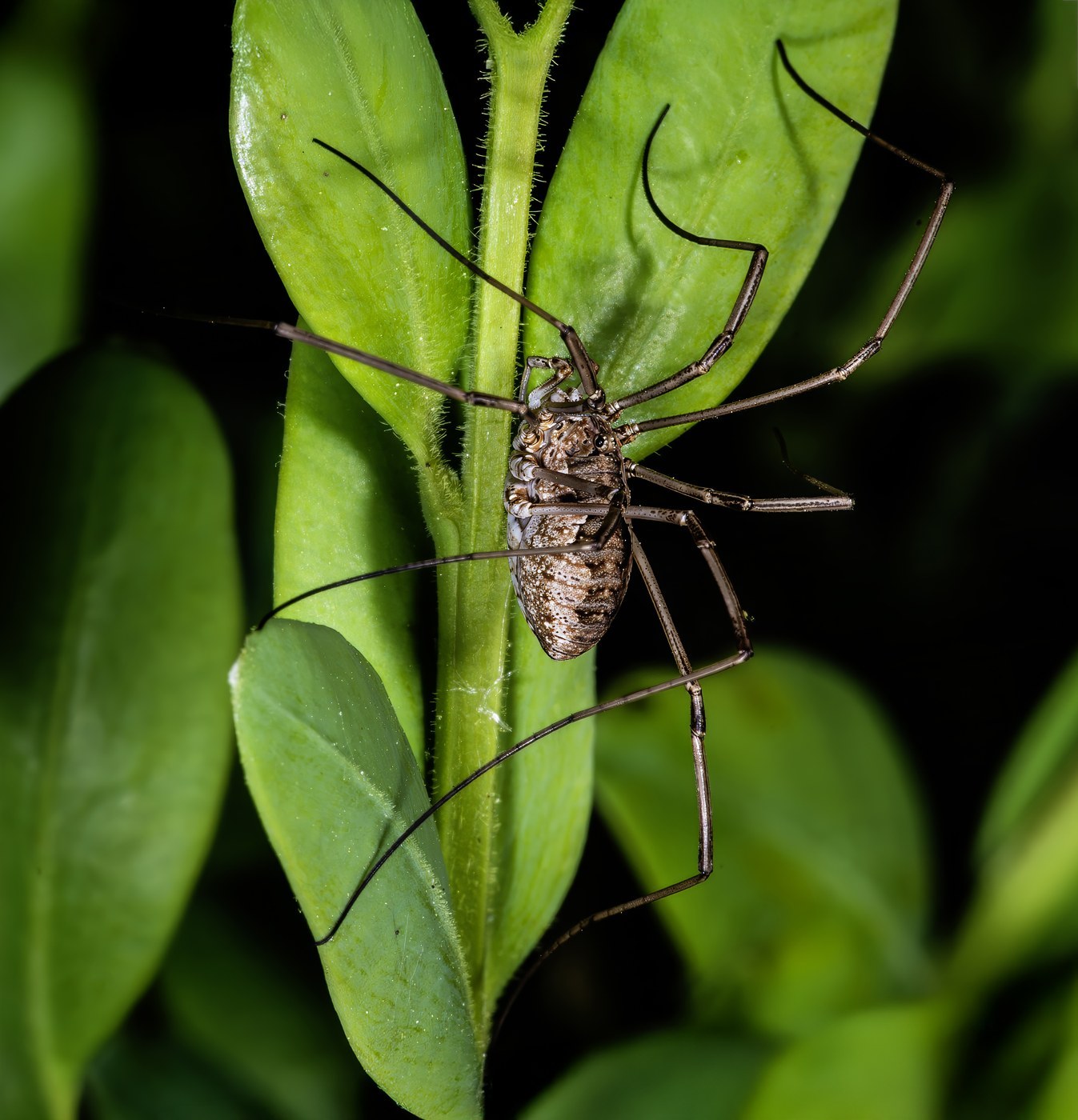
Key Visual Features
- Body is small and compact, typically only about 1/4 to 3/8 inch (6-9 mm) across, appearing as a single rounded or oval segment rather than the clearly divided two-part body seen in spiders.
- The most distinctive feature is the set of extremely long, thin, thread-like legs, which can span several inches across even though the body itself is tiny — legs are often many times longer than the body.
- Coloring is typically brown, tan, or grayish, sometimes with a darker saddle-shaped marking or mottling on the back, but generally without bold patterns.
- Unlike spiders, the body shows no narrow "waist" separating a front and back section — it appears as one continuous oval shape.
- Eyes, when visible, are usually a single pair mounted on a small raised turret or bump near the middle of the back, rather than the multiple eyes typically arranged across the front of a spider's head.
- Legs move independently and can twitch or vibrate when the animal is disturbed, and the second pair of legs is often noticeably longer and thinner than the others, used to feel around like antennae.
Where and When You'd See It
- Found in gardens, leaf litter, under rocks and logs, in tall grass, and commonly around building foundations, porches, and damp corners of sheds or basements.
- Prefers humid, shaded conditions and is often seen gathering in clusters on walls, tree trunks, or in sheltered crevices, especially during humid weather.
- Most active from late summer through fall in many regions, when adult numbers peak, though they can be found across the warmer months generally.
- Mostly active at night or during cooler, humid periods, tending to hide in cover during hot, dry, bright daytime conditions.
Similar-Looking Bugs
- True spiders have a clearly divided body with a narrow waist separating the front section (cephalothorax) from the rounded abdomen, unlike the harvestman's single fused oval body.
- Crane flies are sometimes mistaken for harvestmen because of their long thin legs, but crane flies are flying insects with wings and only six legs, compared to the harvestman's eight legs and no wings.
- Cellar spiders (sometimes also called daddy longlegs) do have long thin legs but retain the spider body plan with a distinct waist and produce webs, while harvestmen do not build webs at all.
Quick ID Checklist
- Single fused oval body with no narrow waist, about 1/4-3/8 inch across.
- Extremely long, thin legs, often many times the length of the body.
- Second pair of legs notably longer and thinner, used like feelers.
- Brown, tan, or gray coloring, sometimes with a darker saddle marking.
- Found in leaf litter, gardens, and damp sheltered spots; does not build webs.
Frequently asked questions
How do I tell a harvestman apart from a true spider?
Look at the body shape: a harvestman has one continuous oval body with no narrow waist, while a spider's body is clearly divided into two separate sections joined by a thin waist.
Does a harvestman spin a web like a spider?
No, harvestmen do not produce silk or build webs, which is a key behavioral difference from web-building spiders such as cellar spiders.
Why are the legs so much longer than the body?
Their extremely long, thread-like legs, especially the second pair used as feelers, are a defining trait of the group and can span several inches even though the fused body itself is quite small.
Could a long-legged flying insect be mistaken for a harvestman?
Insects like crane flies have long legs but also have wings and only six legs, while a harvestman has eight legs and no wings, which is an easy way to rule out an insect.