
Honeybee Identification Guide
Spot a Honeybee by its fuzzy amber-and-black banding and pollen-laden hind legs.
Read the full Honeybee encyclopedia entry →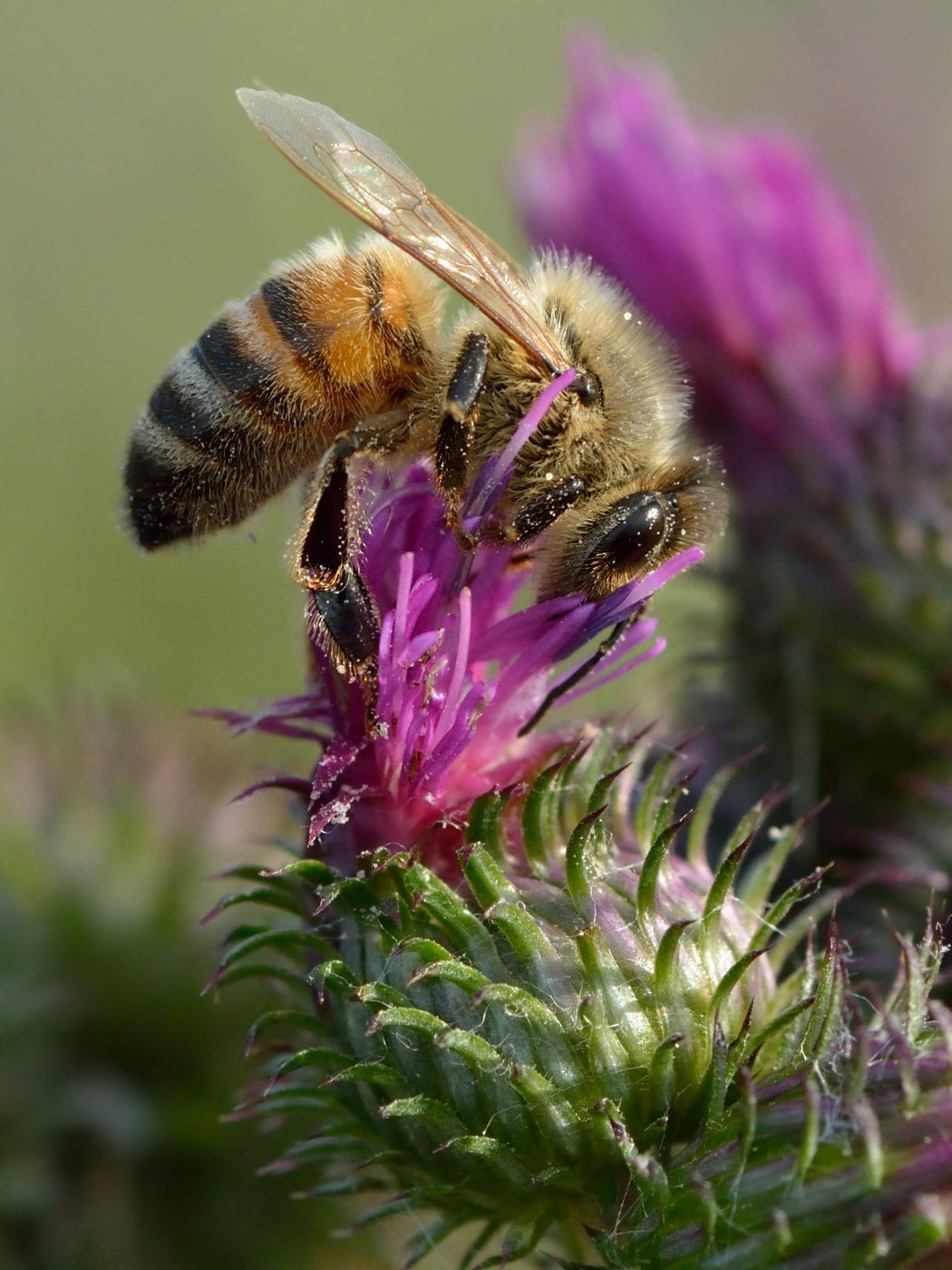
Key Visual Features
- Small to medium insect, about 12-15 mm long, with a slender, tapered body.
- Coloring is golden-brown to amber with darker brown or black banding across the abdomen.
- Body is covered in fine, branched hairs, especially dense on the thorax, giving it a soft, fuzzy look.
- Two pairs of translucent wings that fold flat and overlap along the back at rest.
- Hind legs are flattened and fringed with hairs, forming "pollen baskets" that often show visible clumps of yellow or orange pollen.
- Antennae are bent (elbowed) and relatively short compared to the body.
Where and When You're Likely to See It
- Common wherever flowering plants are present: gardens, orchards, meadows, farmland, and urban green spaces worldwide.
- Active from spring through autumn whenever temperatures are warm enough for foraging, typically above roughly 12-13°C (54°F).
- Most active during daylight hours, peaking in mid-morning to afternoon when flowers are producing nectar.
- Found visiting a wide range of blossoms, often moving methodically from flower to flower on the same plant species during a single foraging trip.
- Colonies are established in cavities such as hollow trees, rock crevices, or man-made hives, so individual bees are usually seen traveling between a fixed nest site and nearby flowers.
Similar-Looking Species
- Bumblebees are noticeably rounder, larger, and much furrier overall, with broader color bands and a more robust build.
- Yellowjackets and other wasps have smooth, shiny, hairless bodies with a distinct narrow waist and lack pollen baskets on the hind legs.
- Hover flies mimic bee coloring but have only one pair of wings, large fly-like eyes, and short, stubby antennae rather than elbowed ones.
- Carpenter bees resemble bumblebees but have a shiny, hairless abdomen rather than a fully fuzzy one.
Quick ID Checklist
- Fuzzy, amber-and-black banded body around 12-15 mm long.
- Elbowed antennae and two pairs of clear, overlapping wings.
- Flattened, hairy hind legs, often carrying visible pollen loads.
- Methodical flower-to-flower foraging behavior on the same plant type.
- Seen near a hive, hollow tree, or other fixed nest cavity.
Frequently asked questions
How do I tell a Honeybee apart from a wasp?
Honeybees have fuzzy, hairy bodies and flattened pollen-carrying hind legs, while wasps are smooth, shiny, and lack pollen baskets.
Why do Honeybees have pollen stuck to their legs?
Their hind legs are specially shaped with stiff hairs called pollen baskets that collect and transport pollen back to the colony.
What time of day are Honeybees most active?
They forage mainly during daylight, with activity peaking when temperatures are warm and flowers are producing the most nectar, usually mid-morning to afternoon.
Do all Honeybees look the same color?
Coloring can vary somewhat between subspecies and individuals, from lighter golden tones to darker brown, but the overall banded, fuzzy pattern remains consistent.