
Horn Fly Identification Guide
Identify the tiny horn fly by its small dark body, forward-pointing proboscis, and habit of clustering densely on the backs and shoulders of cattle.
Read the full Horn Fly encyclopedia entry →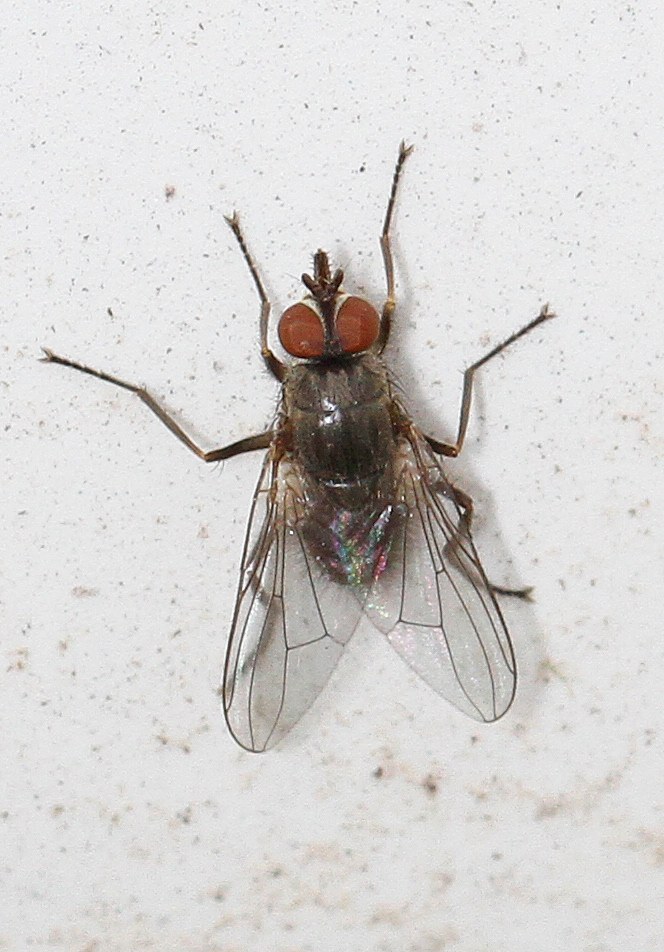
Key Visual Features
The horn fly is one of the smallest livestock-associated flies, notable for its dense clustering behavior on cattle.
- Size: Small, about 3-5 mm, roughly half the size of a house fly.
- Color: Dark gray to blackish body, with subtle darker markings on the thorax.
- Body shape: Compact and narrow, smaller and slimmer overall than most muscid flies.
- Wings: Clear, held close to the body at a shallow angle when resting, folding nearly flat over the back.
- Legs: Short, dark, and adapted for clinging tightly to hair, allowing the fly to stay in place even as the host animal moves.
- Antennae: Short with a small feathery bristle, typical of related flies but proportionally tiny given the fly's small size.
- Distinctive traits: A forward-projecting piercing proboscis is visible when viewed head-on, held horizontally like a small horn — the source of the common name.
Where and When You'll See Them
Horn flies are almost always found directly on cattle, typically clustered in dense groups on the back, shoulders, and sides, sometimes moving to the belly during hot, sunny periods. They rarely leave the host animal except briefly to lay eggs in fresh manure. Look for them in pastures and grazing land during warm months, where hundreds of individuals can be seen packed closely together on a single animal.
Similar-Looking Bugs
- Face flies: Larger overall and cluster specifically around the eyes, nose, and mouth rather than the back and shoulders, and lack the prominent forward-pointing proboscis.
- Stable flies: Also has a piercing proboscis but is noticeably larger, grayer, and more commonly found on the legs of cattle or entering barns, rather than densely packed on the back.
- House flies: Considerably larger with sponging (non-piercing) mouthparts and no tendency to cluster tightly on a host animal's body.
Quick ID Checklist
- Very small (3-5 mm), dark gray to black body
- Forward-pointing proboscis visible from the front
- Clusters densely on the back and shoulders of cattle
- Rarely leaves the host animal except to lay eggs in fresh manure
- Found in pastures during warm months
Frequently asked questions
What makes the horn fly's name make sense visually?
When viewed head-on, its piercing proboscis projects forward in a short, horn-like manner, which is the origin of the common name.
How is the horn fly different from other cattle-associated flies?
Its notably small size, dark body, and tendency to form dense, tightly packed clusters directly on the animal's back and shoulders (rather than the face or legs) help set it apart.
Do horn flies spend much time away from cattle?
Very little — they remain on the host animal almost continuously and only briefly depart to lay eggs in fresh manure nearby.
Where on the animal's body are horn flies typically found?
Mainly the back, shoulders, and sides, though they may shift to the belly during especially hot or sunny periods of the day.