Hornet Identification Guide
Identify true hornets by their large size, rounded head, and robust black-and-yellow or brown banded body.
Read the full Hornet encyclopedia entry →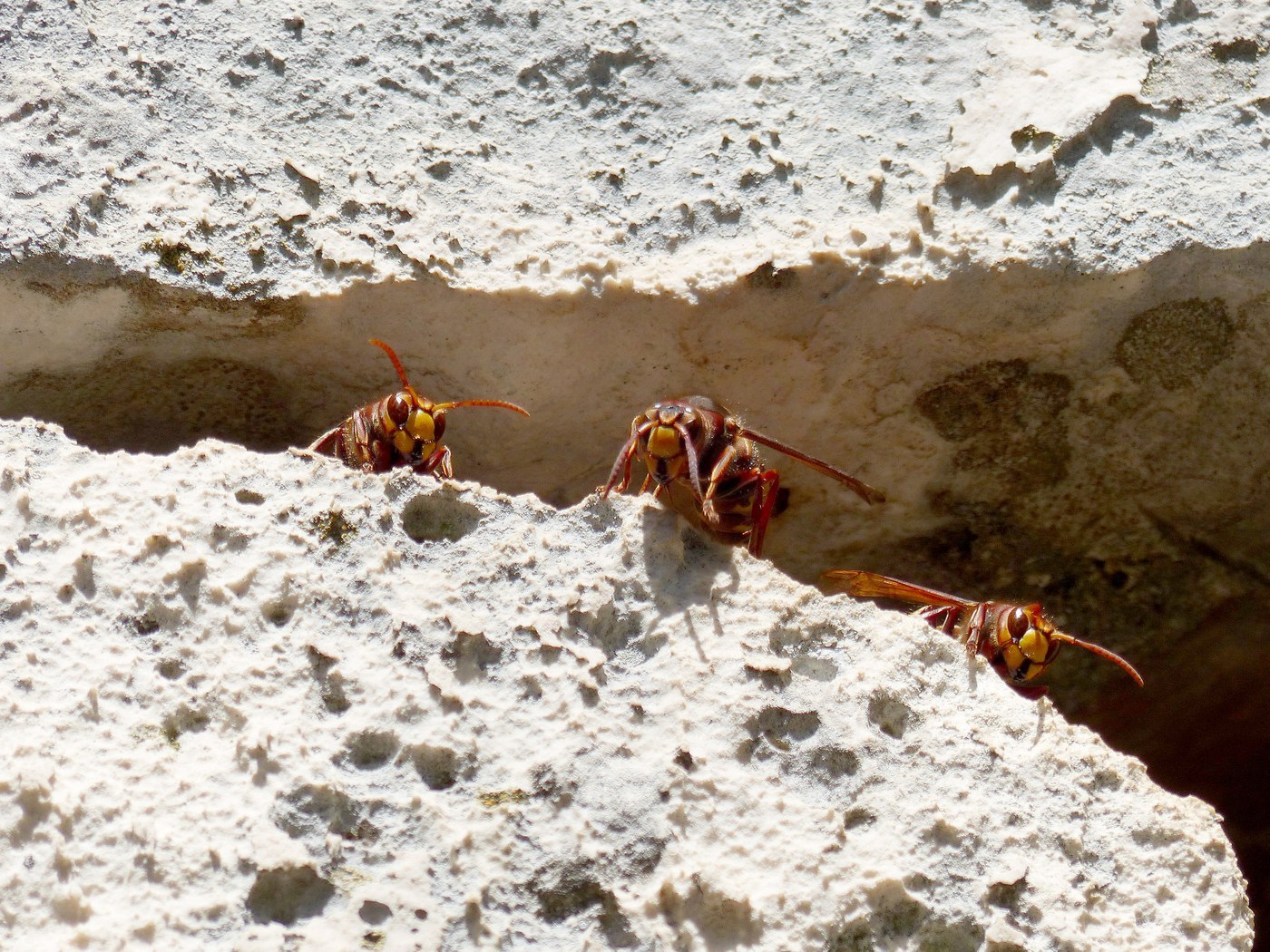
Key Visual Features
Hornets are a group of large, robust wasps, and their size and proportions are the first clues that separate them from smaller wasp species.
- Hornets are notably large, with worker body length commonly in the 3/4 to 1.5 inch (2-3.8 cm) range depending on species, making them among the biggest common wasps encountered.
- The head is broad and rounded, often appearing larger in proportion to the body than in smaller wasp species, with large compound eyes.
- The body shows a stout thorax and a smooth, only lightly haired abdomen, patterned in bands of black and yellow, black and white, or brown and orange depending on the species.
- Like other wasps, hornets have a narrow waist connecting the thorax and abdomen, though it is generally less thread-thin than in many smaller wasps due to their overall larger, sturdier build.
- Wings are clear to lightly smoky and are folded lengthwise along the body at rest, and the legs are long and dangle during flight.
Where and When You'd See It
Hornets build large, enclosed paper nests, often gray or brown and papery in texture, typically found in trees, shrubs, or sheltered spots like eaves and cavities. Colonies are most active and visible from mid-summer through fall, when nest populations peak and workers forage widely for insects and sugary substances. Hornets tend to be seen around forest edges, gardens, and areas with abundant insect prey or ripening fruit, and are generally most active during daylight hours in warm weather.
Similar-Looking Bugs
- Smaller wasps, such as paper wasps and yellowjackets, share the general black-and-yellow banding but are noticeably smaller and more slender, with a less rounded head.
- Bald-faced hornets are technically a type of wasp rather than a true hornet but are commonly grouped with hornets due to their large size and black-and-white patterning, distinguished by their mostly black body with white facial and tail markings rather than yellow bands.
- Carpenter bees are similarly large and robust but have a fuzzy, rounded abdomen and thorax rather than the smooth, banded abdomen and narrow waist of a hornet.
- Overall body size combined with the broad, rounded head is the most useful way to separate true hornets from smaller, similarly colored wasps.
Quick ID Checklist
- Notably large body size compared to most other wasps
- Broad, rounded head with large eyes
- Black-and-yellow, black-and-white, or brown-orange banded abdomen
- Narrow waist, but sturdier and less thread-thin than smaller wasps
- Builds large, enclosed, papery nests in trees or sheltered spots
Frequently asked questions
What makes a hornet different from other large wasps?
Hornets are distinguished mainly by their large body size and notably broad, rounded head compared to smaller wasp species.
What does a hornet nest typically look like?
It is a large, enclosed, papery structure, usually gray or brown, often found in trees, shrubs, or sheltered cavities.
How can I tell a hornet from a carpenter bee?
A hornet has a smooth, banded abdomen and a narrow waist, while a carpenter bee has a fuzzy, rounded body without the wasp-like narrow waist.
When are hornets most active?
Colonies are most active and visible from mid-summer through fall as nest populations reach their peak.
Hornet identified by the community
Recent Hornet finds identified with Bug Identifier.