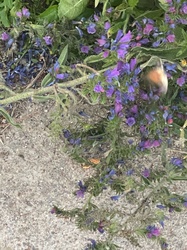
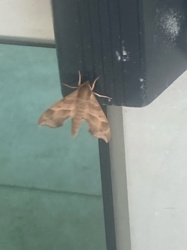
Hummingbird Hawk-Moth Identification Guide
Spot this hovering, day-flying moth by its hummingbird-like feeding behavior and orange hindwings.
Read the full Hummingbird Hawk-Moth encyclopedia entry →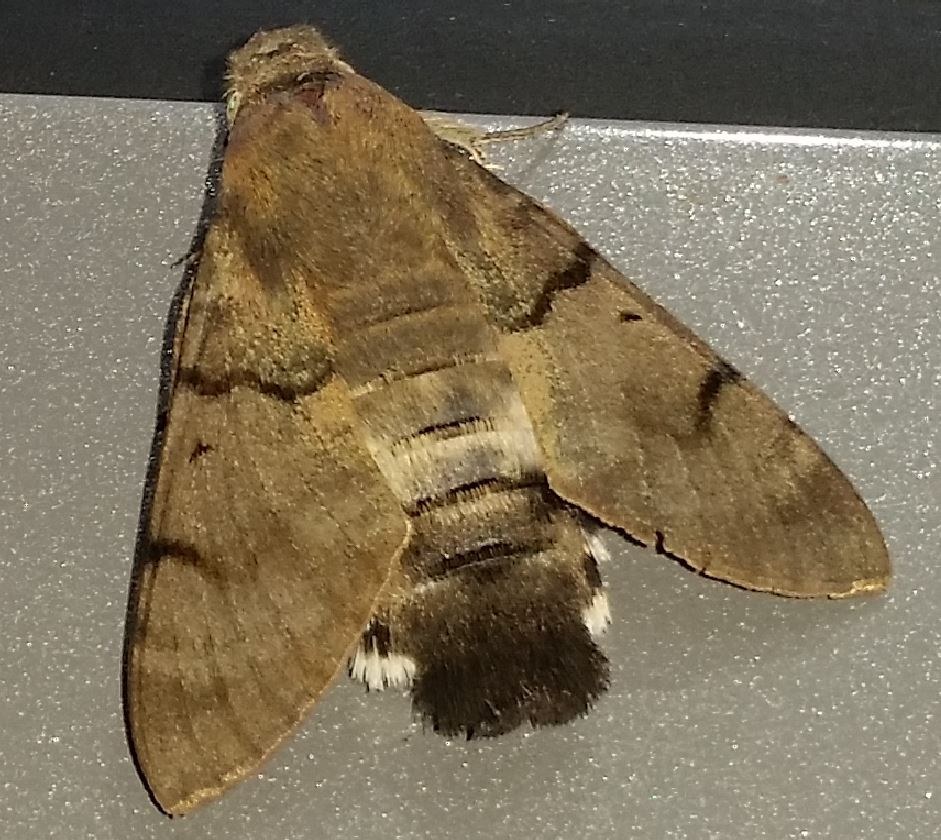
Key Features
- Compact, robust-bodied moth, wingspan about 4–4.5 cm (1.6–1.8 inches)
- Forewings are mottled grayish-brown, while the hindwings are bright orange, visible mainly as a blur during hovering flight since the wings beat too fast to see clearly
- Thick, tapering body with a fan-like tuft of hair-scales at the tip of the abdomen, resembling a bird's tail and used to help stabilize hovering flight
- Long, straight proboscis used to probe flowers while hovering — it is not coiled at rest the way most moth proboscises are, and it stays extended for much of a feeding bout
- Extremely fast wingbeats that produce an audible hum, and the ability to hover motionless in front of flowers, closely mimicking a hummingbird's feeding style
- Large eyes relative to head size, and short, clubbed antennae typical of hawk-moths
Where & When to Spot One
- Found across Europe, North Africa, and much of temperate Asia, with populations migrating northward in warm months and sometimes reaching much cooler climates in summer
- Frequents gardens, parks, meadows, and roadside verges with tubular flowers such as buddleia, jasmine, honeysuckle, and petunias
- Unlike most moths, this species is day-flying and most active in bright sunshine, though it can also be seen at dusk or on overcast but warm days
- Active from spring through autumn, with sightings peaking in summer as migrants move north and local populations build up
Similar Species
- Broad-bordered and Narrow-bordered Bee Hawk-Moths are similarly day-flying and hover at flowers but have largely transparent wings rather than solid brown forewings
- Actual hummingbirds are much larger and have feathers rather than scaled wings, but from a distance the hovering flight and hum can cause confusion, especially in regions like Europe where hummingbirds don't naturally occur
- Some large hoverflies and bee mimics can hover at flowers too, but they lack the moth's long extended proboscis and characteristic tail fan
- The straight, uncoiled proboscis extended while hovering at a flower is a reliable field mark distinguishing it from bee hawk-moths
Quick ID Checklist
- Hovers in place at flowers like a hummingbird
- Gray-brown forewings, bright orange hindwings (visible in flight)
- Long straight proboscis extended while feeding
- Fan-shaped tail tuft
- Active during daytime, especially sunny afternoons
Frequently asked questions
Is the Hummingbird Hawk-Moth actually a hummingbird?
No, it's a moth — the resemblance comes from its hovering flight, humming wingbeats, and long proboscis used like a hummingbird's bill.
When is the best time to see one?
During warm, sunny days from late spring through summer and into early autumn, especially near nectar-rich flowers.
Why does it hum?
The sound comes from its extremely rapid wingbeats, which also allow it to hover in place while feeding.
How do I tell it apart from a bee hawk-moth?
Bee hawk-moths have largely clear, transparent wings, while the Hummingbird Hawk-Moth has solid gray-brown forewings and orange hindwings.
Hummingbird Hawk-Moth identified by the community
Recent Hummingbird Hawk-Moth finds identified with Bug Identifier.