
Jorō Spider Identification Guide
A large, brightly colored orb weaver with yellow-and-blue-gray banding, known for spinning massive golden webs across yards and tree lines.
Read the full Jorō Spider encyclopedia entry →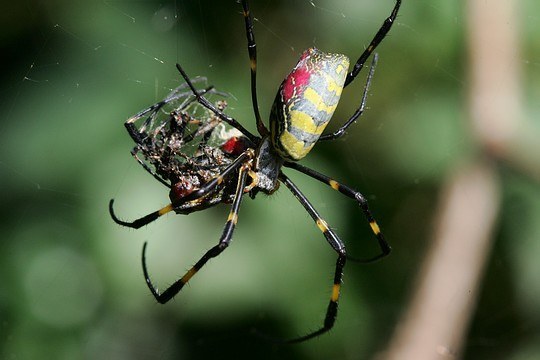
Key Visual Features
The Jorō spider (Trichonephila clavata) is a large, vividly marked orb weaver that has become increasingly recognizable for its size and golden webs.
- Size: Females are large, with a body length of about 0.75–1 inch (18–25 mm) and a leg span that can reach 3–4 inches; males are much smaller and slimmer.
- Color: Bright yellow and blue-gray banded pattern on an elongated abdomen, often with red or orange-red markings near the underside and tip.
- Body shape: Long, narrow, cylindrical abdomen tapering toward the rear, distinct from the rounder abdomens of many other orb weavers.
- Legs: Long, banded in yellow and black/dark blue, giving a striking striped appearance.
- Web: Known for producing especially strong, golden-tinted silk woven into large, multi-layered orb webs, sometimes with a fine mesh barrier woven behind the main web.
Where and When You'd See It
Jorō spiders are native to East Asia and have become established in parts of the southeastern United States in recent years. They favor forest edges, tall trees, power lines, porches, and open structures where they can anchor large webs between elevated points. They are most conspicuous from late summer through fall, when females reach full size and their large golden webs become highly visible strung between trees, eaves, and utility wires.
Similar-Looking Species
- Golden silk orb weaver (banana spider): Closely related and similar in size and golden web silk, but has a more uniformly yellow-and-brown body with tufted "furry" leg joints, differing from the Jorō's bold blue-gray-and-yellow banding.
- Banded garden spider: Smaller, with thinner silvery-yellow-black bands and a different web structure lacking the dense golden multilayer webbing.
- Marbled orbweaver: Rounder abdomen with mottled rather than banded coloring.
- Black-and-yellow garden spider: Bold solid yellow-and-black patches rather than fine banding, and a rounder abdomen shape.
Quick ID Checklist
- Large size with an elongated, cylindrical yellow-and-blue-gray banded abdomen
- Long legs striped in yellow and black/dark blue
- Red-orange markings often visible near the abdomen tip or underside
- Builds large, multi-layered webs with golden-tinted silk between trees or structures
- Most visible in late summer through fall in wooded or suburban edge habitats
Frequently asked questions
How can I tell a Jorō spider from a golden silk orb weaver?
The Jorō spider shows bolder blue-gray-and-yellow banding with red-orange accents, while golden silk orb weavers tend to have more uniform yellow-brown coloring and tufted, hairy leg joints.
Why do Jorō spider webs look golden?
Their silk has a natural golden tint, and they often weave large, multi-layered webs — sometimes with an extra fine mesh behind the main orb — that catch the light distinctly.
When are Jorō spiders most commonly seen?
They become most noticeable in late summer through fall, when females reach their largest size and their expansive webs are fully built out between trees, eaves, or wires.
Where do Jorō spiders typically build their webs?
They favor elevated open spaces such as forest edges, tree canopies, porches, and power lines where they can anchor large webs across open gaps.