Katydid Identification Guide
Learn to recognize this leaf-mimicking relative of the grasshopper by its long antennae, flattened body, and nighttime chorus.
Read the full Katydid encyclopedia entry →Key Visual Features
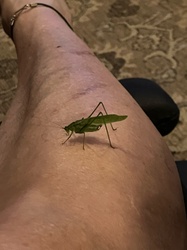
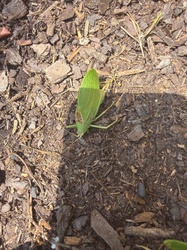
Katydids are large, leaf-green (occasionally brown or pink) insects closely related to crickets and grasshoppers, but easy to tell apart once you know what to look for.
- Size: Most species run 1 to 2.5 inches long, with some tropical species larger.
- Color: Overwhelmingly bright leaf-green, sometimes with brown, tan, or pink forms; wing veins often mimic leaf veins.
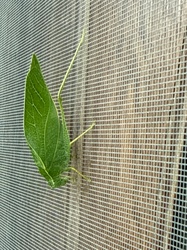
- Body shape: Laterally flattened body with wings held roof-like (tent-shaped) over the back, closely resembling a folded leaf.
- Wings: Broad, oval forewings that look like actual leaves, complete with vein patterns; hindwings are membranous and tucked beneath.
- Legs: Long hind legs built for jumping, similar to a grasshopper's but more slender.
- Antennae: The single best giveaway — thread-like antennae that are as long as, or much longer than, the entire body. This is the main feature separating katydids from short-horned grasshoppers.
Where and When You'd See One
Katydids live in trees, shrubs, and tall grass across temperate and tropical regions worldwide. They are most active from summer through early fall and are largely nocturnal, feeding and calling after dark. During the day they sit motionless among foliage, relying on their leaf-like camouflage. Their loud, rhythmic "katy-did, katy-didn't" song, produced by rubbing the forewings together, is often heard well before the insect itself is spotted.
Similar-Looking Bugs
- Grasshoppers: Have short antennae (much shorter than the body) and are usually active by day; katydids have very long antennae and are mostly nocturnal.
- Crickets: Rounder, flatter-backed bodies, usually darker brown or black, and hold wings flat rather than tent-like; crickets are more likely found on the ground than in foliage.
- Leaf insects (Phylliidae): Even more extreme leaf mimics found in tropical Asia, with wider, flatter, leaf-shaped bodies and legs; true katydids retain a more standard elongated jumping-insect silhouette.
- Mantises: Have raptorial front legs held folded near the head and a triangular head that swivels; katydids lack grasping front legs.
Quick ID Checklist
- Antennae longer than the body — the single best field mark
- Bright green, leaf-shaped forewings held tent-style over the back
- Long hind legs for jumping, similar to a grasshopper
- Found in trees/shrubs at night, heard more often than seen
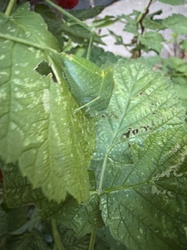
- Motionless, leaf-camouflaged posture during daylight hours
Frequently asked questions
What is the easiest way to tell a katydid from a grasshopper?
Check the antennae. Katydids have thread-thin antennae as long as or longer than their entire body, while grasshoppers have short, stubby antennae much shorter than their body length.
Why are katydids so hard to spot during the day?
Their green, leaf-shaped wings and flattened, leaf-veined body provide excellent camouflage among foliage, and they typically remain motionless in vegetation until night falls.
Is the sound I hear at night a katydid?
A steady, rhythmic 'katy-did' or buzzing-clicking call from trees and shrubs after dark is a strong sign, since katydids produce sound by rubbing specialized areas on their forewings together.
Do all katydids look bright green?
Most common species are green, but brown, tan, and even pink color forms occur in some species, so body shape, wing texture, and antenna length are more reliable identification features than color alone.
Katydid identified by the community
Recent Katydid finds identified with Bug Identifier.