
Lantern Bug (Peanut-head Bug) Identification Guide
Recognize the bizarre elongated, peanut-shaped head that gives this tropical planthopper its name.
Read the full Lantern Bug (Peanut-head Bug) encyclopedia entry →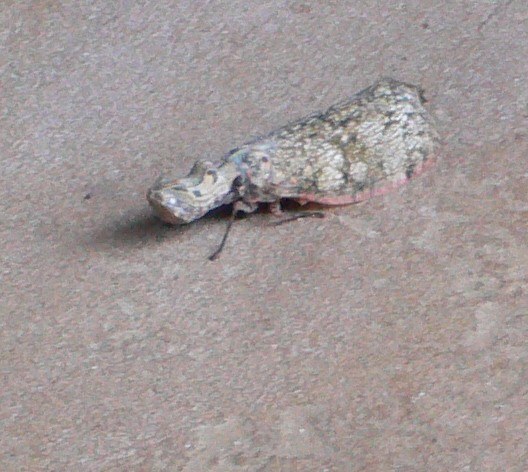
Key Visual Features
- Large planthopper, often 2-3.5 inches (5-9 cm) long including the head projection.
- Most distinctive feature is an enlarged, hollow, peanut- or snout-shaped projection extending forward from the head, which can appear light-colored or patterned.
- Body coloring varies by species but is often mottled gray, brown, or green, providing bark-like camouflage.
- Wings are broad and held roof-like over the body at rest; some species show bright eyespot patterns or colorful patches on the hindwings when flashed open.
- Legs are relatively short compared to the body, and the insect tends to walk or hop rather than run quickly.
- The overall silhouette is bulky and front-heavy due to the oversized head structure.
Where and When You'd See It
- Found in tropical and subtropical forests, most notably in Central and South America, resting on tree trunks and bark.
- Primarily nocturnal or most active at dusk, spending daylight hours motionless on bark where its coloring blends in.
- Often found singly or in small groups on the same tree, especially on trunks with rough or lichen-covered bark.
- Sightings are more common in humid forest habitats rather than open or dry environments.
Similar-Looking Species
- The spotted lanternfly and other lanternflies are related planthoppers but lack the exaggerated, elongated peanut-shaped head projection.
- Some large moths resting on bark can create a superficially similar bulky silhouette, but moths lack the distinctive snout-like head extension and have feathery or thread-like antennae rather than the lantern bug's short antennae hidden near the head base.
- Other bark-mimicking insects may share the mottled camouflage coloring, but the oversized frontal head structure is unique to lantern bugs among common lookalikes.
Quick ID Checklist
- Prominent peanut- or snout-shaped projection extending from the head.
- Large body, often 2-3.5 inches long including the head projection.
- Mottled bark-like coloring for camouflage on tree trunks.
- Broad wings held roof-like at rest, sometimes with hidden eyespots.
- Found resting motionless on tropical forest tree bark, active at dusk or night.
Behavior Notes
- Individuals tend to stay on the same tree trunk for extended periods, moving only short distances even when approached.
- If startled, a lantern bug may flick its wings open briefly to reveal bright hindwing patterns before settling back into its camouflaged resting position, a useful moment for closer observation.
- Because they rest high on trunks or in the understory, a flashlight scan of bark surfaces after dark in the right habitat is often more productive than daytime searching.
Frequently asked questions
What is the purpose of the peanut-shaped head?
This guide covers identification only; the enlarged head is simply the key visual feature used to recognize the species, distinguishing it clearly from other planthoppers and bark-dwelling insects.
How do I tell a lantern bug from a spotted lanternfly?
The lantern bug has a much larger, elongated peanut- or snout-shaped head projection that spotted lanternflies and most other lanternflies do not have.
Where would I be most likely to see one?
On the bark of trees in tropical and subtropical forests, particularly in Central and South America, where it rests motionless during the day and is most active around dusk.
Can lantern bugs fly?
Yes, they have broad wings held roof-like over the body at rest and are capable of flight, sometimes revealing colorful hindwing patterns when they open their wings.