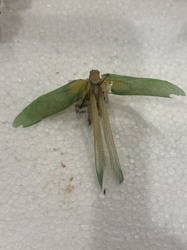
Leaf Insect Identification Guide
A flattened, broad-bodied phasmid with vein-like markings and leaf-shaped limbs that make it nearly indistinguishable from real foliage.
Read the full Leaf Insect encyclopedia entry →Key Visual Features
Leaf insects (family Phylliidae) are close relatives of stick insects but take camouflage in a different direction, mimicking flat leaves rather than twigs.
- Size: Medium to large, typically 2.5-4.5 inches (6-11 cm), with females generally larger and broader than males
- Color: Shades of green ranging from bright to olive, occasionally with brown or yellowish patches mimicking discoloration or decay spots on a real leaf
- Body shape: Broad, flattened, and oval to leaf-shaped, quite unlike the cylindrical body of typical stick insects — the abdomen in particular is expanded and flattened to resemble a leaf blade
- Wings/legs: The legs, and in females especially the wing covers, have broad, flattened lobes with visible vein-like lines running through them, closely mimicking the midrib and veins of a real leaf; leg segments may also be flattened and leaf-shaped
- Wings for flight: Males are typically slimmer with more functional wings and can fly, while females have reduced flight ability due to their bulkier, broader bodies
- Antennae: Relatively short and thin compared to the broad body
- Other markings: Some individuals show irregular brown blotches or edge notches that mimic insect-chewed or decaying leaf margins, enhancing the disguise
Where and When You'd See It
Leaf insects are native to tropical forests of Southeast Asia and nearby islands, where they live among the foliage of trees and shrubs. They remain still by day, clinging to leaves and blending in almost perfectly, and are more likely to move and feed during the evening and night. As tropical species, they can be encountered year-round in native habitat conditions and are also widely kept and observed in captivity due to their remarkable camouflage.
Similar-Looking Bugs
- Stick insects (various species): Have a long, cylindrical, twig-like body rather than the broad, flattened, oval leaf-shaped body of a true leaf insect
- Giant prickly stick insect: Though its female has a somewhat broadened, leaf-like abdomen, the body is still elongated and covered in spines, unlike the smoother, more purely leaf-shaped body of a true leaf insect
- Actual leaves: The resemblance is the entire strategy; distinguishing features include a small head with compound eyes, short antennae, and jointed legs, along with subtle asymmetry not found in real foliage
- Katydids with leaf-like wings: Some katydids also mimic leaves, but they have long, thread-like antennae and a more typical insect body profile rather than the extremely flattened, broad body of a leaf insect
Quick ID Checklist
- Broad, flattened, oval body resembling a single leaf
- Green (sometimes with brown patches) coloring with vein-like markings on the legs and wing covers
- Bulkier, less mobile females versus slimmer, flight-capable males
- Short antennae relative to the broad body
- Found motionless on foliage in Southeast Asian tropical forest habitat, most active at night
Frequently asked questions
How is a leaf insect different from a stick insect?
Leaf insects have a broad, flattened, leaf-shaped body with vein-like markings, while stick insects have a long, cylindrical, twig-like body.
Can leaf insects fly?
Males are slimmer with more functional wings and can fly, while females are bulkier with reduced flight ability.
What is the best way to spot a leaf insect among real leaves?
Look for a small head with compound eyes, short antennae, jointed legs, and subtle asymmetry in the leaf shape, since real leaves lack these features.
Where are leaf insects typically found?
They are native to tropical forests of Southeast Asia and nearby islands, living among the foliage of trees and shrubs.
Leaf Insect identified by the community
Recent Leaf Insect finds identified with Bug Identifier.