
Locust Identification Guide
Identify locusts by their robust hind legs, long narrow wings, and tendency to form dense, fast-moving swarms.
Read the full Locust encyclopedia entry →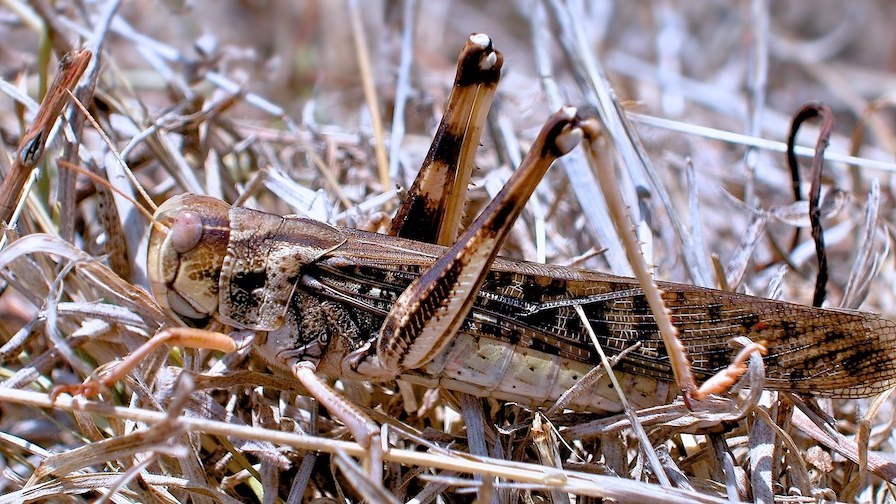
Key Visual Features
Locusts are a type of short-horned grasshopper capable of dramatic changes in appearance and behavior under crowded conditions.
- Body: Elongated and robust, typically 1 to 2.5 inches long depending on species, with a hardened, somewhat cylindrical thorax.
- Color: Solitary-phase individuals are often green or brown, blending with vegetation, while swarming-phase individuals frequently develop brighter yellow, orange, or pink coloring with dark markings.
- Legs: Large, powerfully muscled hind legs adapted for strong jumping, along with four slender walking legs.
- Wings: Long, narrow forewings that are leathery and protective, covering broader, membranous hindwings used for sustained flight.
- Antennae: Relatively short and thick compared to katydids or crickets, a key trait distinguishing locusts and grasshoppers from other jumping insects.
Where and When You'd See Them
Locusts are found in grasslands, savannas, agricultural fields, and semi-arid regions, with activity peaking during warm, dry seasons that favor rapid vegetation growth followed by drying conditions—circumstances that can trigger the shift from solitary to swarming behavior. In their solitary phase, individuals are scattered and behave much like ordinary grasshoppers, feeding and resting individually on low vegetation during the day. Under crowded, resource-limited conditions, however, they can transform into a gregarious swarming phase, forming dense, coordinated groups that move together across the landscape, often most active during daylight hours when temperatures are warm.
Similar-Looking Bugs
- Grasshoppers: Many locust species are technically grasshoppers, but true grasshoppers that never swarm typically stay solitary and lack the dramatic color and behavioral shift seen in true locusts.
- Katydids: Have very long, thread-like antennae often longer than the body, unlike the short, thick antennae of locusts.
- Crickets: Rounder body shape with long antennae and a different wing arrangement; locusts are more elongated with shorter antennae.
- Cicadas: Broader, wedge-shaped body with large transparent wings and no jumping hind legs, quite different from a locust's build.
Quick ID Checklist
- Elongated body, generally 1 to 2.5 inches long, with strong jumping hind legs
- Short, thick antennae (unlike the long antennae of crickets and katydids)
- Long, leathery forewings covering membranous hindwings
- Coloring shifts from green/brown when solitary to brighter yellow/orange when swarming
- Found in grasslands and agricultural areas, sometimes in dense, coordinated groups
Frequently asked questions
What is the difference between a locust and a regular grasshopper?
Locusts are grasshopper species capable of shifting from a solitary phase, where they look and act like ordinary grasshoppers, to a gregarious swarming phase marked by brighter coloring and coordinated group movement.
How can I tell a locust from a katydid?
Locusts have short, thick antennae, while katydids have very long, thread-like antennae that often exceed the length of their body.
What color are locusts in their swarming phase?
Swarming-phase locusts often develop brighter yellow, orange, or pink coloring with contrasting dark markings, compared to the green or brown tones typical of the solitary phase.
When are locusts most likely to be seen swarming?
Swarms tend to form under crowded, resource-limited conditions, often following periods of rapid plant growth and warm, dry weather in grassland and agricultural regions.