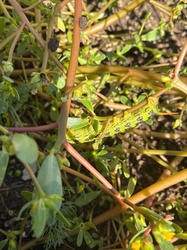
Lubber Grasshopper Identification Guide
Recognize these heavy-bodied, flightless grasshoppers by their short wings and slow, lumbering movement.
Read the full Lubber Grasshopper encyclopedia entry →Key Visual Features
Lubber grasshoppers are a group of large, heavy-bodied grasshoppers known for their oversized, robust build and reduced ability to fly. Adults commonly reach 2 to 3 inches long.
- Body shape: Thick, bulky body that looks disproportionately large compared to most other grasshoppers.
- Wings: Short wings that fail to cover the length of the abdomen, leaving lubbers unable to fly or capable of only very limited flight.
- Color: Varies by species and region, ranging from yellow with black spotting to black bodies marked with yellow, orange, or red stripes.
- Legs and antennae: Sturdy legs suited more for walking and climbing than powerful jumping compared to typical grasshoppers, with moderately short, thickened antennae.
- Movement: Notably slow and deliberate compared to most grasshoppers, which rely on quick jumps and flight to escape.
Where and When You'll See It
Lubber grasshoppers are found in open fields, roadsides, woodland edges, and gardens, most commonly across the southern and southeastern United States. They are most visible from spring through fall, with nymphs appearing earlier in the season and maturing into full-sized adults by mid-to-late summer. Because they move slowly and rely less on flight, they are often seen crawling along the ground or climbing low vegetation in full daylight.
Similar-Looking Species
- Eastern lubber grasshopper: The most common and widespread lubber species, often what people mean generically by "lubber grasshopper," typically bright yellow/gold with black markings or a darker form with yellow stripes.
- Other large grasshoppers (such as differential or American grasshoppers): These have long wings extending past the abdomen and fly readily, unlike lubbers.
- Band-winged grasshoppers: Also large-bodied at times but typically fly in short, noisy bursts, unlike the mostly ground-bound lubbers.
Quick ID Checklist
- Very large, heavy body compared to typical grasshoppers
- Short wings that don't reach the tip of the abdomen
- Slow, deliberate crawling movement rather than quick hops or flight
- Bright warning-style coloring: yellow/black or black/yellow-red combinations
- Found in fields and roadsides, mainly in the southern US, spring through fall
Frequently asked questions
Why can't lubber grasshoppers fly well?
Their wings are noticeably shorter than their abdomen, which limits or prevents flight, so they rely mainly on walking and short hops to get around.
What colors do lubber grasshoppers come in?
Coloring varies, ranging from yellow or gold bodies with black spots to black bodies marked with yellow, orange, or red stripes, depending on the individual and life stage.
How do lubber grasshoppers move differently from other grasshoppers?
They tend to crawl slowly and deliberately rather than making the quick jumps and flights typical of most grasshopper species.
Where are lubber grasshoppers commonly found?
They're most common in open fields, roadsides, and woodland edges across the southern and southeastern United States, active from spring through fall.
Lubber Grasshopper identified by the community
Recent Lubber Grasshopper finds identified with Bug Identifier.