
Luna Silkmoth Identification Guide
Recognize this pale green giant silk moth by its long trailing hindwing tails and translucent eyespots.
Read the full Luna Silkmoth encyclopedia entry →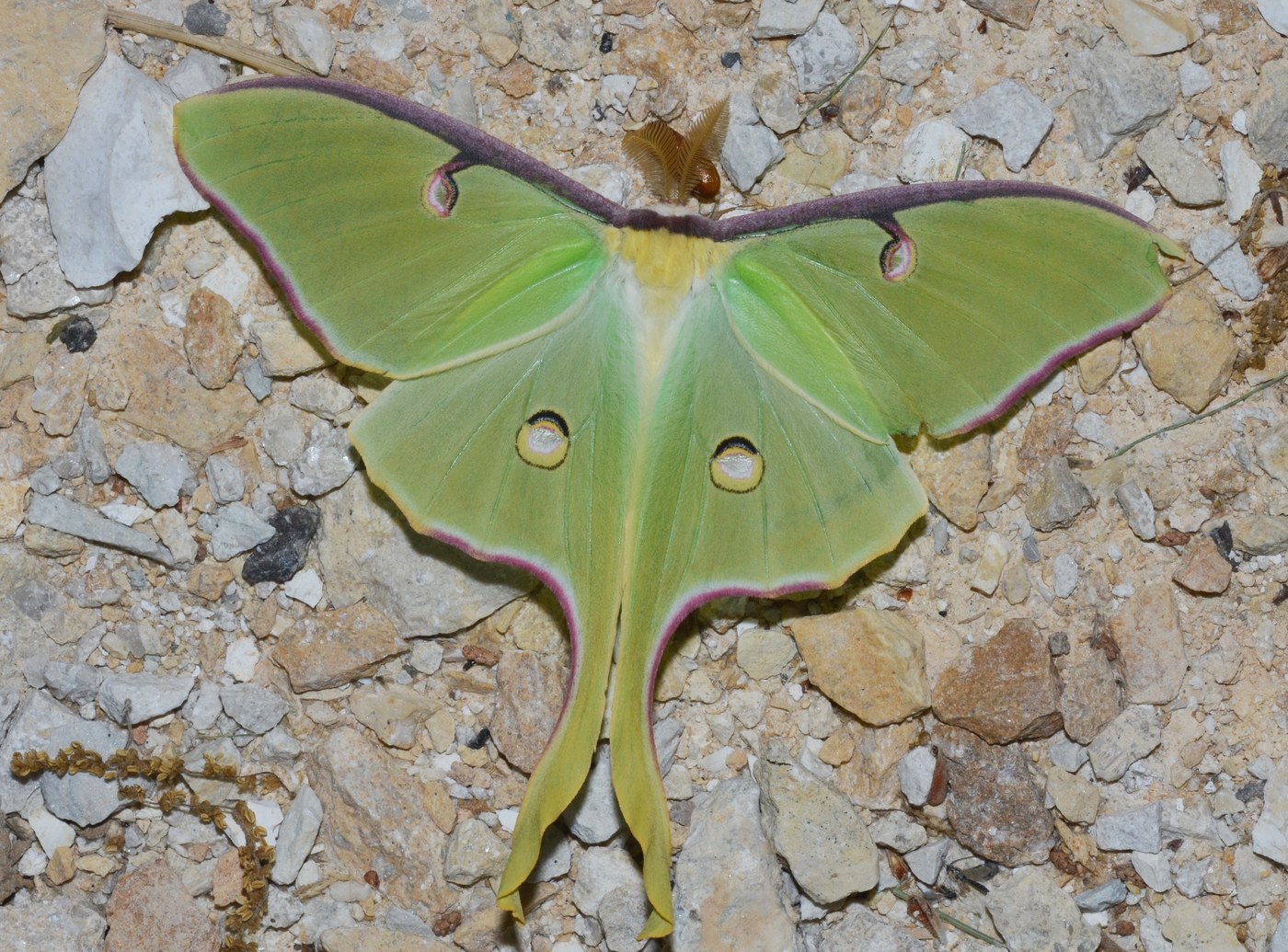
Key Visual Features
The Luna Moth (Actias luna) is one of the most recognizable giant silk moths in North America, with a wingspan of about 3 to 4.5 inches (7.5 to 11.5 cm). Its features are distinctive and hard to confuse with most other species:
- Pale, translucent lime-green to mint-green wings across the whole body
- Long, elegant, twisted trailing tails extending from each hindwing, sometimes reaching 1.5 inches or more
- A small, translucent, eye-like spot (ocellus) on each of the four wings, usually pale with a thin dark or reddish outline
- A leading edge of the forewing often bordered in a thin band of maroon, pink, or lavender
- A stout, white to pale, furry body and legs
- Large, feathery (bipectinate) antennae, especially broad and comb-like in males, used to detect female pheromones
At rest, the wings are held flat and outstretched, fully displaying the pale green color, eyespots, and distinctive tails.
Where and When You'll See It
Luna Moths are found across the eastern half of North America, from Canada down through the eastern and southeastern United States, in deciduous forests with host trees such as walnut, hickory, sweetgum, birch, and persimmon. Adults are strictly nocturnal and do not feed, living only about a week as winged adults. They are strongly attracted to lights and are most often seen from late spring through summer, with one generation in the north and up to three overlapping generations further south.
Similar-Looking Moths
- Polyphemus Moth: Also a large silk moth but tan-brown overall with large, bold purplish-blue and yellow eyespots, lacking the Luna Moth's pale green color and long tails.
- Io Moth: Much smaller, with yellow (male) or reddish-brown (female) wings and a single large black-and-blue eyespot on each hindwing, no tails present.
- Other Actias species (found in Asia): Similar pale green color and tails, but these do not naturally overlap with the Luna Moth's North American range, so location alone usually rules out confusion.
Quick ID Checklist
- Pale lime-green wings, wingspan roughly 3–4.5 inches
- Long, twisting tails trailing from the hindwings
- Small translucent eyespot on each wing
- Feathery antennae, broadest and most comb-like in males
- Nocturnal, drawn to lights, seen late spring through summer in eastern North American forests
Frequently asked questions
What is the easiest feature to identify a Luna Moth by?
Its pale lime-green wings combined with the long, twisting tails trailing from the hindwings are unmistakable and not shared by most other North American moths.
How can I tell a male from a female Luna Moth?
Males have noticeably broader, more feathery (comb-like) antennae than females, which is the most reliable way to distinguish the sexes at a glance.
Why don't I see Luna Moths during the day?
Adults are strictly nocturnal and rest motionless on foliage or tree trunks during daylight hours, relying on their pale coloring for camouflage, so they are almost only encountered at night near lights.
How long do adult Luna Moths live?
As adults, they live only about a week, since they lack functional mouthparts and do not feed during this final life stage.