Mantidfly Identification Guide
Learn how to recognize this odd lacewing relative with mantis-like raptorial front legs.
Read the full Mantidfly encyclopedia entry →Key Visual Features
The mantidfly is a small to medium insect (roughly 0.5 to 1.5 inches long) that looks like a miniature praying mantis crossed with a lacewing. Its most distinctive trait is a pair of enlarged, spined front legs held folded in front of the head, used for grabbing prey — just like a mantis. Behind this raptorial pair, look for:
- A long, slender, mobile neck-like extension of the thorax that lifts the head and front legs up and forward
- Two pairs of clear, membranous wings held roof-like or flat over the body, with a fine net of veins typical of the lacewing order
- A triangular head with large compound eyes and short, thread-like antennae
- A slim abdomen and four thin, ordinary walking legs at the rear (only the front pair is enlarged)
- Coloring that ranges from pale tan and yellow to brown or black, sometimes with wasp-like patterning
Where and When You'd See It
Mantidflies are most often spotted in warm months, from late spring through late summer, in gardens, woodland edges, meadows, and areas with flowering plants where small insects gather. They are attracted to lights at night and are sometimes found resting on foliage or tree bark during the day. They tend to be uncommon and easily overlooked because of their small size and mantis-mimicking camouflage.
Similar-Looking Bugs
- True praying mantises are much larger, lack the netted lacewing-style wings, and have a more rigid elongated thorax rather than a slender flexible neck.
- Lacewings have the same delicate wing venation but lack the enlarged grasping front legs entirely.
- Some wasps share a slender waist and similar size but have distinctly different wing shape and no raptorial forelegs.
Quick ID Checklist
- Mantis-style grasping front legs folded near the head
- Slender, elongated "neck" region unlike a true mantis's thorax
- Two pairs of clear, finely veined wings
- Small overall size compared to true mantises
- Found near flowers and foliage in warm months
Frequently asked questions
What is the single best feature for identifying a mantidfly?
The combination of mantis-like grasping front legs with a pair of clear, finely veined lacewing-style wings is the giveaway — no true mantis has netted wings like this.
How can I tell a mantidfly from a young praying mantis?
Young mantises lack wings entirely or have wing buds, while mantidflies of a similar size already show fully formed, clear, net-veined wings and a distinctly slimmer, more flexible neck.
What time of year are mantidflies easiest to find?
They are most commonly encountered from late spring through summer, especially around flowering vegetation or near outdoor lights at night.
Do mantidflies have long antennae like a mantis?
No, their antennae are short and thread-like, noticeably shorter than the longer antennae seen on many true mantises.
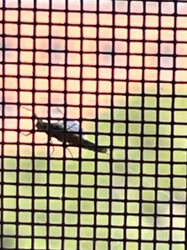
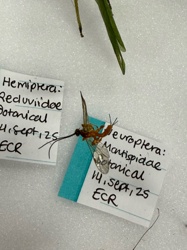
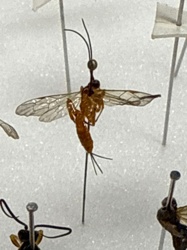
Mantidfly identified by the community
Recent Mantidfly finds identified with Bug Identifier.