March Fly Identification Guide
Learn how to recognize march flies by their stout dark bodies, long dangling legs, and springtime swarming habits.
Read the full March Fly encyclopedia entry →Key Visual Features
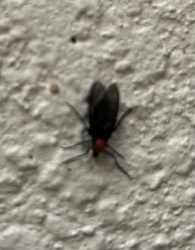
March flies (family Bibionidae) are stout, hairy-bodied flies typically ranging from 0.3 to 0.6 inches long.
- Body: Thick, cylindrical, and often shiny black, though some species show reddish-orange thoracic patches.
- Legs: Notably long and thick, often dangling loosely beneath the body during flight, giving these insects a clumsy, trailing-leg silhouette.
- Head: Males have very large, hemisphere-shaped eyes that nearly cover the head, while females have smaller, more separated eyes.
- Wings: A single pair of smoky or clear wings, sometimes with a darker leading edge, held flat over the back at rest.
- Antennae: Short and stubby compared to the body, easy to overlook against the dark head.
Where and When You'd See Them
March flies emerge in large, loose swarms during spring in many regions, though some species appear in autumn. Adults are most active on mild, sunny days and are commonly seen hovering low over lawns, gardens, and roadside vegetation, or resting on flowers where they feed on nectar and pollen. Larvae develop in damp soil, leaf litter, and decaying organic matter, so adult swarms often appear near grassy fields, pastures, and garden beds with rich soil.
Similar-Looking Bugs
- Crane flies: Much longer, thread-like legs and a slender body; march flies are stockier and hairier.
- House flies: Smaller, with shorter legs and a broader, flatter head; lack the dangling-leg flight posture.
- Mosquitoes: Slimmer body and long piercing mouthparts; march flies have short, blunt mouthparts suited for feeding on flowers.
- Horse flies: Larger and broader-headed with patterned eyes; march flies are smaller and darker overall.
Quick ID Checklist
- Stout, dark, hairy body about a quarter to half an inch long
- Long legs that dangle noticeably during slow, low flight
- Males show oversized, dome-like eyes; females have smaller separated eyes
- Seen swarming over grass and flowers on mild spring days
- Larvae found in damp soil or decaying plant matter
Frequently asked questions
Why do march flies fly with their legs dangling?
Their legs are proportionally long and thick, and during their slow, hovering flight the legs trail loosely beneath the body rather than being tucked in, which is a useful visual cue for identification.
How can I tell a male from a female march fly?
Males have very large eyes that nearly meet at the top of the head, while females have noticeably smaller eyes that are clearly separated, giving the sexes distinctly different head shapes.
What time of year are march flies most visible?
Most species swarm in spring, often appearing suddenly in large numbers on warm, calm days, though a few species are more active in fall.
Where do march fly larvae live?
Larvae live in moist soil, thatch, and decaying organic matter, which is why adult swarms tend to appear over lawns and fields with rich, damp ground.
March Fly identified by the community
Recent March Fly finds identified with Bug Identifier.