Mediterranean Flour Moth Identification Guide
A small grey moth with fine zigzag wing markings, typically found fluttering near stored grain and flour indoors.
Read the full Mediterranean Flour Moth encyclopedia entry →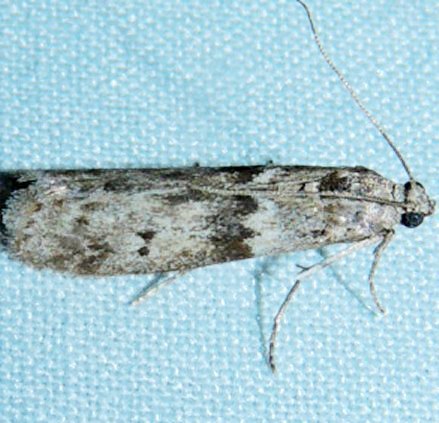
Key Visual Features
The Mediterranean Flour Moth is a small, slender moth with a wingspan of about 16-25mm.
- Forewings: Pale grey to blue-grey, crossed by darker, fine zigzag or wavy transverse lines, with scattered small black specks across the wing surface.
- Hindwings: Plain pale grey, fringed, and generally unmarked compared to the patterned forewings.
- Body: Slender and elongated, matching the narrow wing shape.
- Resting posture: Wings held tent-like over the body, with the tips of the forewings often slightly raised at the rear, giving a subtly lifted, angular silhouette rather than lying perfectly flat.
- Flight: Weak and fluttery, typically short, low flights rather than sustained flying.
Where and When You'll See It
This moth is almost always encountered indoors, in and around food storage areas, mills, pantries, and warehouses where flour, grain, or similar dry goods are kept. Because indoor conditions stay warm year-round, multiple overlapping generations can occur, meaning adults may be seen at any time of year rather than following a strict outdoor season. They tend to rest on walls, shelving, or packaging near infested material during the day and become more active in the evening.
Similar-Looking Species
- Indian Mealmoth - has a distinctly two-toned wing pattern, with a pale base and a darker reddish-bronze outer half, unlike the more uniform zigzag-lined grey of the Mediterranean Flour Moth.
- Other Ephestia species - closely similar in general appearance; separating them typically requires close comparison of the fine wing line patterns.
- Case-bearing Clothes Moth - plainer buff coloring without the zigzag lines, and associated with fabric rather than food storage.
Life Cycle & Behavior
Females scatter eggs directly onto flour, grain, or similar dry food material, and the caterpillars spin silken webbing through the food as they feed, often binding particles together into loose clumps. Pupation takes place in a silken cocoon, frequently tucked into a crevice or fold of packaging. In warm indoor environments, the full life cycle from egg to adult can complete in just a matter of weeks, allowing several generations annually.
Quick ID Checklist
- Small grey moth with fine dark zigzag lines across the forewing
- Plain pale grey hindwings
- Slightly raised, angular resting posture with tent-folded wings
- Found indoors near flour, grain, or similar dry food storage
- Weak, fluttery, low flight
Frequently asked questions
How do I distinguish a Mediterranean Flour Moth from an Indian Mealmoth?
The Mediterranean Flour Moth has fine, even zigzag lines across an overall grey forewing, while the Indian Mealmoth shows a more obvious two-tone pattern with a pale base and reddish-bronze tip.
Where indoors is this moth most likely to be seen?
It is most commonly found in and around mills, pantries, and warehouses where flour or grain products are stored.
Why do I see this moth year-round rather than in a specific season?
Because it typically lives in heated indoor environments, multiple generations can overlap continuously, so adults may appear at any time of year rather than following an outdoor seasonal pattern.
What does the resting posture look like?
The moth holds its wings tent-like over its body, with the rear tips of the forewings often slightly raised, giving a subtly angular rather than flat profile.
Mediterranean Flour Moth identified by the community
Recent Mediterranean Flour Moth finds identified with Bug Identifier.