
Milkweed Bug Identification Guide
Learn to identify the bold orange-and-black pattern of the milkweed bug commonly found on milkweed plants.
Read the full Milkweed Bug encyclopedia entry →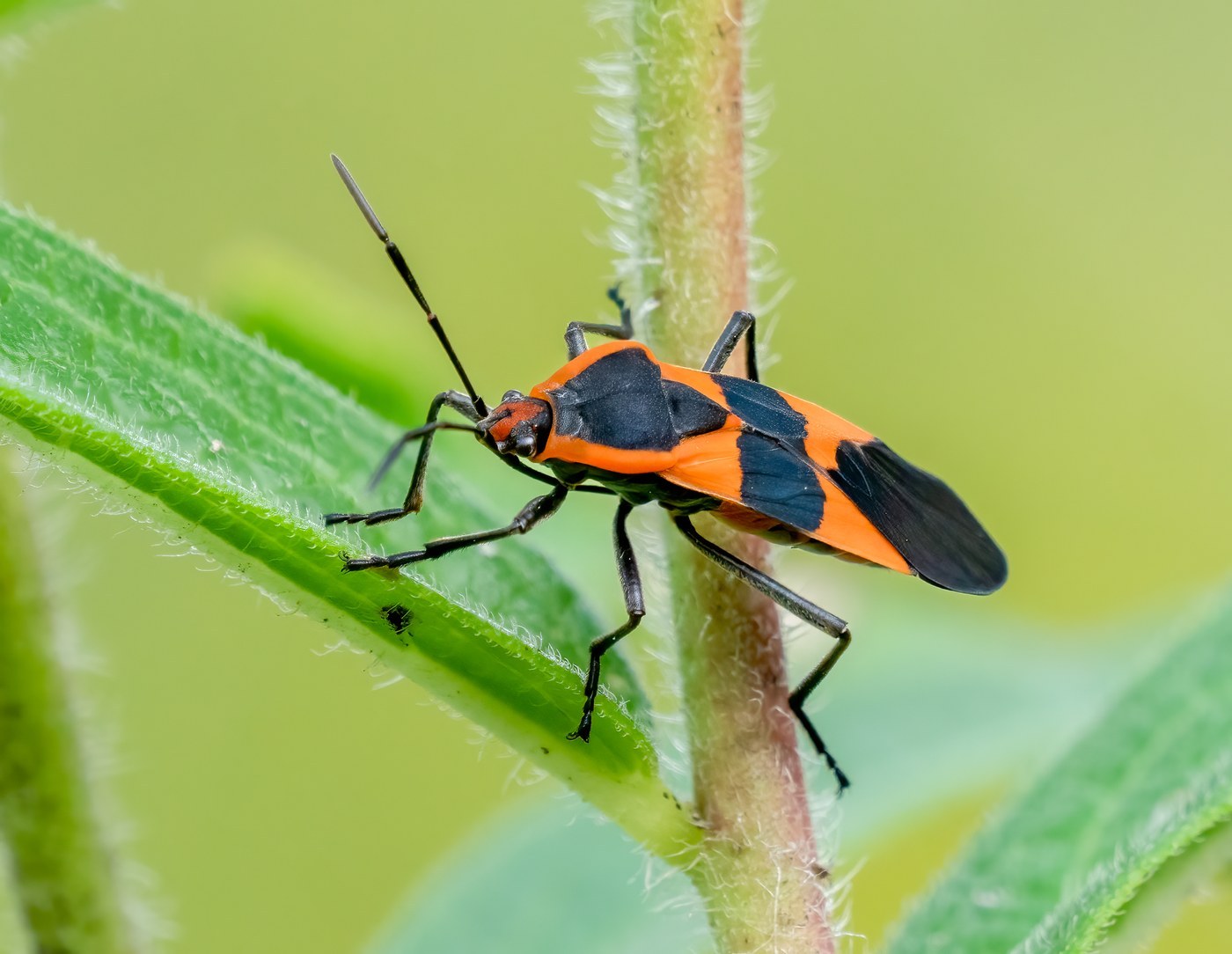
Key Visual Features
- Medium-sized true bug, roughly 0.5-0.75 inches (1.2-1.9 cm) long.
- Body coloring is bright orange or reddish-orange with bold black markings, typically forming a black X or triangular pattern across the back.
- Head is black or dark, often with a narrow orange band, and the body has an elongated oval shape.
- Wings lie flat over the back at rest, with the black-and-orange pattern continuing across the wing covers.
- Legs and antennae are dark and relatively slender.
- Nymphs (immature stages) are smaller, wingless, and often show a similar orange-and-black color scheme, becoming more pattern-defined as they mature.
Where and When You'd See It
- Found directly on milkweed plants, including on leaves, stems, and seed pods, often in groups of multiple individuals.
- Most visible during the warmer months when milkweed is flowering and producing seed pods, since the bugs are closely tied to this plant's life cycle.
- Active during the day, often seen clustered together feeding or resting on the same plant.
- Found in meadows, roadside patches, gardens, and other open areas where milkweed grows.
Similar-Looking Species
- Monarch butterfly caterpillars share the same host plant but look entirely different, with a soft, striped caterpillar body rather than a hard-shelled, winged bug.
- Boxelder bugs have a similar general black-and-orange/red pattern but are typically found on boxelder or maple trees rather than milkweed, and have a more elongated, narrower black stripe pattern versus the milkweed bug's bolder blocky markings.
- Other seed bugs in the same family can look similar; close attention to the specific black pattern shape and the plant it is found on (milkweed specifically) helps confirm identification.
Quick ID Checklist
- Bright orange-and-black body about 0.5-0.75 inches long.
- Bold black X or triangular pattern across the back.
- Found directly on milkweed leaves, stems, or seed pods.
- Often seen in groups feeding together on the same plant.
- Nymphs show a similar but less defined orange-and-black coloring.
Behavior Notes
- Groups often gather in dense clusters on developing seed pods, with individuals of different life stages mixed together on the same pod.
- Movement is generally slow and deliberate rather than quick or evasive, and disturbed bugs tend to walk away rather than fly.
- Adults have fully formed wings and are capable of short flights between plants, while nymphs remain wingless and confined to walking until their final molt.
Frequently asked questions
How do I tell a milkweed bug from a boxelder bug?
Milkweed bugs have a bolder, blockier black-and-orange pattern and are found specifically on milkweed plants, while boxelder bugs have narrower stripe-like markings and are typically found on boxelder or maple trees.
Are milkweed bugs the same as monarch caterpillars?
No, they are unrelated; monarch caterpillars are soft-bodied and striped, while milkweed bugs are hard-shelled true bugs with wings and a distinct orange-and-black pattern, though both can be found on the same milkweed plants.
What part of the milkweed plant are they usually found on?
They are commonly seen on the leaves, stems, and especially the seed pods of milkweed, often clustered together in groups.
Do young milkweed bugs look like the adults?
Nymphs are smaller and wingless but generally show a similar orange-and-black coloring that becomes more sharply patterned as they mature into winged adults.