Mormon Cricket Identification Guide
A large, flightless shieldback katydid known for its huge migratory bands across the western rangelands.
Read the full Mormon Cricket encyclopedia entry →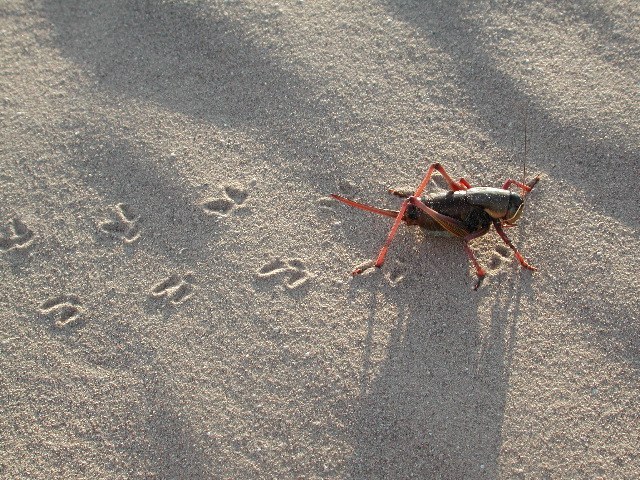
Key Visual Features
The Mormon cricket (Anabrus simplex) is not a true cricket but a shieldback katydid, named for its bulky, shield-like pronotum covering the top of the thorax.
- Size: Large-bodied, typically 2.5-3.5 inches (6-9 cm) including the abdomen
- Color: Highly variable — black, brown, purple, red, orange, tan, or green, sometimes with a glossy sheen
- Body shape: Stout, humpbacked appearance with a domed pronotum shield
- Wings: Vestigial and non-functional — Mormon crickets cannot fly or hop far; the reduced wing pads are visible as small flaps on the back
- Legs: Long hind legs adapted for walking and short jumps rather than powerful leaping
- Antennae: Long, thin, thread-like antennae often longer than the body, a hallmark of katydids versus grasshoppers
- Other markings: Females carry a long, curved, sword-like ovipositor extending from the rear of the abdomen
Where and When You'd See It
Mormon crickets live in sagebrush steppe, rangeland, and dry grassland habitats across the western United States, particularly the Great Basin region. They are most conspicuous in late spring through mid-summer when populations can build into dense, slow-moving marching bands that cross roads and fields in search of food. Adults are active by day, basking in open sun and moving in mass migrations that can stretch for miles during outbreak years.
Similar-Looking Bugs
- True crickets (family Gryllidae): Smaller, more rounded, with a flatter body and shorter pronotum; lack the domed shield
- Katydids (green, leaf-mimic types): Usually green and slender with functional wings for flight or gliding, unlike the flightless Mormon cricket
- Grasshoppers: Have short, stout antennae (much shorter than the body) versus the Mormon cricket's long, thread-like antennae, and most grasshoppers can fly
- Jerusalem cricket: Has a shiny, hairless, humanlike head and no visible wings at all, and lacks the domed pronotum shield
Quick ID Checklist
- Large, humpbacked body with a shield-like pronotum
- Long, thread-like antennae longer than the body
- Flightless with only vestigial wing pads
- Highly variable body color (black, brown, purple, orange)
- Seen walking in large groups across open rangeland in late spring/summer
Frequently asked questions
Is the Mormon cricket actually a cricket?
No — despite the name, it is a type of shieldback katydid, identifiable by its long, thread-like antennae and domed pronotum rather than the shorter antennae of true crickets.
Can Mormon crickets fly?
No. Their wings are reduced to small non-functional pads, so they get around entirely by walking and occasional short hops.
Why do I see so many at once?
In certain years, populations build up and form dense marching bands that move together across open ground, a well-known behavior of this species in western rangelands.
How can I tell males from females?
Females have a long, curved, blade-like ovipositor projecting from the tip of the abdomen, which males lack.
Mormon Cricket identified by the community
Recent Mormon Cricket finds identified with Bug Identifier.