Oleander Hawk-Moth Identification Guide
Recognize this large, streamlined hawk-moth by its swirling olive-green and pink camouflage pattern.
Read the full Oleander Hawk-Moth encyclopedia entry →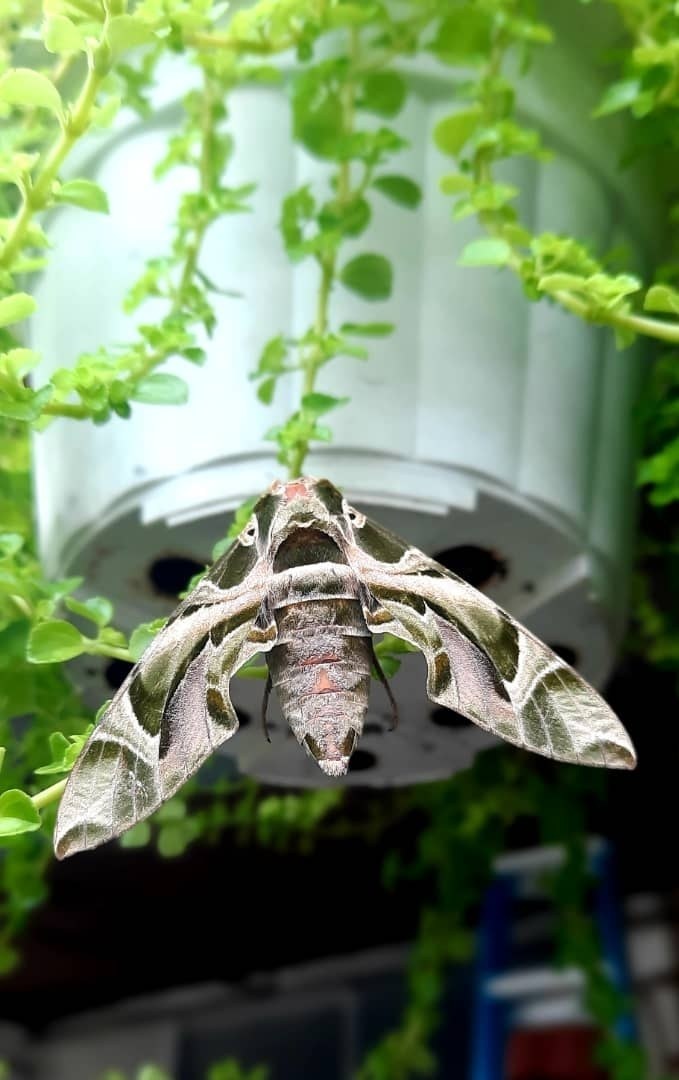
Key Visual Features
The Oleander Hawk-Moth (Daphnis nerii) is a large, elegantly patterned sphinx moth with a wingspan of about 3.5 to 4.7 inches (9 to 12 cm). Key features include:
- Intricate swirling patterns of olive-green, moss-green, and pale pink or lavender across the forewings, resembling a camouflage or marbled design
- A streamlined, torpedo-shaped body tapering to a pointed abdomen, colored in matching green and pink tones
- Long, narrow, swept-back forewings typical of hawk-moths (sphinx moths), built for fast, powerful flight
- Smaller, paler hindwings mostly hidden under the forewings at rest
- Short, stout antennae that thicken slightly toward the tip
- A long proboscis (feeding tube) that can be coiled tightly beneath the head when not in use
At rest, the wings are held swept back tightly against the body in a distinctive arrow or jet-like shape, very different from the flat, spread posture of many other moths.
Where and When You'll See It
This species is native to Africa and parts of Asia but is a strong migrant, regularly turning up across the Mediterranean, southern Europe, and even further north in warm summers. It favors gardens, parks, and open scrubland wherever oleander shrubs grow, since these are the primary caterpillar host plant. Adults are active at dusk and after dark, often seen hovering in front of tubular flowers to feed, much like a hummingbird. Sightings peak in the warmer months, generally summer, with migrant individuals appearing further from the core range during hot, favorable weather.
Similar-Looking Moths
- Other sphinx/hawk-moths (family Sphingidae): Share the streamlined body and swept wings, but the Oleander Hawk-Moth's unique green-and-pink marbled pattern is quite distinctive once learned.
- Privet Hawk-Moth: Larger and patterned in pink-and-black bands on the abdomen with brown-gray forewings, lacking the Oleander Hawk-Moth's swirling green camouflage.
- Eyed Hawk-Moth: Has prominent blue-black eyespots on the hindwings, which the Oleander Hawk-Moth does not display.
Quick ID Checklist
- Wingspan roughly 3.5–4.7 inches with long, swept-back wings
- Swirling olive-green and pink marbled pattern, unique among common hawk-moths
- Streamlined, tapering body matching the wing coloration
- Hovers at flowers at dusk or night, hummingbird-style
- Found near oleander plants in warm climates or as a summer migrant further north
Frequently asked questions
Why is it called the Oleander Hawk-Moth?
It gets its name because the caterpillars feed primarily on oleander plants, which serve as the main host plant across much of the species' range.
How does the Oleander Hawk-Moth fly and feed?
Like other hawk-moths, it hovers in place in front of flowers at dusk or at night while uncoiling its long proboscis to feed, a flight style often compared to that of a hummingbird.
Can this moth be seen outside of Africa and Asia?
Yes, it is a strong migrant and regularly appears across southern Europe and the Mediterranean region in summer, occasionally reaching further north during particularly warm seasons.
What makes its wing pattern distinctive compared to other hawk-moths?
Its swirling combination of olive-green and pink tones creates a marbled, camouflage-like design that is not shared by most other common hawk-moth species.
Oleander Hawk-Moth identified by the community
Recent Oleander Hawk-Moth finds identified with Bug Identifier.