
Orange Sulphur Identification Guide
Identify this common field butterfly by its orange-tinted wings, though telling it apart from Clouded Sulphur takes a careful look.
Read the full Orange Sulphur encyclopedia entry →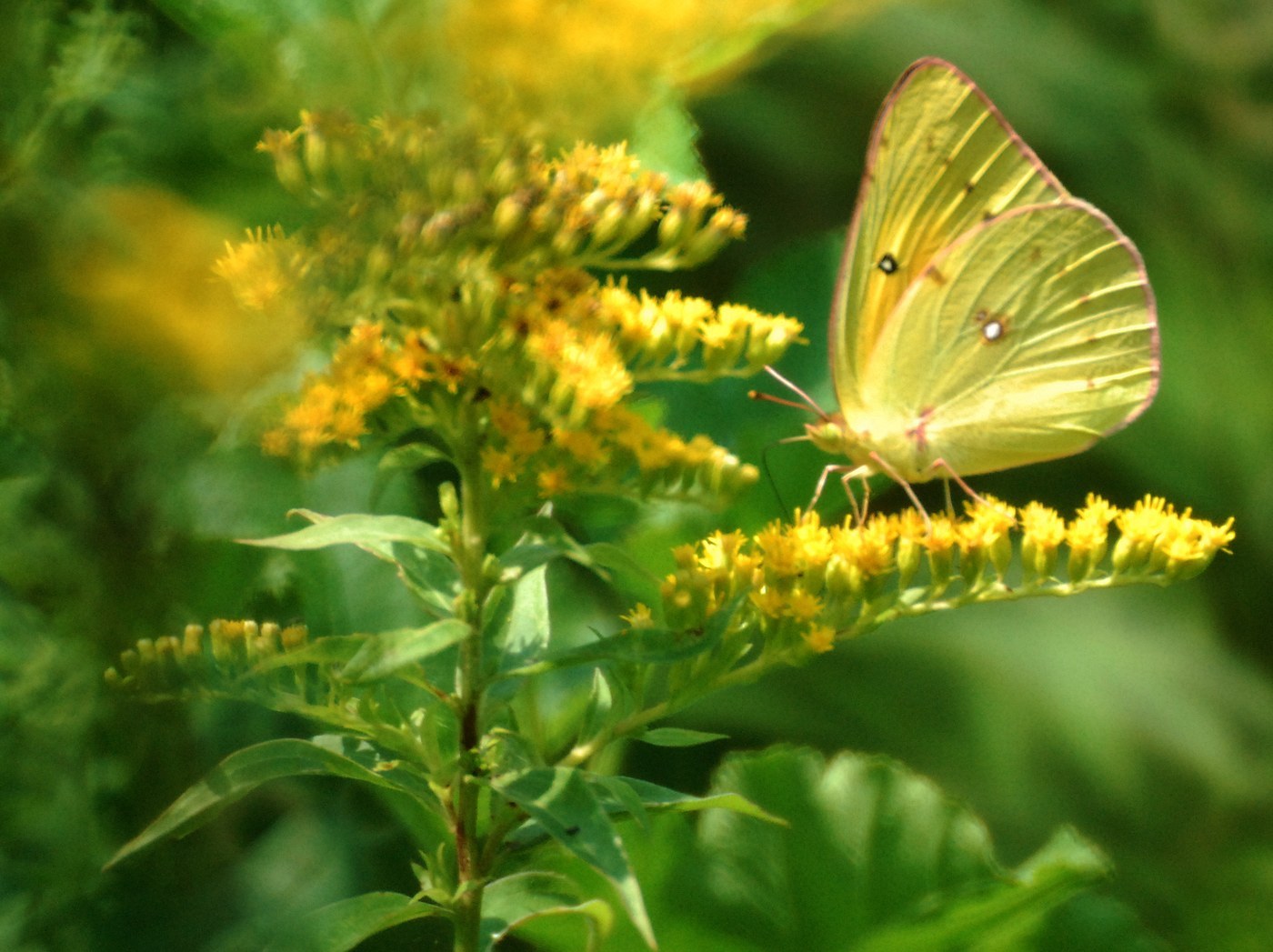
Key Visual Features
The Orange Sulphur (Colias eurytheme) is a medium-sized butterfly with a wingspan of about 1.5 to 2.25 inches, closely resembling its relative the Clouded Sulphur.
- Color: Dorsal wings range from yellow-orange to a fairly deep orange, with males generally showing more pronounced orange coloring than females.
- Borders: Males have a solid black wing border, while females show a spotted or broken black border.
- Markings: A dark spot on the forewing and an orange spot on the hindwing are typically visible.
- Underside: Yellow-orange with a silver spot ringed in pink on the hindwing, along with small scattered dark spots.
- Pale form females: Some females appear in a whitish "alba" form rather than orange or yellow.
Where and When You'll See It
Orange Sulphurs are extremely common and widespread across fields, meadows, alfalfa and clover fields, and roadsides throughout most of North America. They fly low and fast over open, sunny habitat and are active from spring through fall, with multiple broods produced through the warmer months. They are frequently seen flying alongside Clouded Sulphurs, often at the same flowers.
Similar-Looking Species
- Clouded Sulphur: The two species are extremely close relatives and commonly hybridize, making some individuals difficult to definitively separate. In general, Orange Sulphurs show noticeably more orange suffusion across the wings, especially in males, while Clouded Sulphurs remain a cleaner pale yellow.
- Cloudless Sulphur: Larger overall, with a cleaner, more uniform yellow color and a different border pattern.
- Overall approach: Because of hybridization, the safest way to separate the two Colias species in the field is to note the overall degree of orange coloring rather than relying on any single mark.
Quick ID Checklist
- Medium-sized, yellow-orange to deep orange wings
- Solid black border in males, spotted border in females
- Silver spot ringed in pink on the ventral hindwing
- Frequently seen flying and nectaring alongside Clouded Sulphurs
- Common in fields, meadows, and alfalfa/clover habitat
Frequently asked questions
What's the main difference between Orange Sulphur and Clouded Sulphur?
Orange Sulphurs generally show more orange coloring across the wings, especially in males, while Clouded Sulphurs tend to stay more purely pale yellow, though hybrids can blur this distinction.
Why is it sometimes hard to identify an individual sulphur precisely?
Orange Sulphurs and Clouded Sulphurs interbreed frequently, producing intermediate individuals whose coloring falls between the two typical patterns.
What habitat is best for finding Orange Sulphurs?
Open fields, meadows, and alfalfa or clover fields are ideal, since these areas provide abundant nectar and host plants.
Do female Orange Sulphurs always look orange?
No, some females occur in a pale whitish 'alba' form instead of the typical orange or yellow coloring.