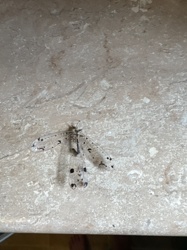
Owlfly Identification Guide
A dragonfly-like insect with huge eyes and long, clubbed antennae that easily give away its true identity.
Read the full Owlfly encyclopedia entry →Key Visual Features
The Owlfly is a distinctive insect, generally with a wingspan of about 2 to 3.5 inches (5 to 9 cm), often mistaken at first glance for a dragonfly due to its similar overall shape and flight style.
- Body shape: Long, slender body with an elongated abdomen, somewhat resembling a dragonfly or damselfly, but with a softer, less rigid-looking build.
- Eyes: Very large, prominent compound eyes that dominate the head, often giving the face a bulging, owl-like look, which is the source of the common name.
- Antennae: The most reliable identifying feature: long, thread-like antennae that end in a distinct club or knob at the tip, quite different from the short, bristle-like antennae of true dragonflies and damselflies.
- Wings: Two pairs of long, narrow, clear to lightly patterned wings held either flat or angled at rest, with a fine network of veins running through them.
- Color: The body is generally brown, tan, or grayish, sometimes with subtle mottling on the wings, providing effective camouflage against bark and dry vegetation.
Where and When You'd See It
Owlflies are found in open woodlands, fields, and shrubby edges, often perching on twigs, grass stems, or bark during the day, where their coloring helps them blend in. They are most active during the warmer months, generally summer, and are frequently seen flying in quick, darting movements similar to a dragonfly, especially around dusk. Unlike aquatic-associated insects such as mayflies or dobsonflies, Owlflies are not tied to water and their larvae develop in soil or leaf litter rather than in streams or ponds.
Similar-Looking Species
- Dragonflies: Share a similar long body and strong flight, but dragonflies have short, bristle-like antennae rather than the long, club-tipped antennae of the Owlfly, and their eyes typically meet or nearly meet at the top of the head.
- Damselflies: Smaller and more delicate, with wings folded or held at a slight angle rather than the flatter wing posture often seen in resting Owlflies, and again lacking clubbed antennae.
- Antlions (adult form): Somewhat similar body plan and clubbed antennae, but antlions are usually smaller with a weaker, more fluttery flight compared to the fast, direct flight of an Owlfly.
The clubbed antennae are by far the most dependable way to confirm an Owlfly and rule out dragonflies and damselflies, which can otherwise look quite similar in overall shape and flight behavior.
Quick ID Checklist
- Long, thread-like antennae ending in a distinct club or knob
- Very large, prominent eyes giving an owl-like facial look
- Long, slender body resembling a dragonfly at first glance
- Found perched on twigs and grass in open woodlands and fields, not near water
- Fast, darting flight, often active around dusk in summer
Frequently asked questions
What is the single best feature for identifying an Owlfly?
The long antennae ending in a distinct club or knob are the most reliable field mark, since dragonflies and damselflies, which Owlflies otherwise resemble, have short, bristle-like antennae instead.
Why might someone mistake an Owlfly for a dragonfly?
Both have a long, slender body, strong direct flight, and similar overall size, so from a distance an Owlfly's silhouette can look very dragonfly-like until the antennae or eyes are examined closely.
Do Owlflies live near water like dragonflies do?
No, unlike dragonflies and damselflies, Owlflies are not tied to aquatic habitats. Their larvae develop in soil or leaf litter, so adults are typically found in open woodlands, fields, and shrubby areas rather than near ponds or streams.
When are Owlflies most likely to be seen flying?
They tend to be most active during summer, often flying in quick, darting movements, with increased activity noted around dusk.
Owlfly identified by the community
Recent Owlfly finds identified with Bug Identifier.