Painted Lady Butterfly Identification Guide
Recognize this widespread orange-and-black butterfly by its mosaic wing pattern and white-spotted wingtips.
Read the full Painted Lady Butterfly encyclopedia entry →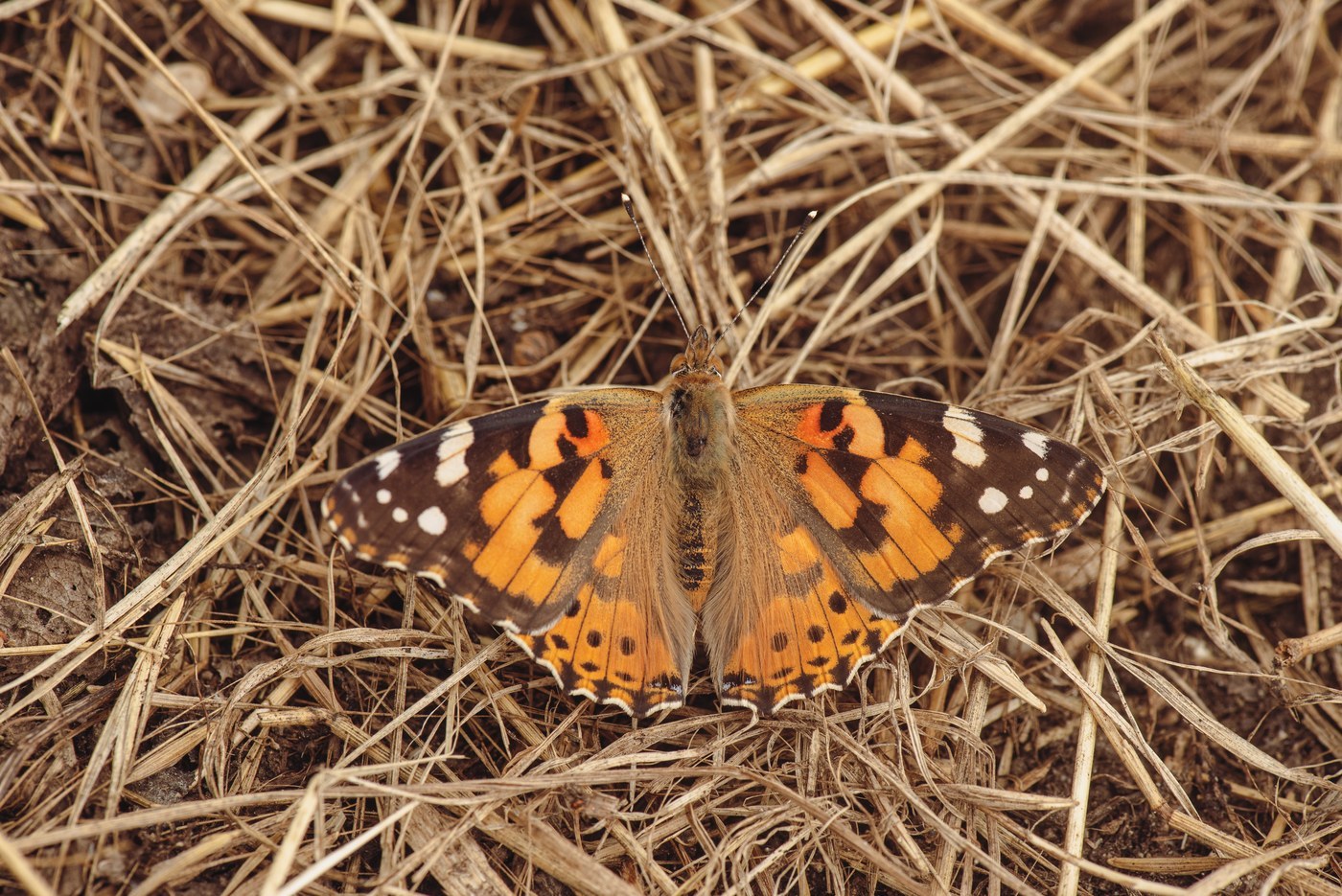
Key Visual Features
The painted lady is one of the most widely distributed butterflies in the world, recognizable by its intricate patterned wings.
- Wingspan ranges from about 2 to 2.5 inches (5-6.5 cm), with an upperside that is a mosaic of orange, black, and white patches, giving a somewhat mottled or tortoiseshell appearance.
- The forewing tips are black with a scattering of small white spots, a feature visible both at rest and in flight.
- The underside of the hindwing shows a subtler pattern of tan, gray, and cream marbling with a row of small, faint eyespots near the outer margin, useful for identification when the butterfly rests with wings closed.
- The body is dark and covered in fine hairs, with clubbed antennae typical of butterflies.
- Caterpillars are spiny, dark gray to blackish with pale mottled markings and yellow side stripes, living within loose silk webbing on host plant leaves.
Where and When You'd See It
Painted ladies are found in open, sunny habitats such as fields, gardens, meadows, and roadsides, wherever nectar flowers and host plants like thistle and mallow are available. They are strong, far-ranging fliers and are known for long-distance migrations across continents in some years, with population booms leading to especially large numbers. Adults are active during the day, especially in warm, sunny conditions, and can be seen from spring through fall in many temperate regions, with peak abundance often in mid-to-late summer.
Similar-Looking Bugs
- American lady butterflies look similar but have two large eyespots on the underside of the hindwing instead of the row of smaller spots seen in painted ladies.
- Red admiral butterflies show a bolder, more solid orange-red band across a darker wing rather than the fragmented mosaic pattern of the painted lady.
- Monarch butterflies are larger with a more uniform orange background and bold black veining, lacking the mottled, patchwork wing pattern of the painted lady.
- The combination of a mottled orange-black-white upperside and the row of small marginal eyespots on the hindwing underside is the most reliable way to separate painted ladies from these lookalikes.
Quick ID Checklist
- Mosaic of orange, black, and white on the wing upperside
- Black forewing tips with small white spots
- Hindwing underside shows a row of small eyespots, not two large ones
- Found in open sunny habitats near thistle and other nectar plants
- Strong, active flier, often seen in large seasonal numbers
Frequently asked questions
How do I tell a painted lady from an American lady butterfly?
Check the underside of the hindwing: painted ladies show a row of several small eyespots, while American ladies show two large, prominent eyespots.
What makes the painted lady's wing pattern distinctive?
Its upperside is a fragmented mosaic of orange, black, and white patches, unlike the bolder solid bands seen in butterflies like the red admiral.
Where are painted ladies most commonly seen?
They favor open, sunny habitats such as meadows, fields, and gardens with abundant flowers, including areas with thistle.
Are painted lady caterpillars easy to find?
They live within loose silk webbing on host plant leaves and appear as spiny, dark gray caterpillars with pale mottling and yellow side stripes.
Painted Lady Butterfly identified by the community
Recent Painted Lady Butterfly finds identified with Bug Identifier.