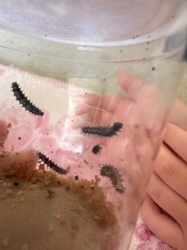
Painted Lady Caterpillar Identification Guide
A dark, spiny caterpillar with yellow-green side stripes that spins loose silk webbing over thistle and mallow leaves.
Read the full Painted Lady Caterpillar encyclopedia entry →Key Visual Features
The painted lady caterpillar grows to about 1.25 to 1.5 inches long and has a mottled, spiky appearance.
- Color: Base color mottled black, dark brown, or gray, sometimes with a purplish tint
- Stripes: One or more pale yellow-green stripes run lengthwise along the sides, broken by the dark mottling
- Spines: Rows of branching black spines cover the body, giving it a bristly, textured look rather than a smooth surface
- Head: Small, dark, and often held tucked close to the body
- Body shape: Slender and tapered, less bulky than many spiny caterpillars
- Legs: Three pairs of small true legs near the head and several pairs of prolegs along the rear half of the body
Where and When You'll See It
Painted lady caterpillars feed on a wide variety of plants, with thistle being a favorite, along with mallow, hollyhock, and various other low-growing plants. A telltale sign of their presence is a loose, messy silk webbing drawn over a leaf or shoot tip, inside which the caterpillar shelters while feeding. They are found from spring through fall across a very broad range, since the painted lady butterfly is one of the most widely distributed butterfly species in the world.
Similar-Looking Bugs
- American lady caterpillar: Very similar mottled, spiny appearance, but tends to feed on everlasting and pussytoes plants and constructs a similar but slightly different silk shelter; ranges and host plants can help distinguish the two
- Buckeye caterpillar: Also dark and spiny but has more distinct blue-based spines and orange markings near the head, along with a preference for plantain and snapdragon-family plants
- Gulf fritillary caterpillar: Bright orange body with black spines rather than the dark mottled color of the painted lady caterpillar
Quick ID Checklist
- Dark, mottled body with branching black spines
- Pale yellow-green stripe along the sides
- Found inside loose silk webbing on leaves
- Common on thistle, mallow, and hollyhock
- Present from spring through fall across a wide range
Frequently asked questions
How do I identify a painted lady caterpillar?
Look for a dark, mottled caterpillar covered in branching black spines with a pale yellow-green stripe along its sides, often found sheltering inside loose silk webbing on a leaf.
What plants attract painted lady caterpillars?
Thistle is a favorite host, along with mallow, hollyhock, and several other common low-growing plants.
Why does a painted lady caterpillar spin webbing on leaves?
It draws loose silk over a leaf or shoot tip to create a shelter it feeds within, which is often the first clue of its presence before the caterpillar itself is spotted.
How is the painted lady caterpillar different from the gulf fritillary caterpillar?
The painted lady caterpillar has a dark, mottled body with a pale stripe, while the gulf fritillary caterpillar is bright orange with black spines and no dark mottling.
Painted Lady Caterpillar identified by the community
Recent Painted Lady Caterpillar finds identified with Bug Identifier.