
Periodical Cicada Identification Guide
Recognize periodical cicadas by their black bodies, striking red eyes, and mass emergence in the same year after 13 or 17 years underground.
Read the full Periodical Cicada encyclopedia entry →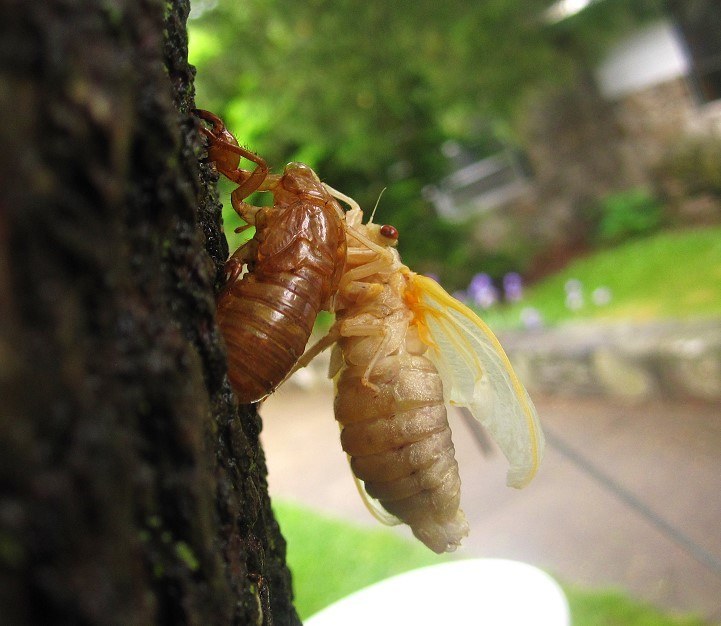
Key Visual Features
Periodical cicadas stand out among cicadas for their coloring and their remarkable, synchronized emergence pattern.
- Body color: Black body with an overall darker appearance than most other cicada species.
- Eyes: Bright red to orange-red eyes, one of the most distinctive and easily spotted features.
- Wings: Clear, transparent wings with bold orange veins running through them, held tent-like over the back.
- Size: Smaller than many annual cicada species, typically around 1 to 1.5 inches long.
- Legs: Orange-tinged legs that contrast with the dark body.
- Sound: Produces loud, distinctive buzzing and clicking choruses from treetops, often overlapping into a continuous drone when many individuals call together.
Where and When You'll See Them
Periodical cicadas live most of their lives underground as nymphs, feeding on fluids from tree roots for 13 or 17 years depending on the brood, before emerging together in massive, synchronized numbers within a narrow window in late spring, typically May into early June. Emergences are tied to specific geographic "broods," so in any given year they appear only in certain regions where a brood is due. Once above ground, adults are short-lived, active for only a few weeks in wooded areas and yards with mature trees before dying off.
Similar-Looking Bugs
- Dog-day (annual) cicada: Larger, with a green and black mottled body and dark—not red—eyes; also appears every summer rather than in a synchronized multi-year cycle.
- Other cicada species generally: Vary by size and color, but the combination of small size, black body, and bright red eyes is a strong indicator specifically of a periodical cicada.
- Locusts: A common but inaccurate nickname sometimes applied to periodical cicadas; true locusts are a type of grasshopper and look quite different, with long hind legs for jumping.
Quick ID Checklist
- Black body with striking red or orange-red eyes
- Clear wings with orange veins
- Smaller size than typical annual cicadas
- Appears in enormous synchronized numbers in late spring
- Found in wooded areas tied to a specific multi-year brood cycle
Frequently asked questions
How do I know if the cicadas I'm seeing are periodical or annual?
Check the eye color and timing—periodical cicadas have bright red eyes and emerge in huge synchronized numbers in late spring roughly every 13 or 17 years, while annual (dog-day) cicadas have dark eyes and appear every summer.
Why do periodical cicadas emerge in such large numbers at once?
Their entire brood develops underground on the same multi-year schedule, so when the time comes, huge numbers emerge within the same narrow window in a given region.
How long do periodical cicadas live after emerging?
Adults are active above ground for only a few weeks before their life cycle ends, a brief period compared to the many years spent underground as nymphs.
Are periodical cicadas the same as locusts?
No, that's a common misnomer—locusts are a type of grasshopper with jumping hind legs, while cicadas are a completely different group of insects with a distinct body shape and no jumping legs.