Pipevine Swallowtail Caterpillar Identification Guide
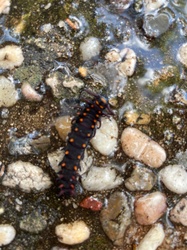
Recognize the pipevine swallowtail caterpillar by its dark red-black body, fleshy tubercles, and close ties to pipevine plants.
Read the full Pipevine Swallowtail Caterpillar encyclopedia entry →Key Visual Features
The pipevine swallowtail caterpillar is the larval stage of Battus philenor, a large dark butterfly.
- Size: grows to roughly 2 inches long at maturity.
- Color: body ranges from dark red-brown to nearly black, sometimes with a velvety appearance.
- Tubercles: covered in rows of soft, fleshy, finger-like projections (tubercles) rather than stiff spines; these are flexible and non-branching.
- Markings: some populations show small orange or reddish-orange dots at the base of certain tubercles, especially along the back.
- Body shape: cylindrical and thick-bodied, with the fleshy projections giving a slightly bristly silhouette without sharp spines.
Where and When You'd See It
- Found almost exclusively on pipevine (Aristolochia) plants, its required host.
- Larvae feed in groups when young, later becoming more solitary as they mature.
- Most commonly observed from spring through summer, with multiple generations possible in warmer regions.
- Found in gardens, woodland edges, and natural areas wherever pipevine grows.
Similar-Looking Bugs
- Black swallowtail caterpillar: green with black bands and yellow spots, very different in color from the dark, uniformly colored pipevine swallowtail larva.
- Spicebush swallowtail caterpillar: green with large eyespots on the thorax, lacking the fleshy tubercles and dark red-black coloring of the pipevine swallowtail.
- Gulf fritillary caterpillar: orange with black branching spines, distinguishable by its brighter color and spiny rather than fleshy projections.
Behavior Notes
Young larvae hatch from clusters of eggs and stay close together at first, moving in loose processions along vines and leaf edges as they feed. As they grow, the caterpillars disperse to feed individually and become bolder wanderers, sometimes seen crossing paths, sidewalks, or driveways in search of new pipevine growth once nearby leaves are stripped. When ready to pupate, mature larvae often travel some distance from the host plant to find a sheltered vertical surface.
Quick ID Checklist
- Dark red-brown to black body, sometimes velvety looking
- Rows of soft fleshy tubercles, not stiff spines
- Occasional small orange dots near tubercle bases
- Found feeding on pipevine plants
- Grows to about 2 inches long
Frequently asked questions
What plant is the pipevine swallowtail caterpillar almost always found on?
It feeds almost exclusively on pipevine (Aristolochia species), which is its required host plant.
Does the pipevine swallowtail caterpillar have sharp spines?
No, it has soft, fleshy, finger-like tubercles rather than stiff or branching spines.
What color is a mature pipevine swallowtail caterpillar?
It is typically dark red-brown to nearly black, sometimes with small orange dots near the tubercles.
Do pipevine swallowtail caterpillars live in groups?
Younger larvae often feed in groups, while older caterpillars tend to become more solitary.
Pipevine Swallowtail Caterpillar identified by the community
Recent Pipevine Swallowtail Caterpillar finds identified with Bug Identifier.