Planthopper Identification Guide
Learn to identify planthoppers by their wedge-shaped bodies, roof-held wings, and quick jumping or gliding escape.
Read the full Planthopper encyclopedia entry →Key Visual Features
Planthoppers form a large and varied group of sap-feeding insects, but most share a few recognizable traits.
- Size: Ranges from about 5mm to over 20mm depending on the species.
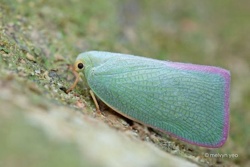
- Color: Highly variable, including green, brown, tan, gray, or boldly patterned forms; some species have waxy white filaments trailing from the body.
- Body shape: Typically wedge-shaped when viewed from above, with the head often narrower or more pointed than the wider hind body; some species have elongated, snout-like head projections.
- Wings: Two pairs held tent-like or roof-like over the back at rest, often with visible vein patterns.
- Legs: Strong hind legs suited for jumping, in addition to walking legs.
- Antennae: Short and often positioned below the eyes rather than prominently forward.
Where and When You'll See It
Planthoppers are found feeding on the stems, leaves, or bark of a wide range of host plants, including grasses, shrubs, and trees, using piercing-sucking mouthparts to draw sap. They occur in gardens, fields, forests, and wetlands depending on the species. Most are seen from spring through fall, often resting motionless on stems where their coloring and shape provide camouflage, then jumping or gliding away rapidly when disturbed.
Similar-Looking Bugs
- Leafhoppers: Generally slimmer and more streamlined, without the wedge-shaped or snout-like head some planthoppers show.
- Treehoppers: Have a distinctive enlarged pronotum forming a horn or thorn shape, which most planthoppers lack.
- Cicadas: Much larger overall, with prominent wide-set eyes and clear wings held tightly over the body rather than the planthopper's more varied wing posture.
Quick ID Checklist
- Wedge-shaped body, sometimes with an elongated or snout-like head
- Wings held tent- or roof-like over the back at rest
- Strong hind legs for jumping, quick to flee when approached
- Found feeding on stems and leaves of a wide variety of plants
- Coloring and pattern often camouflaged against the host plant
Frequently asked questions
What is the easiest way to recognize a planthopper?
Look for a wedge-shaped body with wings held tent-like over the back and strong hind legs for jumping; many species also have an elongated or pointed head.
How are planthoppers different from leafhoppers?
Planthoppers tend to have a more distinctly wedge-shaped or snouted head and bulkier body, while leafhoppers are generally slimmer and more streamlined overall.
Where do planthoppers usually live?
They live on the stems, leaves, or bark of host plants in gardens, fields, forests, and wetlands, wherever they can feed on plant sap.
Why do some planthoppers have white waxy filaments?
Certain species produce waxy strands from the abdomen as part of their natural appearance, which can also help with camouflage among plant fibers.
Planthopper identified by the community
Recent Planthopper finds identified with Bug Identifier.