
Poplar Hawk-Moth Identification Guide
Learn to identify this large gray sphinx moth by its unusual resting posture and hidden reddish hindwing patch.
Read the full Poplar Hawk-Moth encyclopedia entry →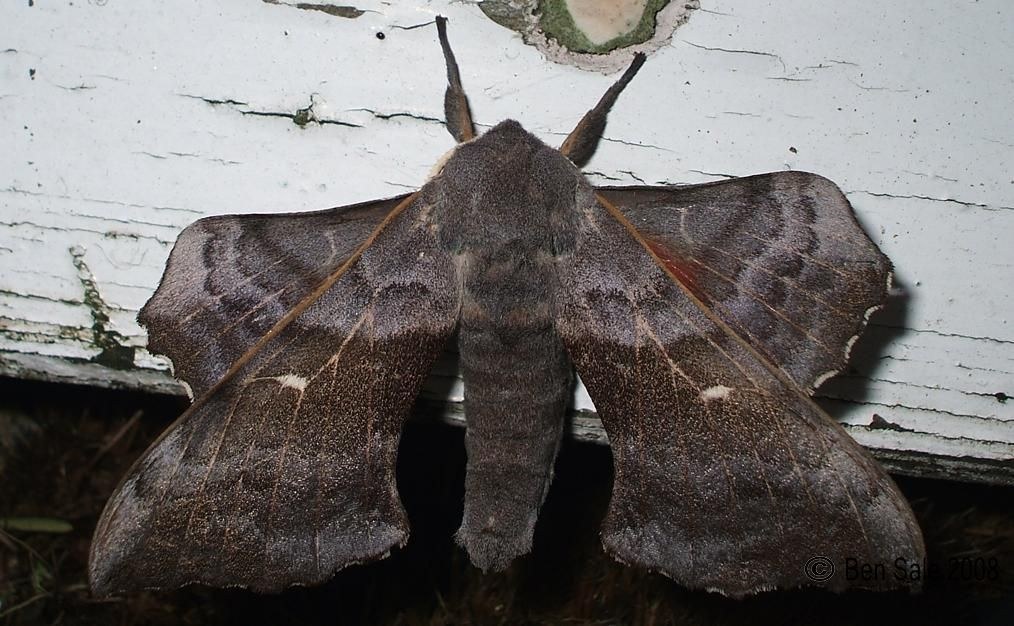
Key Visual Features
The Poplar Hawk-Moth (Laothoe populi) is one of the most commonly encountered large moths in Europe, with a wingspan of about 2.8 to 3.5 inches (7 to 9 cm). Identifying features include:
- Grayish to grayish-brown forewings with subtle mottling and faint darker wavy lines, giving a bark-like camouflage effect
- Smooth (not scalloped) wing margins, unlike some related hawk-moths
- A patch of soft rusty-orange or brick-red coloring at the base of the hindwing, normally hidden but flashed briefly if the moth is disturbed
- A stout, tapering gray body matching the forewing tone
- Short, thickened antennae typical of sphinx moths
- A highly distinctive resting posture: the hindwings are pushed forward so they project slightly ahead of the folded forewings, creating an unusual layered, almost "backwards" silhouette unlike most other moths
Where and When You'll See It
This species ranges across most of Europe and into western Asia, and is common in gardens, parks, hedgerows, riverbanks, and woodland edges wherever poplar, willow, or aspen trees are found, since these are the main caterpillar host plants. Adults fly at night, typically from May through August with one or two generations depending on region and climate. Being one of the larger and more frequently encountered moths, it is regularly attracted to outdoor lights and porch lamps, and during the day it can be found resting motionless on fences, tree trunks, or walls, where its gray, bark-like pattern provides effective camouflage.
Similar-Looking Moths
- Lime Hawk-Moth: Smaller, more olive-green to pink-tan in color, with distinctly scalloped (wavy) wing edges rather than the Poplar Hawk-Moth's smooth margins.
- Eyed Hawk-Moth: Similar grayish-brown coloring, but reveals large blue-black eyespots on the hindwings when threatened, a feature the Poplar Hawk-Moth lacks (it shows plain reddish patches instead).
- Privet Hawk-Moth: Much larger overall, with a boldly pink-and-black striped abdomen absent in the Poplar Hawk-Moth.
Quick ID Checklist
- Large grayish moth, wingspan roughly 2.8–3.5 inches
- Smooth wing edges with subtle bark-like mottling
- Hidden rusty-red patch at the hindwing base, visible only when disturbed
- Unusual resting posture with hindwings pushed forward of the forewings
- Common near poplar, willow, or aspen trees, often at lights at night
Frequently asked questions
What is the most distinctive way to recognize a resting Poplar Hawk-Moth?
Look at its unusual posture: the hindwings are pushed forward so they project slightly ahead of the folded forewings, creating a layered look that is different from how most other moths hold their wings.
Does the Poplar Hawk-Moth have any hidden color patches?
Yes, it has a soft rusty-orange or brick-red patch at the base of each hindwing that is normally concealed but can be briefly flashed into view if the moth is disturbed.
How can I tell a Poplar Hawk-Moth from an Eyed Hawk-Moth?
Both share grayish-brown coloring, but the Eyed Hawk-Moth reveals bold blue-black eyespots on its hindwings when disturbed, while the Poplar Hawk-Moth shows only plain reddish patches with no eyespots.
When and where is this moth most often seen?
It is active at night from roughly May through August and is commonly found near poplar, willow, or aspen trees, often turning up at porch lights or resting on walls and fences during the day.