
Powdered Dancer Identification Guide
A frosty, pale-blue damselfly whose dusty 'powdered' look makes it easy to pick out along rocky rivers.
Read the full Powdered Dancer encyclopedia entry →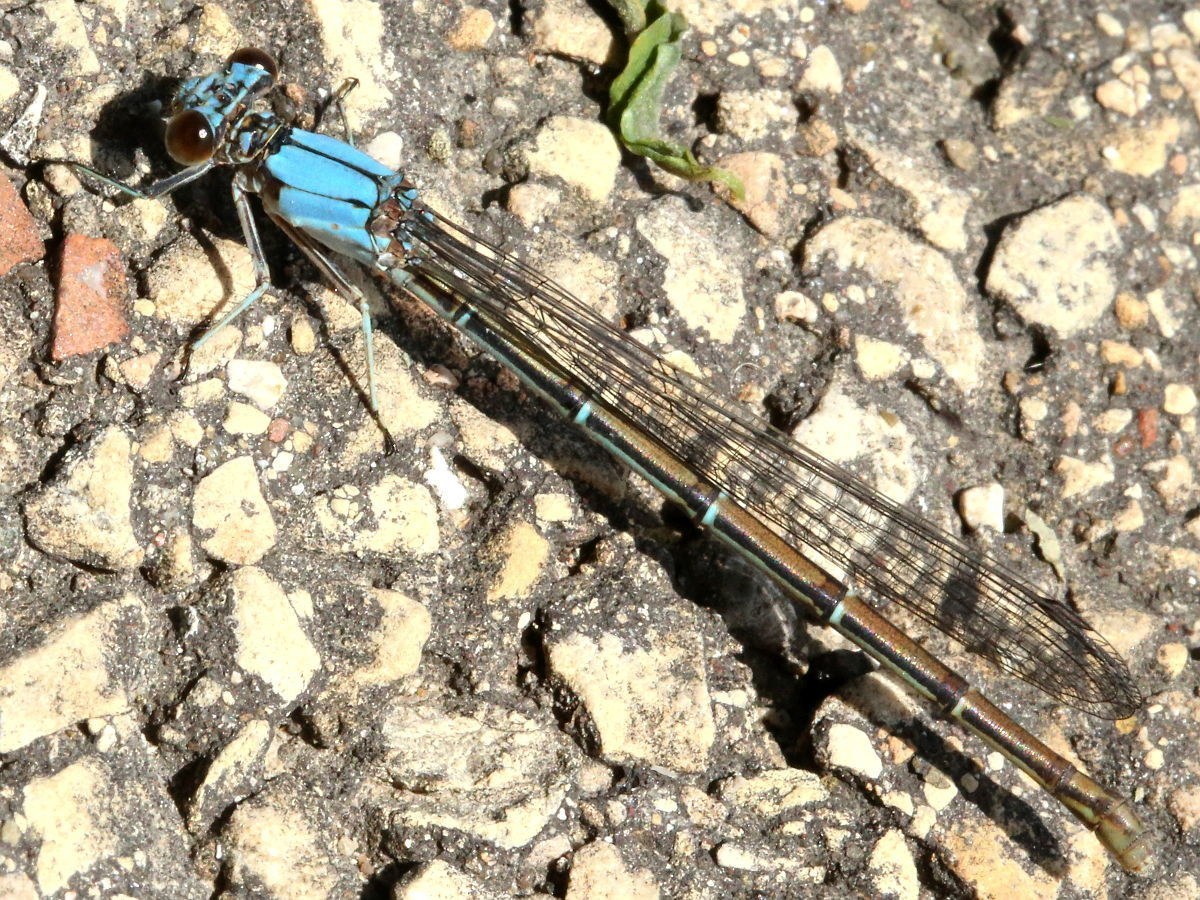
Key Visual Features
The Powdered Dancer is a medium-sized damselfly, roughly 1.2 to 1.5 inches (30 to 38 mm) long, named for the fine pale, waxy bloom (pruinosity) that develops on mature adults and gives them a frosted or "powdered" appearance.
- Color: Mature males develop a whitish-blue to pale gray-blue pruinose coating that can obscure the darker markings beneath, especially on the thorax and the base of the abdomen. Females and immatures are typically tan or pale brown without the heavy bloom.
- Body shape: Slender, elongated abdomen typical of dancers, with the last few segments often showing more contrasting dark and pale banding even in pruinose males.
- Wings: Clear, narrow wings held folded over the back at rest, each with a small dark pterostigma near the tip.
- Legs and antennae: Long, thin legs suited for gripping rocks and stems; short, bristle-like antennae typical of damselflies.
- Eyes: Two large, separated compound eyes positioned at the sides of the head, giving a dumbbell-shaped head outline.
Where and When You'd See It
Powdered Dancers are closely tied to rocky, flowing rivers and streams, where they perch on exposed boulders, cobble, and gravel bars in open sun. They are found widely across the eastern and central United States. The flight season runs from late spring into fall, with peak activity during the warm midday hours when adults bask on sunlit rocks near riffles and rapids.
Similar-Looking Species
- Blue-fronted Dancer: Shows blue restricted mainly to the front of the thorax and the tip of the abdomen, rather than an overall powdery bloom.
- Blue-ringed Dancer: Displays crisp pale rings on each abdominal segment instead of a diffuse frosted coating.
- Springwater Dancer: Has a cleaner turquoise tone without the chalky, powdered texture.
The heavy, matte pruinescence is the most reliable clue for Powdered Dancer, but because pruinosity increases with age, younger males can be trickier and may need a closer look at the underlying dark markings to confirm.
Quick ID Checklist
- Wings folded over the back when at rest
- Mature males show a frosty, pale-blue "powdered" bloom
- Found perched on sunlit rocks along fast-flowing rivers and streams
- Slender body with widely separated eyes
- Small dark pterostigma near each wingtip
Frequently asked questions
What does 'pruinose' mean for identifying this damselfly?
Pruinose refers to a waxy, powdery bloom that develops on the exoskeleton as some damselflies mature. In the Powdered Dancer, this bloom gives mature males a frosted pale-blue look that covers the darker base coloration.
Do young Powdered Dancers look different from adults?
Yes. Immature individuals and females lack the heavy powdery coating and instead show more of the underlying tan or brown coloring with visible dark markings, making them harder to distinguish from other dancer species.
Where exactly along a river should I look for them?
Focus on sunny, exposed rocks, cobble bars, and boulders near riffles or moving water, since Powdered Dancers prefer to perch low over flowing rather than still water.
How do I avoid confusing it with other blue dancers?
Look at the extent and texture of the blue coloring. A diffuse, chalky bloom covering much of the body points to Powdered Dancer, while sharply defined rings or patches point to other similar species.