
Privet Hawk-Moth Identification Guide
Identify Europe's largest resident hawk-moth by its bold pink-and-black striped abdomen and streamlined brown wings.
Read the full Privet Hawk-Moth encyclopedia entry →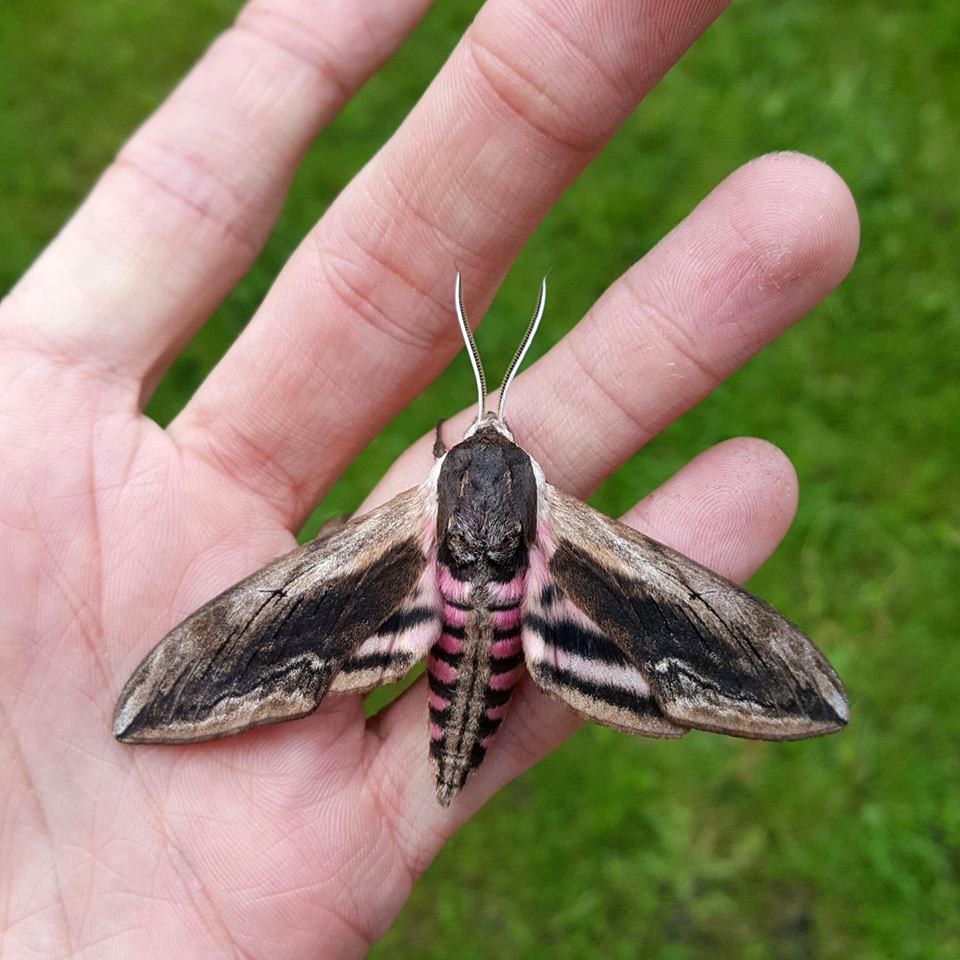
Key Visual Features
The Privet Hawk-Moth (Sphinx ligustri) is the largest native hawk-moth in Europe, with an impressive wingspan of about 3.5 to 4.7 inches (9 to 12 cm). Look for:
- Long, narrow, streamlined forewings in shades of grayish-brown to warm brown, often with darker brown streaks or mottling running along the length of the wing
- A bold, unmistakable abdomen banded in alternating black and bright pink stripes, one of the clearest field marks for this species
- Pink-tinged hindwings crossed by dark bands, usually hidden beneath the forewings at rest
- A thick, torpedo-shaped body tapering toward the rear, built for fast, powerful flight
- Short, robust antennae typical of sphinx moths
- A long coiled proboscis used for feeding from deep tubular flowers while hovering
At rest, the wings are held tightly swept back against the body, forming a sleek, jet-like silhouette, with the pink-and-black abdomen often the easiest feature to spot at a glance.
Where and When You'll See It
This species is found across much of Europe and into western Asia, favoring gardens, hedgerows, woodland edges, and parks wherever privet, lilac, or ash grow, since these serve as the main caterpillar host plants. Adults are strictly nocturnal, flying from late spring into summer, typically June and July. They are strong fliers and are regularly drawn to outdoor lighting after dark. Adults also feed at dusk, hovering in front of scented, tubular flowers such as honeysuckle in a manner similar to a hummingbird.
Similar-Looking Moths
- Oleander Hawk-Moth: Also large and streamlined but patterned in swirling green and pink camouflage rather than plain brown wings with a pink-black abdomen.
- Poplar Hawk-Moth: Noticeably smaller, uniformly gray, and lacks the bold pink-and-black abdominal stripes.
- Convolvulus Hawk-Moth: Similar large size and grayish wings, but has a gray-and-pink banded abdomen with a more mottled forewing pattern and an especially long proboscis; close comparison of abdomen banding and overall wing tone helps separate the two.
Quick ID Checklist
- Very large hawk-moth, wingspan 3.5–4.7 inches
- Grayish-brown, streamlined forewings with subtle darker streaking
- Bold black-and-pink banded abdomen, the clearest identifying feature
- Sleek, swept-back resting posture
- Active at night in early summer, often hovering at flowers like honeysuckle
Frequently asked questions
What is the single best feature for identifying a Privet Hawk-Moth?
Its abdomen banded in bold alternating black and bright pink stripes is the most distinctive and reliable identifying feature, clearly separating it from most other brownish hawk-moths.
Is the Privet Hawk-Moth the largest hawk-moth in Europe?
It is the largest hawk-moth species that breeds natively in Europe, though occasional migrant species from warmer regions can sometimes rival it in size.
When is the best time to see an adult Privet Hawk-Moth?
Adults are active at night during early summer, typically June and July, and are most often noticed near outdoor lights or hovering at fragrant flowers at dusk.
What plants should I check for Privet Hawk-Moth activity?
Look near privet, lilac, or ash, since these are the primary host plants that caterpillars feed on before the adults emerge.