
Puss Moth Identification Guide
Identify this fuzzy gray-white European moth and its bizarre, mask-faced green caterpillar.
Read the full Puss Moth encyclopedia entry →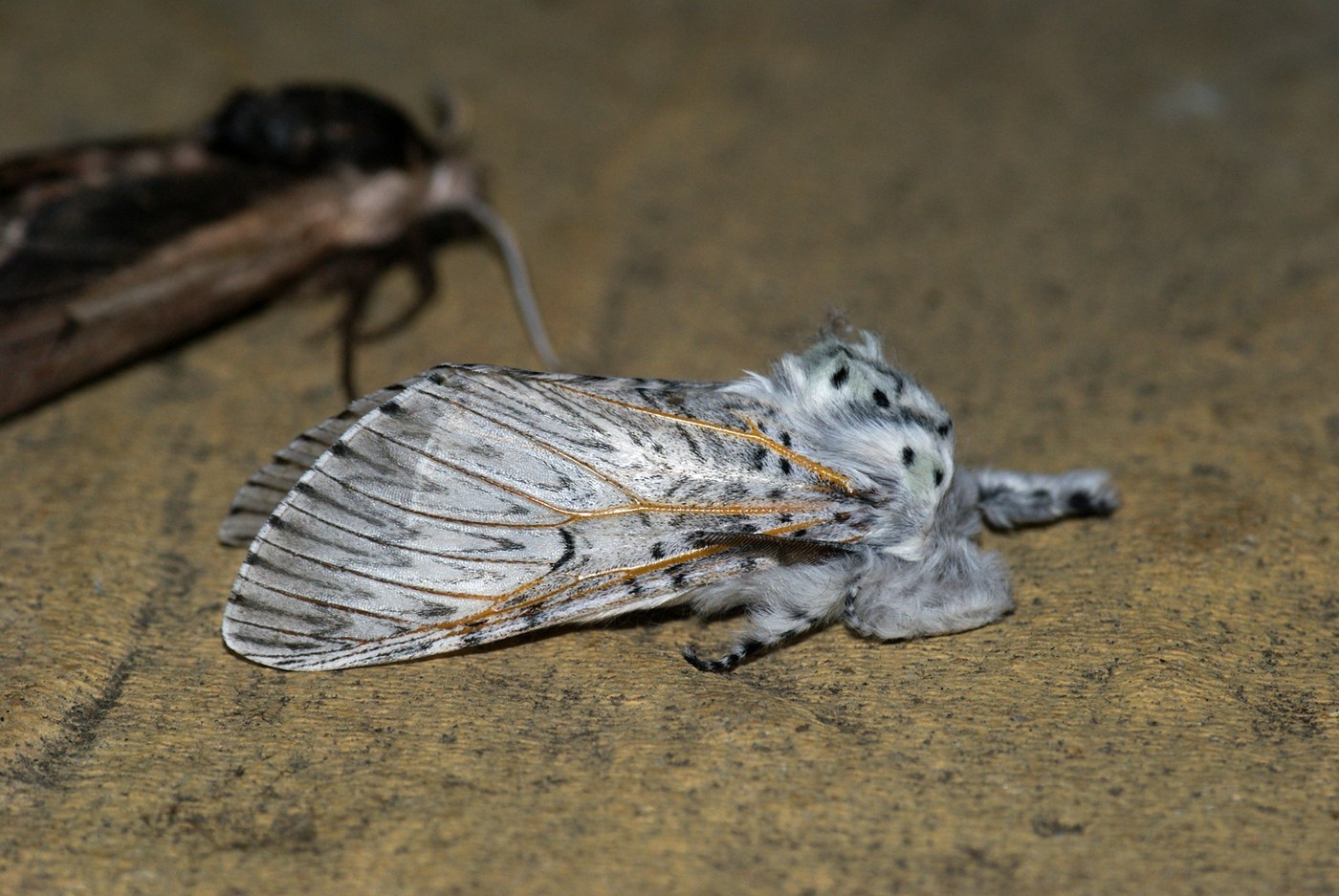
Key Visual Features
The Puss Moth (Cerura vinula) is a stout, fluffy moth native to Europe and parts of Asia, with a wingspan of about 2.4 to 3.1 inches (6 to 8 cm). Distinguishing features include:
- Pale gray to whitish-gray wings marked with fine, wavy dark gray or black lines and speckles
- A dense covering of soft, "fur"-like scales on the thorax and legs, giving the moth its plush, cat-like appearance (hence the common name)
- Thick, hairy front legs that are often held forward when the moth is at rest
- Broad, rounded wings held tent-like or flat over the body when perched
- Comb-like (feathery) antennae, more strongly feathered in males than females
- A generally robust, heavy-bodied build compared to slimmer moth species
The caterpillar is unmistakable and often noticed before the adult: bright green with a large, dark brown or purplish saddle-shaped marking across its back, a flattened "face" pattern near the head end, and two long, thin whip-like tails at the rear that can be raised when disturbed.
Where and When You'll See It
Puss Moths are found throughout much of Europe and temperate Asia, in woodlands, hedgerows, parks, and gardens wherever willow and poplar trees grow, as these are the caterpillars' main host plants. Adults fly at night during a single generation in late spring to early summer, roughly May through June, and are occasionally drawn to outdoor lights. The caterpillars are more frequently observed than the adults, feeding openly on willow or poplar leaves from summer into early autumn.
Similar-Looking Moths
- Sallow Kitten and Poplar Kitten Moths: Close relatives in the same genus group, these are noticeably smaller and less heavily built than the Puss Moth, with finer wing markings.
- Other Notodontidae ("prominent") moths: Share the fuzzy, tufted look but generally lack the Puss Moth's larger size and dense gray fur-like covering.
- Common Emerald or pale geometer moths: Some pale gray moths can look superficially similar at a glance, but they have slender bodies and lack the Puss Moth's furry, robust thorax and legs.
Quick ID Checklist
- Pale gray wings with fine wavy dark lines, wingspan around 2.4–3.1 inches
- Thick, plush, fur-like body and legs
- Feathery antennae, more pronounced in males
- Caterpillar: bright green with a brown saddle marking and twin tail filaments
- Seen at night in late spring near willow or poplar trees
Frequently asked questions
Why is it called the Puss Moth?
The common name comes from the adult moth's dense, soft, fur-like covering of scales, which gives it a plush, cat-like texture and appearance.
How can I recognize a Puss Moth caterpillar versus the adult?
The caterpillar looks nothing like the adult: it is bright green with a brown saddle marking and two thin tail filaments, while the adult is a fuzzy gray-white moth with fine dark wing lines.
What plants should I check if I want to find a Puss Moth caterpillar?
Look on willow and poplar trees, since these are the primary host plants where the caterpillars feed and are most commonly found from summer into early autumn.
When is the best time of year to see an adult Puss Moth?
Adults fly during a single generation in late spring to early summer, roughly May through June, and are most likely to be seen at night, sometimes near outdoor lighting.