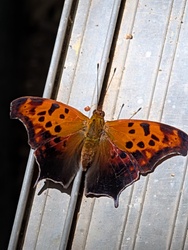
Question Mark Butterfly Identification Guide
Spot the question mark butterfly by the tiny silver question-mark symbol hidden on its underwing.
Read the full Question Mark Butterfly encyclopedia entry →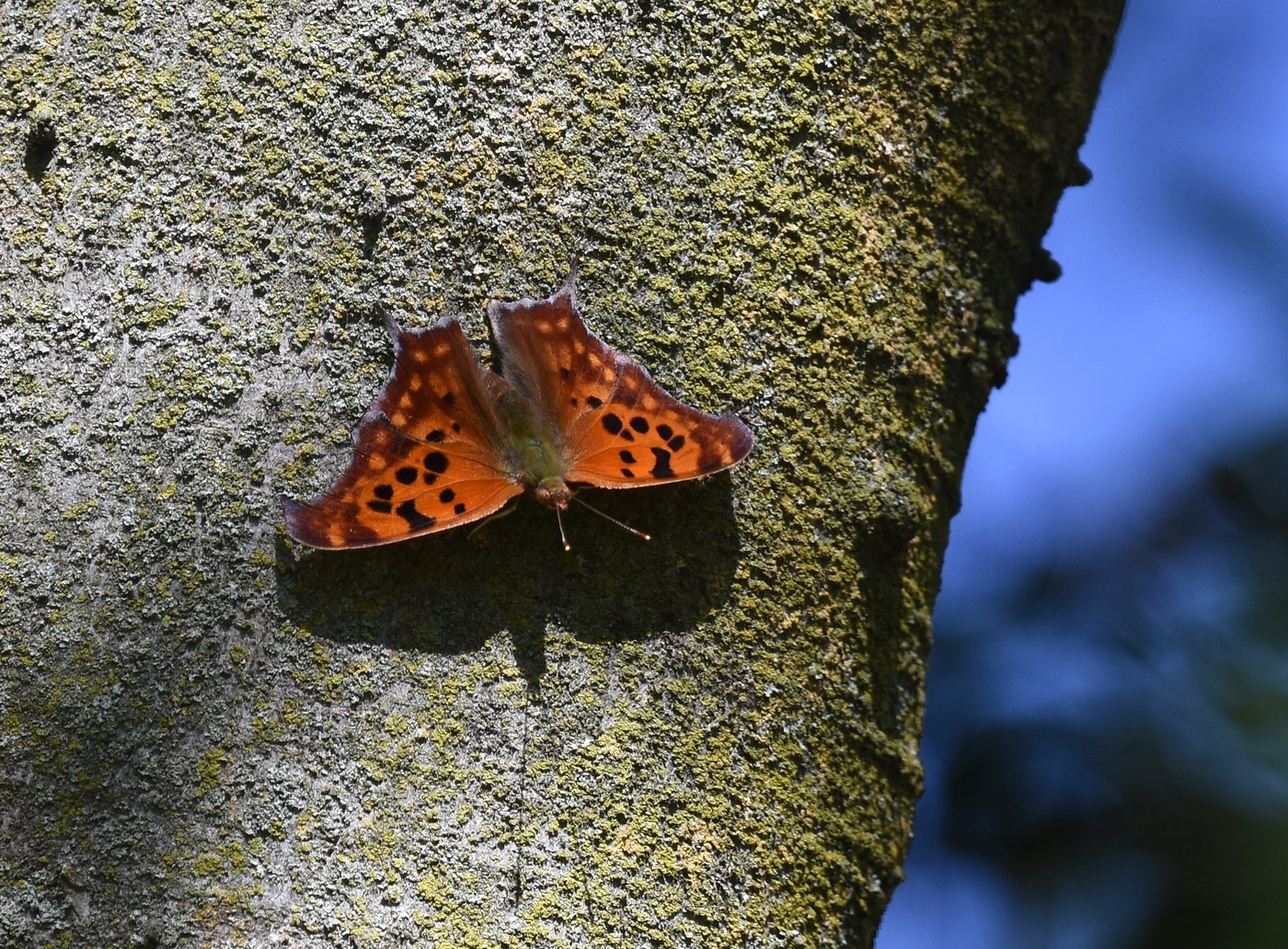
Key Visual Features
The question mark butterfly (Polygonia interrogationis) is one of the larger anglewing butterflies, named for a small punctuation-like mark on its underside.
- Size: Wingspan of about 2 1/4 to 3 inches (5.5–7.5 cm), among the larger anglewings.
- Color: Upper wings are orange with scattered dark spots, and the hindwing often has a broad dark patch near the body.
- Wing shape: Deeply angular and ragged wing margins with pronounced notches, plus an elongated, hooked tip on the forewing that is more pronounced than in the eastern comma.
- Underside: Mottled brown-gray bark-like pattern; the diagnostic mark is a silvery comma shape paired with a separate silvery dot positioned to resemble a question mark ("?") on the hindwing underside.
- Seasonal forms: Summer-form individuals tend to have more black on the hindwing above, while the fall/overwintering form is more uniformly orange with violet-tinged wing edges when freshly emerged.
- Antennae: Clubbed antennae typical of anglewing butterflies.
Where and When You'll See One
Question mark butterflies are found across the eastern and central United States and into southern Canada, in woodlands, forest edges, parks, and shaded yards, often near host plants such as elm, hackberry, and nettle. Like the eastern comma, they favor tree sap, rotting fruit, and damp soil over flower nectar, and are often seen basking with wings open on tree trunks or bare ground. Adults overwinter as adults, so they can be spotted on mild days in very early spring or late fall, in addition to the main summer flight period.
Similar-Looking Bugs
- Eastern comma: Smaller overall, with a shorter forewing hook and an underside mark that is only a comma shape without the accompanying dot.
- Gray comma: Smaller, grayer, and less strongly marked than the question mark butterfly.
- Mourning cloak: Shares dark, ragged-edged wings but has a wide pale cream border rather than the question mark's scattered dark spots on an orange background.
Quick ID Checklist
- Large orange wings with scattered black spots and deep angular notches
- Elongated, hooked forewing tip
- Mottled bark-like underside for camouflage
- Silvery comma-plus-dot mark on the hindwing underside resembling a "?"
- Attracted to tree sap and rotting fruit rather than flowers
Frequently asked questions
Where does the question mark butterfly get its name?
The underside of the hindwing has a small silvery comma-shaped mark paired with a separate silvery dot, and together they resemble a question mark symbol.
How can I tell a question mark butterfly from an eastern comma?
Look at the underside marking and forewing shape: the question mark has both a comma and a dot together (versus just a comma) and typically has a longer, more hooked forewing tip and larger overall size.
What does the question mark butterfly eat as an adult?
Adults are most often found feeding at tree sap, fermenting fruit, and damp soil rather than visiting flowers for nectar, which is a useful behavioral clue when searching for one.
Can question mark butterflies be seen in winter?
They overwinter as adults in sheltered spots like bark crevices, so they can occasionally be seen flying on unusually warm days in late fall or very early spring, in addition to the main summer season.
Question Mark Butterfly identified by the community
Recent Question Mark Butterfly finds identified with Bug Identifier.