Red-legged Grasshopper Identification Guide
Spot one of North America's most widespread grasshoppers by its reddish lower hind legs.
Read the full Red-legged Grasshopper encyclopedia entry →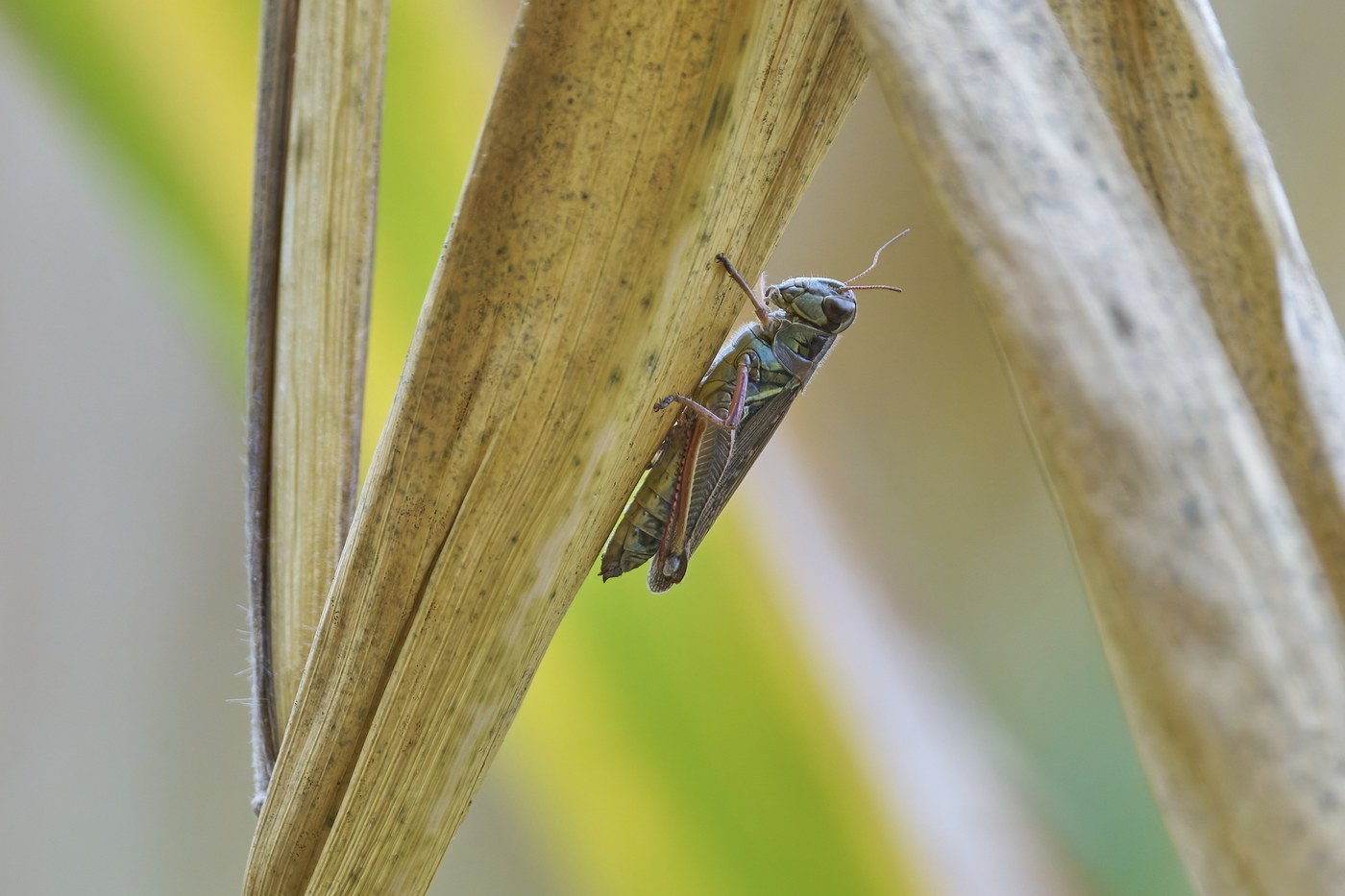
Key Visual Features
The red-legged grasshopper (Melanoplus femurrubrum) is a medium-sized grasshopper, generally 0.75 to 1.25 inches long, and one of the most widely distributed species in North America.
- Color: Brown to olive-brown body on top, often with a yellow-green underside.
- Legs: The defining feature is the reddish tibiae (lower leg segments) on the hind legs, contrasting with a duller femur (thigh) above it.
- Body shape: Moderate, slightly tapered body with a rounded head.
- Wings: Wings typically extend to or just past the tip of the abdomen, allowing functional flight.
- Antennae: Short and thickened, typical of field grasshoppers.
- Face and pronotum: A relatively narrow face profile and a pronotum with a faint pale stripe along the ridge in some individuals, though this is less pronounced than the bold stripes seen in related species.
Where and When You'll See It
This species is extremely widespread, found in grasslands, pastures, roadsides, gardens, and open fields across nearly all of North America. It's active from early summer through fall, often one of the last grasshoppers still visible in late autumn, tolerating cooler temperatures better than many other species. Look for it perched low in grass or hopping across open, sunny ground during the day, frequently mixed in with several other common field grasshopper species in the same patch of habitat.
Similar-Looking Species
- Differential grasshopper: Larger overall with yellow (not red) hind legs marked by a bold black herringbone pattern on the femur.
- Two-striped grasshopper: Larger, with a pair of pale cream stripes running down the back, a feature the red-legged grasshopper lacks.
- American grasshopper: Larger and more elongated, with speckled wings and a pale central stripe, lacking the reddish tibiae.
Quick ID Checklist
- Medium size, brown to olive body
- Reddish tibiae (lower hind leg segments) — the key diagnostic feature
- Yellow-green underside
- Wings reaching close to the abdomen tip
- Common in grasslands, gardens, and roadsides nearly continent-wide, summer into fall
Frequently asked questions
What is the easiest way to identify a red-legged grasshopper?
Check the lower part of the hind legs — a reddish tibia paired with a duller brown femur is the clearest identifying feature of this species.
How big is a red-legged grasshopper?
Adults typically measure about 0.75 to 1.25 inches long, making them a medium-sized grasshopper.
How can I tell it apart from a differential grasshopper?
The differential grasshopper is larger with yellow hind legs marked by a bold black chevron pattern, while the red-legged grasshopper has distinctly reddish lower leg segments and no chevron pattern.
Where and when are red-legged grasshoppers most common?
They're found nearly throughout North America in grasslands, gardens, and open fields, and remain active from early summer well into fall.
Red-legged Grasshopper identified by the community
Recent Red-legged Grasshopper finds identified with Bug Identifier.