Red Wood Ant Identification Guide
Spot the red wood ant by its reddish-orange thorax, dark abdomen, and towering mound nests of pine needles.
Read the full Red Wood Ant encyclopedia entry →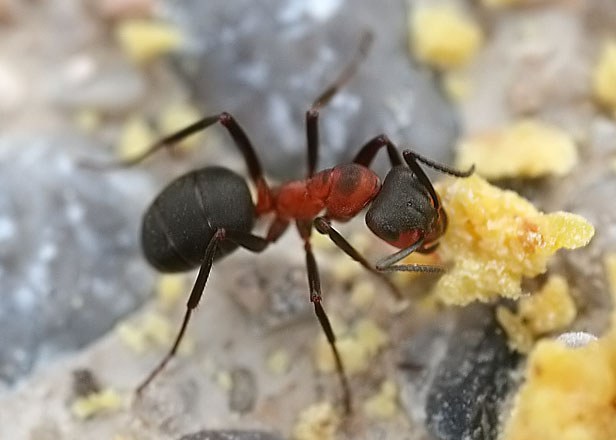
Key Visual Features
Red wood ants (Formica rufa group) are large, distinctive forest-dwelling ants.
- Size: Workers are relatively large for ants, typically 6-9mm long.
- Color: A reddish-orange head and thorax contrast with a darker brown-black abdomen, giving a two-toned appearance.
- Body shape: Robust build with a single-node petiole, large compound eyes, and strong mandibles.
- Antennae: Elbowed, held forward while foraging.
- Legs: Long and sturdy, suited to climbing tree trunks and covering long foraging trails.
- Wings: Present only on reproductive queens and males during their brief mating flight period.
Where and When You'll See It
Red wood ants are strongly associated with coniferous and mixed woodlands. Their most recognizable feature is their nest: a large dome-shaped mound built from pine needles, twigs, and other plant debris, sometimes reaching over a meter tall and wide. Workers create well-worn foraging trails radiating out from the mound, often climbing tree trunks to tend aphids for honeydew or to hunt other insects. They are active from spring through autumn, with the busiest foraging on warm, sunny days.
Similar-Looking Bugs
- Other Formica species: Several related wood ants share the reddish-orange and black coloring; the large communal needle mound is a strong clue you're looking at a red wood ant colony rather than a solitary-nesting relative.
- Carpenter ants: Uniformly dark rather than two-toned, and they nest in wood rather than building surface mounds of debris.
- Fire ants: Smaller overall, more uniformly reddish, and do not build large needle-and-twig dome mounds.
Quick ID Checklist
- Reddish-orange head and thorax paired with a darker abdomen
- Workers around 6-9mm, notably large for an ant
- Large dome-shaped mound nest built from pine needles and twigs
- Found in coniferous or mixed woodland habitat
- Visible foraging trails climbing tree trunks
Frequently asked questions
What makes red wood ants easy to identify compared to other ants?
Their combination of large size, two-toned reddish-orange and black coloring, and the towering dome-shaped needle mound they build makes them fairly distinctive among woodland ants.
Where are red wood ant mounds usually found?
They are typically built in coniferous or mixed forests, often at the base of a tree or in a sunny clearing within woodland.
Do red wood ants build one mound or several?
Colonies can be large and sometimes form interconnected networks of several mounds linked by foraging trails within the same woodland.
How can I tell red wood ants from carpenter ants?
Red wood ants have a distinct reddish-orange thorax against a dark abdomen and build surface mounds of debris, while carpenter ants are more uniformly dark and nest inside wood rather than in an above-ground mound.
Red Wood Ant identified by the community
Recent Red Wood Ant finds identified with Bug Identifier.