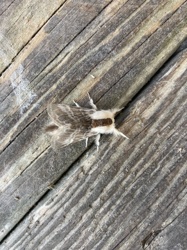
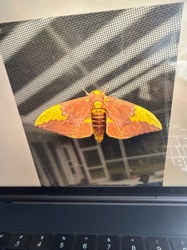
Regal Moth (Hickory Horned Devil) Identification Guide
Spot this striking silk moth by its gray-orange wings with yellow spots, and recognize its famously large, horned caterpillar stage.
Read the full Regal Moth (Hickory Horned Devil) encyclopedia entry →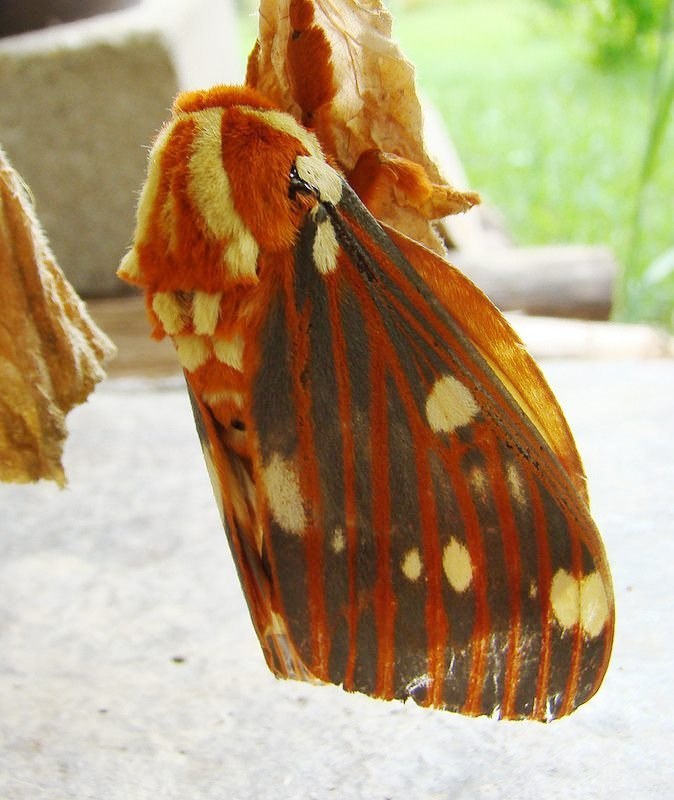
Key Visual Features
The Regal Moth is a massive North American silk moth, with adults reaching a wingspan of 4 to 6 inches (10 to 15 cm), among the largest moths on the continent. Look for:
- Grayish to olive-orange forewings marked with bold yellow-orange spots and streaks along the veins
- Reddish-orange to rust-colored veins that stand out against the gray wing background
- Hindwings that are more solid orange with scattered yellow spots
- A thick, robust orange-and-gray body with a fuzzy texture
- Feathery, bipectinate antennae, larger and more comb-like in males
- No prominent eyespots, unlike many other giant silk moths
The caterpillar form, known as the Hickory Horned Devil, is equally distinctive: an enormous blue-green to teal caterpillar up to 5–6 inches long, covered in rows of black-tipped orange "horns" (spines) near the head, with smaller black spines running down the back and sides.
Where and When You'll See It
Regal Moths are found through the eastern and southeastern United States, favoring deciduous forests with hickory, walnut, sumac, sweetgum, and persimmon — the preferred host plants for the caterpillars. Adults fly at night in summer, generally June through August, and are attracted to lights. Because adults do not feed and live only a short time, sightings of the winged form are less common than sightings of the large caterpillar, which is often noticed crossing roads, sidewalks, or wandering in late summer as it searches for a place to pupate underground.
Similar-Looking Moths
- Imperial Moth: Softer yellow wings mottled with purple-brown rather than the Regal Moth's gray wings with bold yellow spots and orange veins.
- Royal Walnut Moth: This is simply another common name for the same species (Citheronia regalis), not a different moth.
- Other large caterpillars: The Hickory Horned Devil's size, teal-blue color, and prominent curved orange horns near the head make it very difficult to confuse with other North American caterpillars once these features are noted.
Quick ID Checklist
- Adult: 4–6 inch wingspan, gray-orange wings, bold yellow spots, orange veins
- No eyespots on the wings
- Feathery antennae, more developed in males
- Caterpillar: huge, blue-green body with long orange, black-tipped horns behind the head
- Adults active at night in summer, drawn to lights; caterpillars seen wandering in late summer
Frequently asked questions
Is the Hickory Horned Devil a different species from the Regal Moth?
No, the Hickory Horned Devil is simply the caterpillar (larval) stage of the Regal Moth; both names refer to the same species at different points in its life cycle.
How do I tell a Regal Moth from an Imperial Moth?
Regal Moths have grayish wings with bold yellow spots and rusty-orange veins, while Imperial Moths have softer yellow wings mottled with purple-brown patches and no strong vein pattern.
Why is the caterpillar so much larger than most other caterpillars I see?
Regal Moth caterpillars grow unusually large because the species itself is one of the biggest moths in North America, and the larval stage needs to store enough energy to fuel a short-lived, non-feeding adult.
When are Hickory Horned Devil caterpillars most often spotted?
They are most commonly seen in late summer, often August through September, when fully grown caterpillars leave their host trees and wander on the ground looking for a spot to burrow and pupate.
Regal Moth (Hickory Horned Devil) identified by the community
Recent Regal Moth (Hickory Horned Devil) finds identified with Bug Identifier.