
Sacred Scarab Identification Guide
Identify this dung beetle by its matte black shell, toothed head, and spade-like front legs built for rolling.
Read the full Sacred Scarab encyclopedia entry →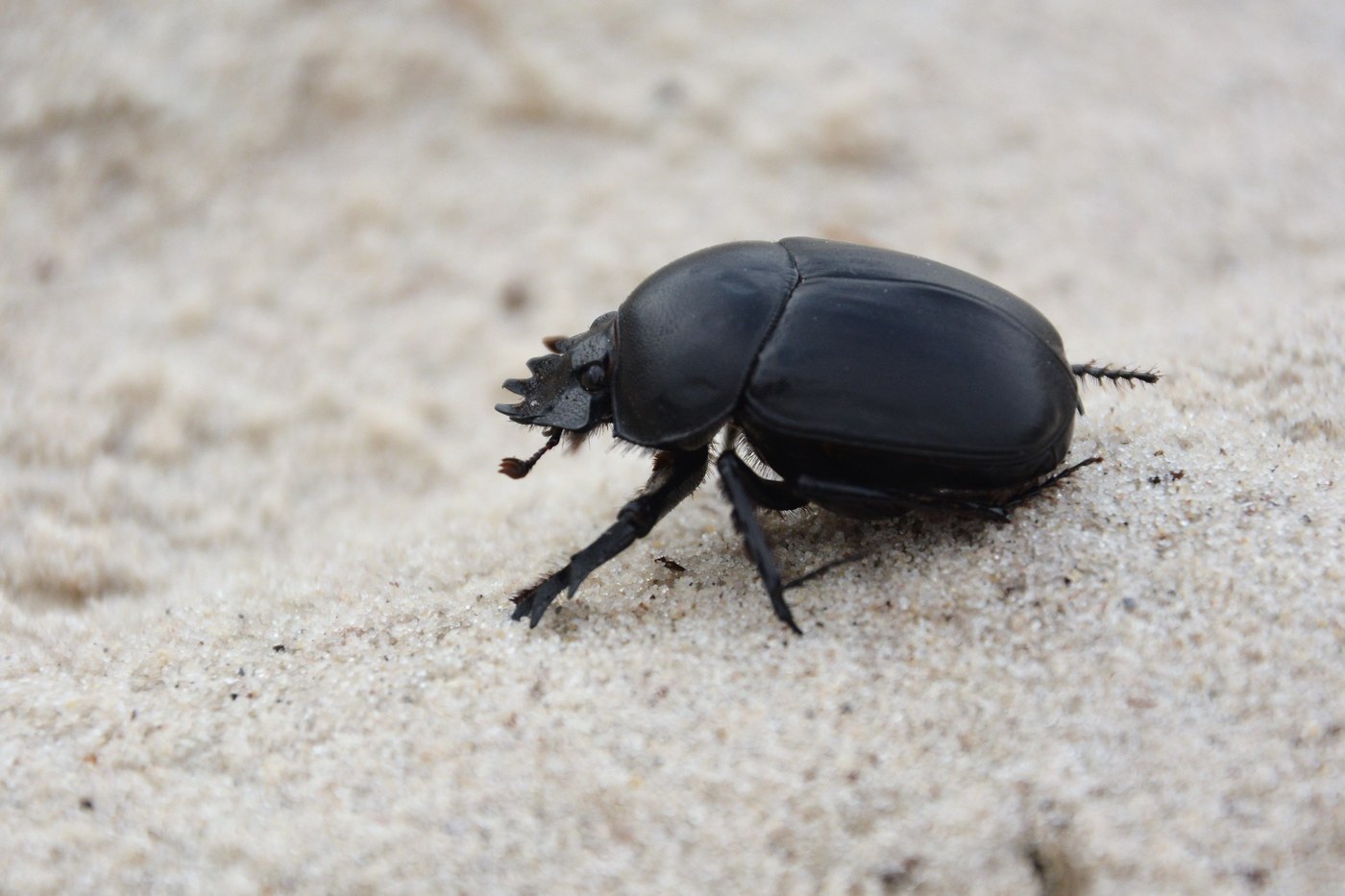
Key Visual Features
The sacred scarab (Scarabaeus sacer) is a robust dung beetle recognized by several distinctive features:
- Size: A stocky, rounded body about 1-1.6 inches (25-40mm) long.
- Coloring: A uniform matte black shell, generally without the metallic sheen seen in many other scarab species.
- Head: A broad, flattened head edged with several tooth-like projections (on the clypeus) used for shaping and shifting material.
- Front legs: Broad, flattened, spade-like front legs adapted for digging.
- Hind legs: Notably long and curved, positioned to grip and maneuver rounded material while walking backward.
Where and When You'll See One
Sacred scarabs are native to the Mediterranean region, North Africa, and parts of the Middle East. They favor open grassland, pasture, and scrubland habitats, especially areas where grazing animals are present. Adults are active during the day in warm months and are most often spotted on the ground, moving material with their distinctive rolling and pushing motion using their long hind legs.
Similar-Looking Bugs
- Other black dung beetles (various Scarabaeus and related genera): Many share the same matte black coloring and rounded body; the specific arrangement and number of tooth-like projections on the head, along with leg proportions, help separate closely related species.
- Rhinoceros beetles: Also large and dark-bodied, but have a prominent horn on the head or thorax, which the sacred scarab lacks, along with a smoother, more domed body rather than the scarab's flattened digging legs.
- Ground beetles: Some large dark ground beetles can appear superficially similar, but have a flatter, more elongated body and thread-like antennae rather than the scarab's lamellate, club-tipped antennae.
Behavior Notes
Sacred scarabs are most easily spotted while actively shaping and moving material along the ground using their toothed head and spade-like front legs, a behavior that is one of the clearest ways to confirm identification in the field. They tend to move with a determined, low-to-the-ground gait and are generally active during the warmest part of the day in open, sunlit habitat.
Quick ID Checklist
- Uniform matte black body, about 1-1.6 inches long
- Flattened head with several tooth-like projections along the front edge
- Broad, spade-like front legs for digging
- Long, curved hind legs used for rolling and maneuvering material
- Found in open grassland and pasture habitats in the Mediterranean region
Frequently asked questions
What is the most distinctive feature of the sacred scarab's head?
It has a broad, flattened head edged with several tooth-like projections, which distinguish it from smoother-headed beetles and help with identification at close range.
Why are the hind legs of a sacred scarab so long and curved?
The elongated, curved hind legs are adapted for gripping and maneuvering rounded material while the beetle moves, a distinctive structural feature within the dung beetle group.
Where in the world is the sacred scarab found?
It is native to the Mediterranean region, North Africa, and parts of the Middle East, typically in open grassland or pasture habitats near grazing animals.
Does the sacred scarab have a shiny metallic shell like other scarabs?
No, unlike many colorful scarab relatives, the sacred scarab has a uniform matte black shell without a metallic sheen.