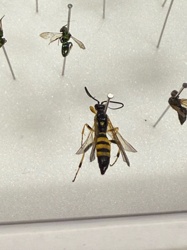
Sawfly Identification Guide
Learn how to identify a sawfly and its caterpillar-like larvae, which are often mistaken for moth or butterfly caterpillars.
Read the full Sawfly encyclopedia entry →Key Visual Features
Sawflies are primitive relatives of wasps and bees, named for the saw-like egg-laying organ of the female, but it's usually their larvae that catch attention.
- Adult size: Small to medium, typically 0.2-0.8 inch (5-20 mm) long.
- Adult body shape: Unlike wasps, sawflies lack a narrow "wasp waist" — the abdomen joins broadly to the thorax, giving a more thick-set profile.
- Adult coloring: Varies by species, often black, brown, or metallic, sometimes with yellow or orange markings.
- Adult wings: Two pairs of clear, membranous wings held flat or tent-like over the back at rest.
- Larvae: Caterpillar-like, with a distinct head capsule, a soft cylindrical body, and rows of small bumps or spines depending on species; coloring ranges from green to gray with spots or stripes.
- Leg count on larvae: A key ID feature — sawfly larvae have six or more pairs of fleshy prolegs on the abdomen (versus five or fewer pairs on true caterpillars), plus three pairs of true legs near the head.
Where and When You'll See It
Sawfly larvae are most often seen from spring through summer feeding in groups along the edges of leaves on trees, shrubs, roses, or conifers. Many species feed side-by-side in a row, sometimes rearing up their hind ends in unison when disturbed. Adults are less commonly noticed, flying near host plants in spring, often resembling small wasps as they move about foliage to lay eggs.
Similar-Looking Bugs
- Moth/butterfly caterpillars: True caterpillars have five or fewer pairs of prolegs, while sawfly larvae have six or more pairs — the easiest way to distinguish them.
- Wasps: Adult sawflies lack the pinched, narrow waist that separates the thorax and abdomen in true wasps.
- Beetle grubs: Beetle larvae typically lack the prominent head capsule and leg pattern of sawfly larvae and often have a more C-shaped, grub-like body.
Quick ID Checklist
- Larvae resemble caterpillars but have six or more pairs of abdominal prolegs
- Larvae often feed in groups along leaf edges
- Adults have a thick waist with no wasp-like pinch
- Two pairs of clear wings on adults
- Group feeding with a synchronized rearing-up defensive posture in some species
Frequently asked questions
How do I tell a sawfly larva from a caterpillar?
Count the fleshy prolegs on the abdomen: sawfly larvae have six or more pairs, while moth and butterfly caterpillars have five pairs or fewer.
Why do sawfly larvae look like they're feeding together?
Many sawfly species lay eggs in clusters, and the larvae that hatch feed side by side along leaf edges, sometimes for weeks.
Is an adult sawfly a wasp?
It's a close relative but not a true wasp — sawflies lack the narrow, pinched waist found in wasps and instead have a broader connection between thorax and abdomen.
What do sawfly larvae do when disturbed?
Some species rear up their hind ends in unison as a group defensive display when a branch or leaf is touched.
Sawfly identified by the community
Recent Sawfly finds identified with Bug Identifier.