
Six-spot Burnet Moth Identification Guide
A day-flying moth with glossy blue-black wings marked by six vivid red spots, often seen clustered on flowers in open grassland.
Read the full Six-spot Burnet Moth encyclopedia entry →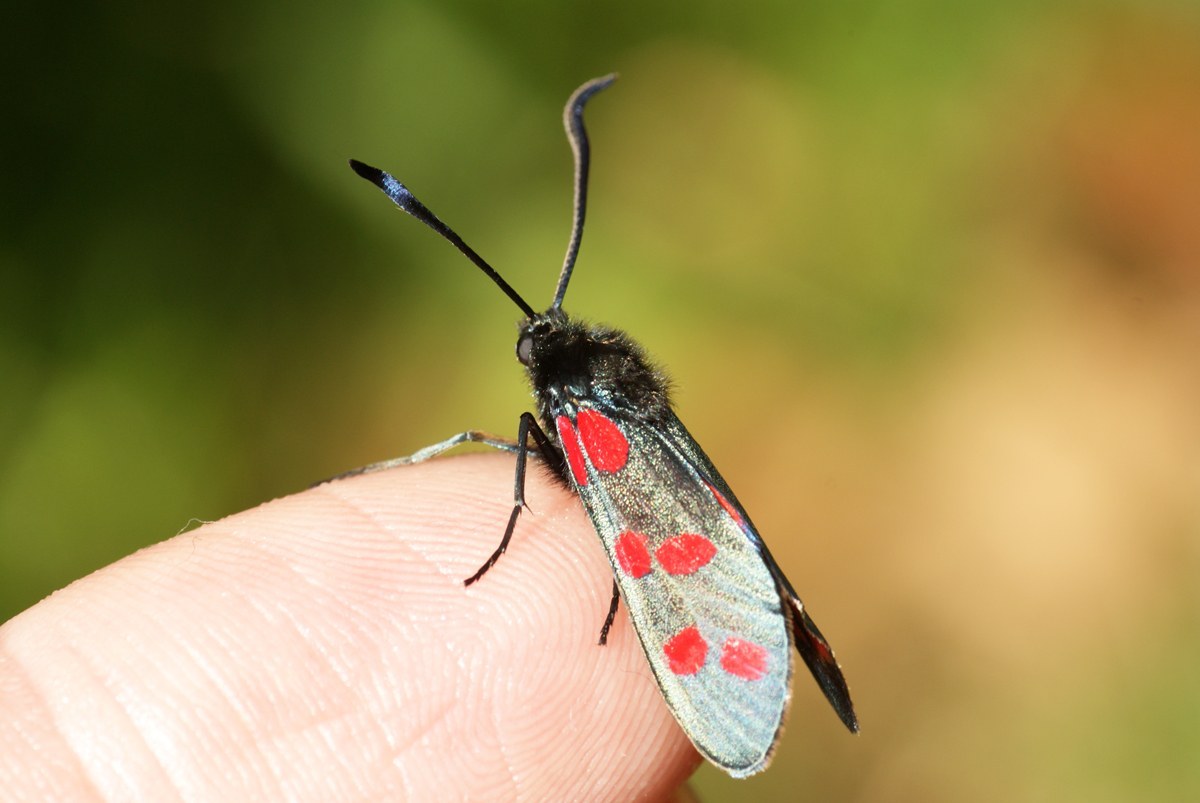
Key Visual Features
The six-spot burnet moth is one of the more colorful and easily identified day-flying moths:
- Size: Small to medium moth, wingspan around 3-4 cm (1.2-1.6 in).
- Color: Glossy, metallic blue-black to greenish-black forewings, providing strong contrast for its markings.
- Signature mark: Six bright red spots arranged on each forewing (the count that gives the species its name), sometimes appearing as five spots plus a smaller sixth near the wingtip.
- Hindwings: Solid red with a narrow dark border, visible in flight or when the moth spreads its wings.
- Body: Compact, dark, slightly furry body matching the metallic wing sheen.
- Antennae: Thickened, club-shaped antennae, unusual among moths and more similar to a butterfly's antenna shape.
Where and When You're Likely to See It
This moth favors open, flower-rich grassland, meadows, coastal cliffs, and chalk downland, particularly where its caterpillar's favored legume host plants grow. Unlike most moths, it is active during the day, flying slowly and often landing to feed at flowers such as knapweed, scabious, and thistles in full sunshine. Adults are on the wing chiefly in summer, and it is common to see several individuals clustered together on the same flower head or resting low in grass during cooler, overcast moments.
Similar-Looking Insects
- Five-spot and narrow-bordered five-spot burnet moths: Close relatives with fewer red spots per forewing; accurate counting of the spots is the main way to separate these similar species.
- Cinnabar moth: Also black with red markings, but the cinnabar's red patches form bold streaks and a border rather than discrete round spots.
- Day-flying butterflies: The burnet's slow, fluttering flight and clubbed antennae can suggest a butterfly, but its stouter body and moth-typical wing-folding at rest set it apart.
Quick ID Checklist
- Glossy blue-black wings with six red spots per forewing
- Solid red hindwings with a dark border
- Club-shaped antennae, unusual for a moth
- Day-flying, slow fluttering flight
- Found in flower-rich grassland in summer
Frequently asked questions
How do I count the spots correctly on a six-spot burnet moth?
Look closely at each forewing for a total of six distinct red spots, sometimes with two spots positioned close together near the wingtip that can look like one at a glance.
Is the six-spot burnet moth active at night like most moths?
No, it is a day-flying species, most easily observed feeding at flowers in bright sunshine rather than being drawn to lights after dark.
How can I distinguish it from the five-spot burnet moth?
The most reliable method is carefully counting the red spots on each forewing, since the five-spot species simply has one fewer spot per wing.
Why does it have clubbed antennae like a butterfly?
Club-shaped antennae are a natural feature of the burnet moth group and are one reason these day-flying moths are sometimes mistaken for butterflies.