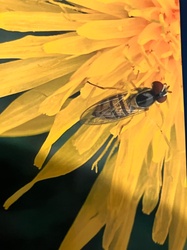
Soldier Fly Identification Guide
Spot soldier flies by their wasp-like appearance, flattened body, and distinctive pale spots or translucent windows near the wing base.
Read the full Soldier Fly encyclopedia entry →Key Visual Features
Soldier flies (family Stratiomyidae) are a diverse group often mistaken for wasps due to their sleek, mimicking appearance, though they are true flies with just one pair of wings.
- Size: Ranges from about 5-20 mm depending on species, generally medium-sized.
- Color: Highly variable — metallic green, blue-black, or dull brown, often with yellow, white, or pale markings on the abdomen.
- Body shape: Flattened, somewhat elongated and wedge-shaped body that narrows toward the head, giving a streamlined look.
- Wings: A single pair, held flat and overlapping over the back at rest (unlike wasps, which hold wings differently); many species show small translucent "windows" near the base of the wing or on the abdomen.
- Legs: Slender, often pale-tipped at the ends, held close to the body.
- Antennae: Short and typically forward-pointing, ending in a small bristle or point, quite different from a wasp's elbowed antennae.
Where and When You'll See Them
Adult soldier flies are commonly seen resting on flowers, leaves, or sunny surfaces near compost piles, decaying plant matter, livestock areas, or wetland margins, since larvae develop in moist organic material, mud, or water. They're most active in warm months, from late spring through fall, and are frequently spotted basking in sun during the day rather than at dusk.
Similar-Looking Bugs
- Wasps: The main mimicry target; wasps have two pairs of wings, a narrow "waist" between thorax and abdomen, and elbowed antennae, while soldier flies have one pair of wings, no pinched waist, and short straight antennae.
- Hover flies: Also wasp-mimics, but hover flies tend to have larger eyes covering most of the head and a more rounded abdomen without the flattened, wedge shape of soldier flies.
- House flies: Bulkier, gray-bodied, and lack the metallic sheen or pale translucent wing markings common in soldier flies.
Quick ID Checklist
- One pair of wings held flat/overlapping over a flattened body
- Often metallic green, blue-black, or brown with pale abdominal spots
- Short, straight antennae (not elbowed like a wasp's)
- No pinched wasp-waist between thorax and abdomen
- Found on flowers/foliage near compost, mud, or wet organic matter
Frequently asked questions
How do I tell a soldier fly from a wasp at a glance?
Count the wings and check the waist: soldier flies have a single pair of wings and no narrow pinched waist, while wasps have two pairs of wings and a distinctly narrow waist between thorax and abdomen.
What are the pale translucent spots on some soldier flies?
Many species have small clear or pale 'window' patches near the wing base or on the abdomen, which is a helpful identifying feature that most wasp mimics they resemble don't share.
Where are soldier fly larvae usually found?
Larvae develop in a range of moist organic habitats including compost, decaying plant material, mud, and even standing water, which is why adults are frequently seen nearby.
Are all soldier flies the same color?
No, coloring varies widely by species — some are shiny metallic green or blue, while others are dull brown or black with yellow or white abdominal markings.
Soldier Fly identified by the community
Recent Soldier Fly finds identified with Bug Identifier.