
Spicebush Swallowtail Identification Guide
Learn to recognize this blue-green swallowtail by its dark wings, pale spot rows, and characteristic tails.
Read the full Spicebush Swallowtail encyclopedia entry →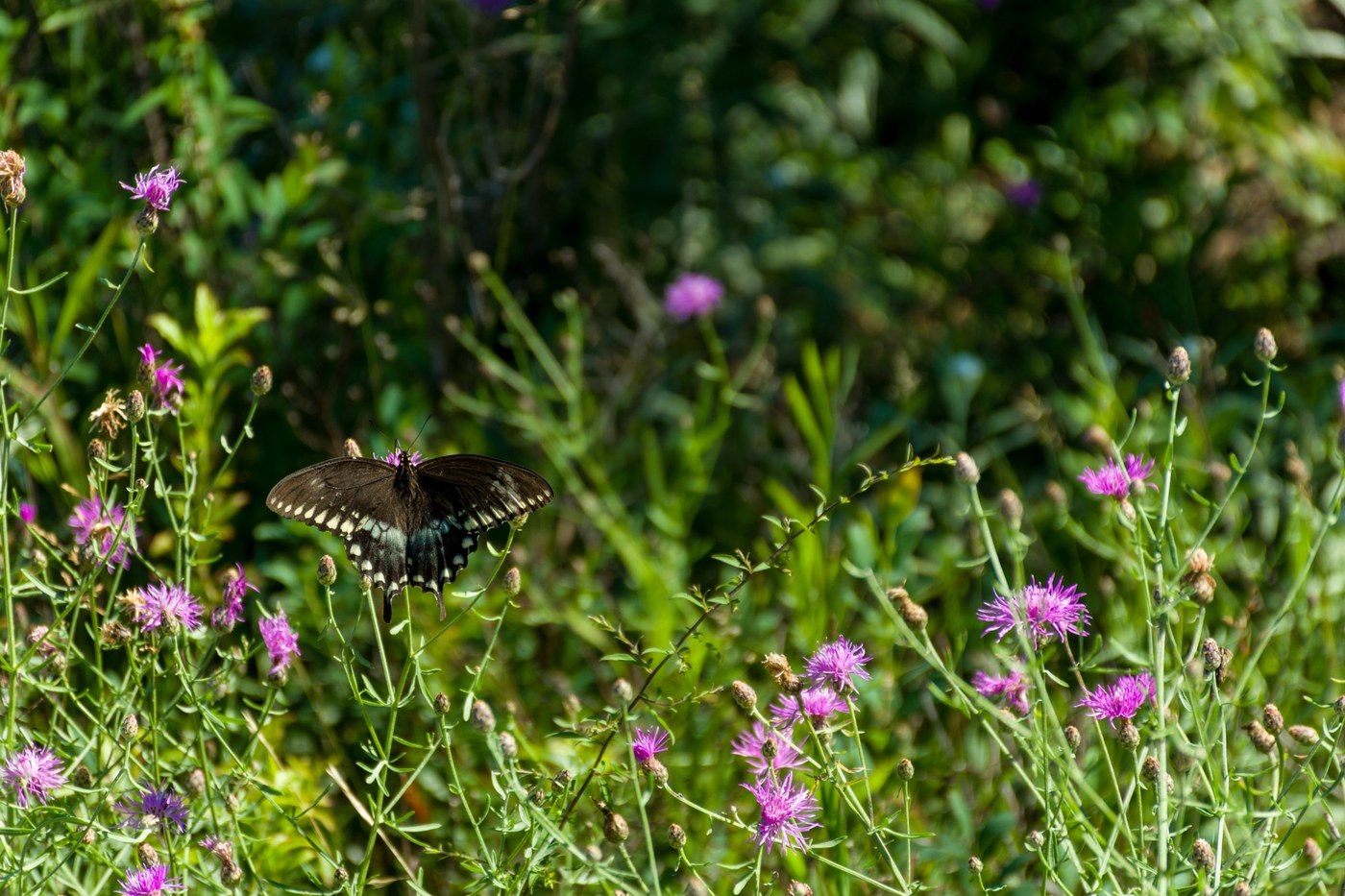
Key Visual Features
The Spicebush Swallowtail (Papilio troilus) is a large, dark swallowtail with a wingspan of roughly 3 to 4 inches.
- Color: Upper wing surface is mostly black with a bold wash of blue-green iridescent scaling across the hindwing (males lean more blue-green, females more pale blue).
- Pattern: A curved row of pale cream or greenish spots runs along the outer edge of both wings.
- Underside: The ventral hindwing shows two rows of orange spots set against a background of blue-green dusting, plus a row of pale marginal spots.
- Body: Black body with fine pale flecking along the sides of the abdomen.
- Tails: Each hindwing ends in a single, moderately long spatula-shaped tail.
- Wings and legs: Broad, rounded wings typical of swallowtails; slender black legs; clubbed antennae typical of butterflies.
Where and When You'll See It
Spicebush Swallowtails favor deciduous woodlands, forest edges, wooded stream corridors, and shaded gardens across the eastern half of North America, wherever their namesake host plants, spicebush and sassafras, grow. Adults are on the wing from spring through early fall, with two or more overlapping broods in warmer parts of their range. Look for them nectaring at midday through late afternoon on flowers like jewelweed, milkweed, and thistle, often gliding low along shaded trails.
Similar-Looking Species
- Pipevine Swallowtail: Has a more uniform, glossier blue sheen across the entire hindwing (rather than scattered pale spots) and a single row of round orange spots on the ventral hindwing instead of two rows.
- Black Swallowtail: Shows a row of bright yellow (not pale cream) spots on the dorsal forewing and a more orderly, boxy spot pattern overall.
- Dark-form female Eastern Tiger Swallowtail: Larger, and if you look closely in bright light you can often see faint "ghost" tiger stripes beneath the dark scaling.
Quick ID Checklist
- Black wings with blue-green iridescent wash on the hindwing
- Curved row of pale cream spots along the wing margins
- Two rows of orange spots on the ventral hindwing
- Single spatula-shaped tail per hindwing
- Found near woodland edges close to spicebush or sassafras
Frequently asked questions
How can I tell a Spicebush Swallowtail from a Pipevine Swallowtail?
Check the underside of the hindwing: Spicebush shows two rows of orange spots, while Pipevine typically shows just one row of larger orange spots against a more solid blue-green background.
Are male and female Spicebush Swallowtails different colors?
Yes, males tend to have more blue-green scaling on the hindwing while females often show paler, more blue-toned scaling, though both sexes share the same overall pattern.
What plants are Spicebush Swallowtails usually found near?
Adults are most often seen near spicebush, sassafras, and other members of the laurel family, which serve as host plants, typically in shaded woodland habitat.
When is the best time of year to spot one?
They fly from spring through early fall across most of their range, with peak sightings in late spring and summer when multiple broods overlap.