
Spined Soldier Bug Identification Guide
Recognize the predatory spined soldier bug by the sharp spines on its shoulders and its thick, curved hunting beak.
Read the full Spined Soldier Bug encyclopedia entry →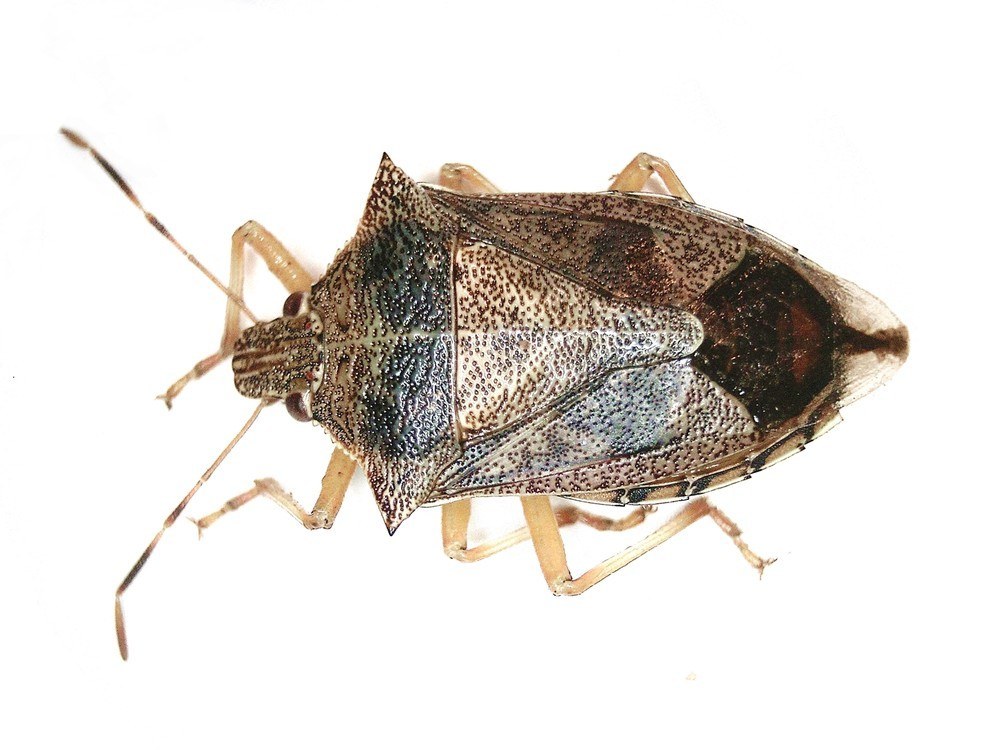
Key Features
- Shield-shaped body, about 10-13mm long
- Mottled brown to grayish-yellow coloring that provides camouflage on foliage
- Distinctive sharply pointed spines projecting outward from each "shoulder" of the pronotum, more pronounced than in most other stink bugs
- Beak (proboscis) is noticeably thick and often held curved away from the body, longer and stouter than in plant-feeding stink bugs
- Antennae are banded with alternating light and dark segments
- Wing membranes often show a faint dark spot near the tip
Where and When to Look
- Found in gardens, agricultural fields, and meadows, especially where caterpillars, beetle larvae, and other soft-bodied insects are present as prey
- Active from late spring through fall
- Often seen on the underside of leaves or moving along stems while hunting, rather than clustered in groups
- Both nymphs and adults can be spotted, with nymphs showing a rounder, less angular body and often brighter markings
Similar-Looking Bugs
- Rough stink bugs have a bark-textured, bumpier surface and jagged tooth-like shoulder edges rather than simple sharp spines
- Two-spotted stink bugs have a much bolder black-and-orange pattern rather than the muted brown-gray tones of the spined soldier bug
- Common brown or green plant-feeding stink bugs lack the pronounced pointed shoulder spines and tend to have a shorter, less robust beak
Quick ID Checklist
- Sharp, outward-pointing spines on the pronotum shoulders
- Mottled brown-gray coloring
- Thick, curved beak held away from the body
- Banded antennae
- Found actively hunting on leaves and stems rather than sitting still
Frequently asked questions
What is the most reliable feature for identifying a spined soldier bug?
The sharply pointed spines projecting from each shoulder of the pronotum are its most distinctive feature.
How is the spined soldier bug different from a typical plant-feeding stink bug?
It has a thicker, more curved beak used for hunting prey, along with more pronounced shoulder spines, whereas plant feeders have shorter beaks and rounder shoulders.
Where are spined soldier bugs commonly found?
In gardens and fields where caterpillars and beetle larvae are present, since it actively hunts these insects.
Do the nymphs look like the adults?
Nymphs are rounder and less angular than adults, without fully developed wings or the prominent shoulder spines, though the general mottled coloring is similar.