
Squash Bee Identification Guide
Identify squash bees by their stocky, honey-bee-like build and their strict early-morning visits to squash and pumpkin blossoms.
Read the full Squash Bee encyclopedia entry →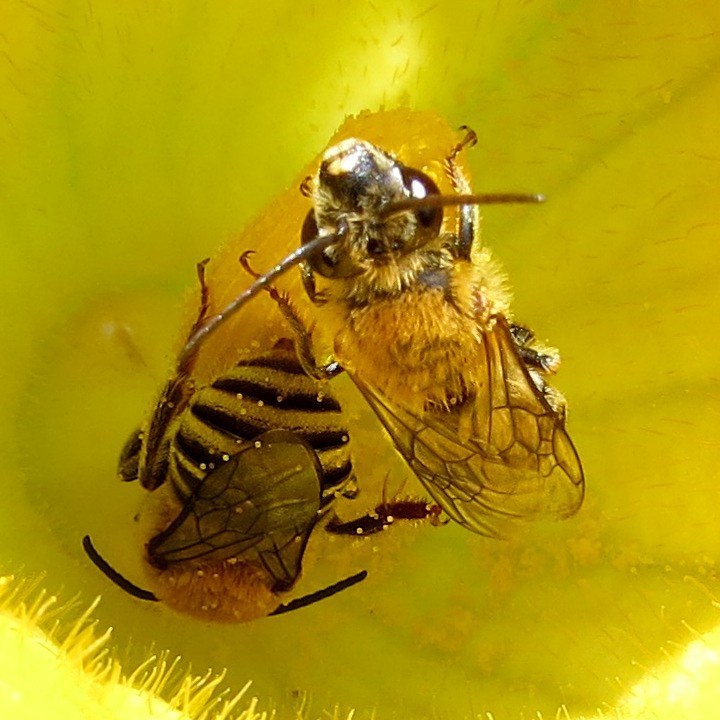
Key Visual Features
Squash bees (genera Peponapis and Xenoglossa) are stocky specialist bees closely tied to one plant family:
- Medium, robust body, roughly 10-16mm, noticeably stockier than a honey bee
- Brownish-gray, fuzzy thorax with a banded, hairy abdomen
- Males have somewhat longer antennae than females, useful for a closer look
- Females carry pollen on dense hairs (scopa) on their hind legs, often visibly loaded when leaving a flower
- Overall build sits between a honey bee and a small bumble bee in bulk
Where and When You'll See Them
Squash bees are specialist pollinators found almost exclusively at squash, pumpkin, and gourd flowers, making the host plant itself one of the best identification clues. They're notably early risers, active at first light and often finished foraging by mid-morning as squash blossoms close. Females nest solitarily in bare soil near the host plants, though several nests may cluster in the same general area. Look for them any time squash-family plants are blooming during the growing season.
Similar-Looking Bugs
- Honey bees are smaller and more slender, and aren't restricted to squash-family flowers.
- Bumble bees are larger, rounder, and generally darker overall, and forage across a much broader range of flower types.
- Digger bees are similar in general size and build but aren't limited to squash blossoms and can be found on a wide variety of flowering plants.
Quick ID Checklist
- Stocky, fuzzy body, 10-16mm, banded abdomen
- Found almost exclusively on squash, pumpkin, or gourd flowers
- Active very early in the morning
- Females nest in bare soil near host plants
- Bulkier build than a honey bee, less rounded than a bumble bee
Frequently asked questions
How can I tell a squash bee from a honey bee?
Squash bees are stockier and more robust than honey bees, and they're found almost exclusively visiting squash, pumpkin, or gourd flowers rather than a wide range of blooms.
What time of day are squash bees active?
They're notably early risers, foraging at first light and often finishing their activity by mid-morning as the host flowers close.
Where do squash bees nest?
Females dig individual burrows in bare soil near the squash-family plants they depend on, sometimes with several nests clustered nearby.
Are squash bees only found on squash plants?
Yes, they are specialist pollinators strongly associated with squash, pumpkin, and gourd flowers, which is one of the most reliable clues for identification.