Sun Spider Identification Guide
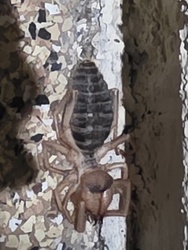
Identify a sun spider by its huge segmented jaws, fast erratic running, and lack of a narrow waist between body segments.
Read the full Sun Spider encyclopedia entry →Key Visual Features
Sun spiders, also called camel spiders or wind scorpions, are arachnids but not true spiders, and their body plan looks distinctly different once you know what to check.
- Size: Body length commonly 2-7 cm depending on species, among the larger arachnids people encounter.
- Color: Tan, sandy yellow, or light brown, often matching the desert or dry-ground substrate they live on.
- Body shape: No narrow waist between the front and back body sections — the body appears as one continuous, somewhat hairy, segmented mass rather than the clearly pinched two-part body of true spiders.
- Jaws (chelicerae): Extremely large, prominent, segmented, pincer-like mouthparts held out in front of the head, often as long as the head itself — this is the single most reliable identifying feature.
- Legs: Eight walking legs plus a pair of long, leg-like pedipalps used for sensing, which can make it look like it has ten legs.
- Eyes: Two large simple eyes set close together at the front of the head, unlike the multiple small eyes of true spiders.
Where and When You'd See It
Sun spiders are found in arid and semi-arid regions such as deserts, dry scrubland, and sandy plains. Despite the "sun" in the name, many species are actually most active at night, though some are diurnal and can be seen dashing across open ground during the heat of the day, especially around dusk. They often shelter under rocks, in burrows, or in shaded crevices to avoid the most intense daytime heat.
Similar-Looking Bugs
- True spiders: Have a clearly pinched waist between cephalothorax and abdomen; sun spiders do not.
- Scorpions: Have a segmented tail and pincers, both absent in sun spiders, which instead have the large forward-facing jaws and no tail.
- Whip scorpions: Have long thin whip-like tails or elongated front legs, features sun spiders lack.
Quick ID Checklist
- Large, segmented, forward-pointing jaws almost as long as the head
- No narrow waist — body looks like one continuous segmented mass
- Ten leg-like appendages (eight legs plus two sensory pedipalps)
- Sandy or tan coloring matching arid, open habitats
- Fast, erratic running rather than the pause-and-stalk movement of many spiders
Behavior Notes
Sun spiders are fast, active runners that chase down prey rather than building webs or ambushing from a burrow lid, and their erratic, quick bursts of movement across open ground are often as noticeable as their appearance.
Frequently asked questions
Is a sun spider actually a true spider?
No, it belongs to a separate arachnid order (Solifugae) and can be told apart by having no narrow waist between body sections, unlike true spiders.
What is the most obvious feature to look for when identifying a sun spider?
Its unusually large, segmented, forward-pointing jaws, which are often nearly as long as its head and are the clearest identification clue.
Why is it called a sun spider if some species are active at night?
The common name refers to its habitat in sunny, arid regions rather than strictly to daytime activity; many species are actually most active after dark or during dusk.
How many legs does a sun spider appear to have?
It looks like it has ten legs because of eight true walking legs plus a pair of long, leg-like sensory pedipalps at the front.
Sun Spider identified by the community
Recent Sun Spider finds identified with Bug Identifier.