
Swallowtail Butterfly Identification Guide
A large, showy butterfly named for the tail-like extensions on its hindwings.
Read the full Swallowtail Butterfly encyclopedia entry →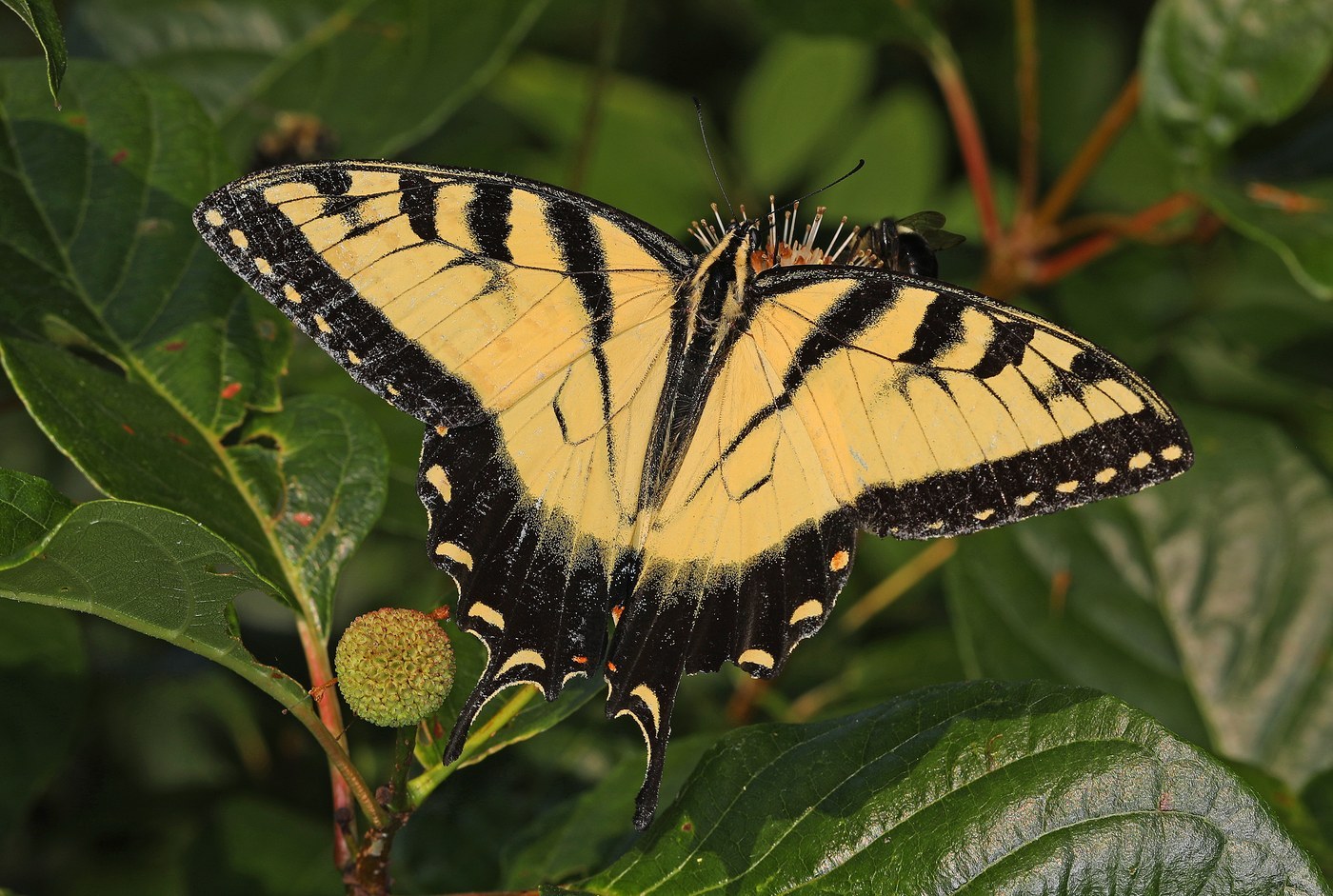
Key Visual Features
- Large butterfly with a wingspan typically ranging from 3 to 5.5 inches (7.5-14 cm), among the bigger butterflies commonly seen in gardens and open areas.
- The defining trait is the "tail" — a narrow, finger-like extension trailing off the bottom of each hindwing, resembling the forked tail of a swallow bird.
- Wing colors and patterns vary widely by species: many combine black wing veins/borders with yellow, and some are mostly black with iridescent blue or blue-green scaling and small orange eyespots near the tails.
- Eyespots, often orange or reddish with a dark center, are commonly present near the base of the tails on the hindwing's underside and sometimes the topside.
- Body is relatively stout compared to smaller butterflies, with a fuzzy thorax and long, clubbed antennae.
- Caterpillar stage often shows large false eyespots near the head end and can appear smooth and green or brown depending on species and age, quite different from the spiny look of some other butterfly larvae.
Where and When You'd See It
- Found in gardens, meadows, woodland edges, and along roadsides wherever flowering plants and the right host plants are available.
- Active during the day, especially in warm, sunny conditions, and commonly seen nectaring at flowers with wings frequently opening and closing while perched.
- Season of activity spans spring through fall in most regions, often with multiple generations produced across the warm months.
- Males are sometimes seen "puddling" — gathering at damp soil, sand, or mud patches in groups.
Similar-Looking Bugs
- Other large butterflies such as monarchs lack the hindwing tails entirely and instead have a more evenly rounded wing outline.
- Some moths have wing shapes with tail-like extensions (such as certain silk moths), but moths typically fly at night, have feathery or thread-like antennae rather than clubbed tips, and rest with wings spread flat rather than folded upright like a butterfly at rest.
- Smaller "hairstreak" butterflies also have tiny tail filaments but are much smaller overall, generally under 1.5 inches across.
Quick ID Checklist
- Large wingspan (3-5.5 inches) with a tail-like extension on each hindwing.
- Bold pattern combining black with yellow, or black with iridescent blue and orange eyespots, depending on species.
- Clubbed antennae and wings held upright when perched, unlike moths.
- Active in daylight, often seen nectaring at garden flowers.
- Caterpillar stage frequently shows large false eyespots near the head.
Frequently asked questions
What single feature best confirms a swallowtail identification?
The finger-like tail extending from the bottom of each hindwing is the most reliable single feature, since few other common butterflies share that shape.
How can I tell a swallowtail from a moth with a similar tail shape?
Check the antennae and wing position at rest — swallowtails have thin, clubbed antennae and fold their wings upright when perched, while tailed moths usually have feathery antennae and rest with wings spread flat, mainly at night.
Do all swallowtails have the same wing colors?
No, wing color and pattern vary a lot between species, ranging from black-and-yellow combinations to mostly black wings with blue iridescence and orange eyespots.
What does swallowtail 'puddling' behavior look like?
It's when butterflies, often males, gather in small groups on damp soil, sand, or mud, which can be a useful behavioral clue alongside their wing shape.