
Tobacco Hornworm Moth (Carolina Sphinx) Identification Guide
Identify this large hawk moth by its zigzag wing pattern and the six pairs of orange-yellow spots along its abdomen.
Read the full Tobacco Hornworm Moth (Carolina Sphinx) encyclopedia entry →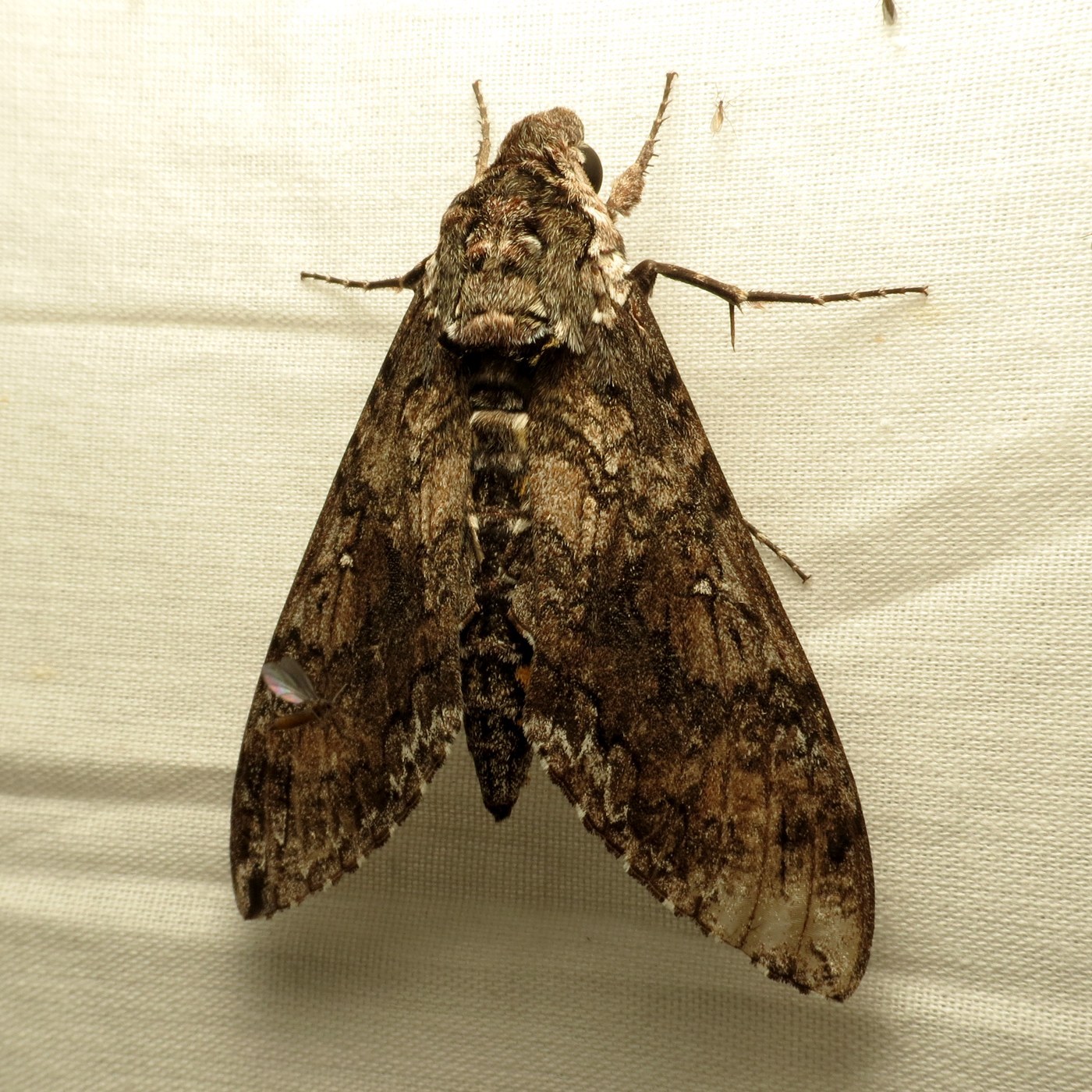
Key Visual Features
The tobacco hornworm moth, also called the Carolina sphinx, is one of the larger hawk moths found in gardens and fields.
- Size: Large, with a wingspan of about 4-5 inches, among the bigger moths likely to be seen in a garden.
- Color and pattern: Forewings are grayish-brown with an intricate mottled and zigzag dark-lined pattern that provides effective camouflage against bark. Hindwings show alternating dark and light bands, visible mainly in flight.
- Body shape: Stout, torpedo-shaped body with a diagnostic row of six pairs of orange-yellow spots running along the sides of the abdomen.
- Wings: Long and narrow relative to the body, typical of strong-flying sphinx moths built for sustained hovering.
- Legs and antennae: Antennae are thick and taper toward the tip, typical of the strong, fast-flying sphinx moth family.
Where and When You'll See It
This species is found in gardens and open fields, especially near solanaceous host plants like tobacco and tomato, as well as other related nightshade-family plants. It ranges widely across the Americas, from farmland to backyard vegetable gardens. Adults fly from spring through fall and are nocturnal, though they are often spotted at dusk hovering at flowers with their long proboscis extended, moving much like a hummingbird as they feed on nectar from deep, tubular blossoms.
Similar-Looking Moths
The tomato hornworm moth (five-spotted hawk moth) is nearly identical in size, shape, and general coloring, making the two easy to confuse at a glance. The key distinguishing feature is the number of paired spots along the abdomen: the tobacco hornworm moth has six pairs, while the tomato hornworm moth has only five pairs. A close look at the abdomen spot count, ideally with the moth at rest or in a clear photo, is the most reliable way to separate these two very similar species.
Quick ID Checklist
- Large gray-brown mottled moth, 4-5 inch wingspan
- Zigzag dark lines across the forewings
- Six pairs of orange-yellow spots along the abdomen
- Alternating dark and light bands on the hindwings
- Hovers at flowers at dusk like a hummingbird
Frequently asked questions
How do I tell this moth apart from the tomato hornworm moth?
Count the abdominal spots — the tobacco hornworm moth has six pairs, while the tomato hornworm moth has five pairs.
When is this moth most active?
It is nocturnal but often seen at dusk hovering at flowers.
What plants is this moth associated with?
It is associated with solanaceous plants such as tobacco and tomato, which serve as caterpillar host plants.
Why does it look like a hummingbird at dusk?
Its hovering flight and long proboscis extended into flowers create a hummingbird-like appearance, though it is a moth.