Toe-Biter Identification Guide
A large, flattened pond predator with powerful grasping front legs and a pair of short breathing tubes at its tail.
Read the full Toe-Biter encyclopedia entry →Key Visual Features
- Large, broad, flattened oval body, with adults commonly ranging from 1.5 to 2.5 inches (4-6.5 cm) or more depending on species
- Brown to grayish-brown coloring that blends well with mud and submerged debris
- Thick, raptorial front legs folded like a praying mantis, used to grasp prey
- Middle and hind legs flattened and fringed for swimming
- Short, paired breathing tubes (siphons) at the tip of the abdomen used to draw air while partially submerged
- Piercing, beak-like mouthpart tucked beneath the head
- Broad, shield-shaped thorax and a somewhat leaf-like overall silhouette
Where and When You'll See It
Toe-biters, also known as giant water bugs, are found in ponds, slow streams, and marshes with submerged vegetation where they can ambush prey. They typically stay near the bottom or cling to plants just below the surface, periodically extending the tip of the abdomen to the surface film to access air. They are most active from spring through fall and are strong fliers, often turning up at outdoor lights on warm nights as they disperse between water bodies. In many regions, males can be seen carrying rows of eggs glued to their backs during the breeding season.
Similar-Looking Bugs
- Creeping water bug: much smaller overall, with a less pronounced raptorial front leg structure and no breathing tubes at the tail.
- Great diving beetle: has a harder, glossier, more domed shell and uniform oar-like hind legs rather than the toe-biter's grasping front legs.
- Water scorpion: similar raptorial front legs, but has a much longer, thin tail-like breathing tube instead of the toe-biter's short paired siphons, and a narrower body.
- Backswimmer: much smaller and swims upside down, lacking the toe-biter's broad, flattened, leaf-like body.
Quick ID Checklist
- Large, broad, flattened body often over 1.5 inches long
- Thick, folded raptorial front legs
- Short paired breathing tubes at the abdomen tip
- Brownish, mud-colored body
- Found near the bottom of ponds or slow water among submerged vegetation, sometimes at lights at night
Frequently asked questions
How can I tell a toe-biter from a water scorpion?
Both have grasping front legs, but the toe-biter has a broad, flattened body with short paired breathing tubes at the tail, while the water scorpion has a narrower body and a single long, thin, tail-like breathing tube.
Why is it called a toe-biter?
The common name refers to its habit of using its piercing mouthpart in defense if handled or stepped on, though it primarily uses this mouthpart to feed on other aquatic prey.
Where do toe-biters live?
They inhabit ponds, marshes, and slow-moving streams with submerged vegetation, staying near the bottom or clinging to plants and periodically surfacing to breathe.
Do toe-biters fly?
Yes, adults are capable fliers and often disperse between water bodies at night, which is why they are sometimes found near outdoor lighting.
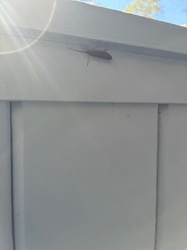
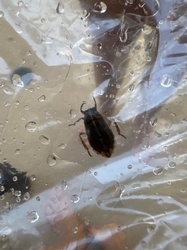
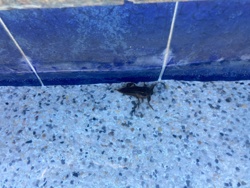
Toe-Biter identified by the community
Recent Toe-Biter finds identified with Bug Identifier.